One education policy for all states not viable, says expert
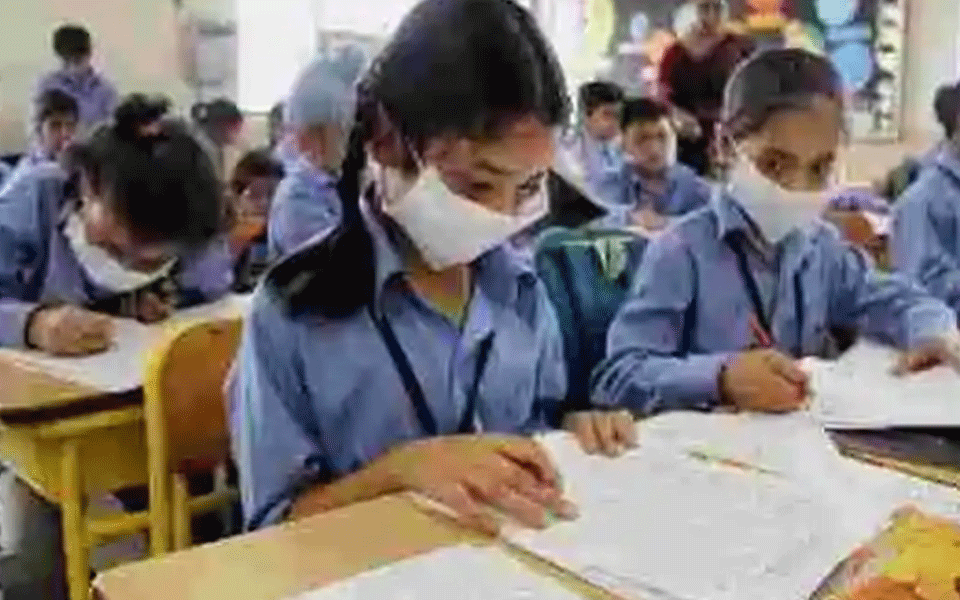
Kolkata: Thrusting one education system on all students across states, irrespective of their socio- economic status, is not a viable idea, one of the panelists of a six-member committee, formed by the Bengal government to study and share views on the new education policy, said.
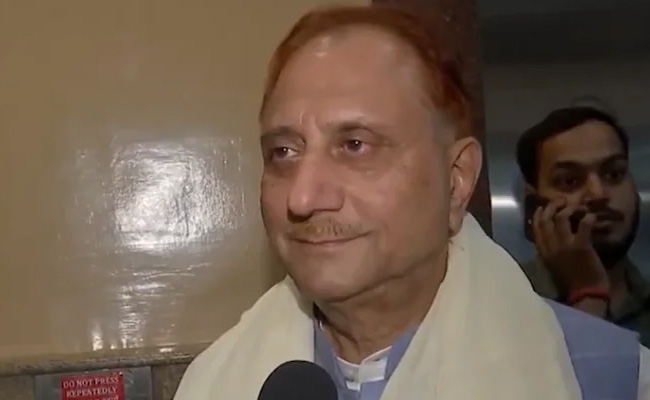
The committee member, who did not wish to be named, also said that a "voluminous report" has been prepared, after carefully considering all aspects of the policy, and it will be submitted to the state government in a couple of days.
"We have almost readied the report, which will be submitted to the government in a couple of days. I am of the view that in a country of 130 crore population, you cannot thrust a uniform education policy on all states, regardless of their needs and economic status. What can be applicable in Manipur may not make sense in Bengal," he said.
Certain facets of the New Education Policy (NEP 2020), such as redesigning of Class 10 board exams and reforms in primary school, "lack clarity", he said, insisting that the Centre should have taken the states into confidence before giving its approval.
"The prevailing education policy where each state has its own board to conduct exams up to the tenth standard cannot be altogether replaced by a new policy without any alternative mechanism in place. These things might not have been considered before ratification of the policy. I have pointed that out in the report," the committee member told PTI.
He claimed that the panel had a difficult time understanding the implications of certain recommendations made for the country's higher education system, and maintained that the "reason for abolishment of MPhil for research scholars was not very clear".
"This policy opens doors for foreign universities to set up base in the country. That is also not a welcome move as we already have top-class higher educational institutions in the country," he said.
According to NEP 2020, students will have to undertake school examinations in grades 3, 5 and 8, which will be conducted by appropriate authority. Board exams for Grades 10 and 12 will be redesigned, it said.
The policy has also advocated a "broad-based, multi- disciplinary, holistic undergraduate education with flexible curricula, creative combinations of subjects, integration of vocational education and multiple entry and exit points with appropriate certification".
The state government had earlier this month formed the six-member committee to study and share observations on the new policy, which was approved by the Union Cabinet in July.
Among others, Jadavpur University Vice-Chancellor Suranjan Das, retired professor and TMC MP Sougata Roy, educationist Pabitra Sarkar and oncologist Nrisingha Prasad Bhaduri are members of the committee.
State education minister Partha Chatterjee had two weeks ago slammed the policy, calling it a "copy of the system prevalent in western countries".
He had also said that the TMC government would convey its opinion on the policy to the Centre after the six-member team submits its report.
Let the Truth be known. If you read VB and like VB, please be a VB Supporter and Help us deliver the Truth to one and all.
Hailstorm brings relief to Bengaluru from scorching summer
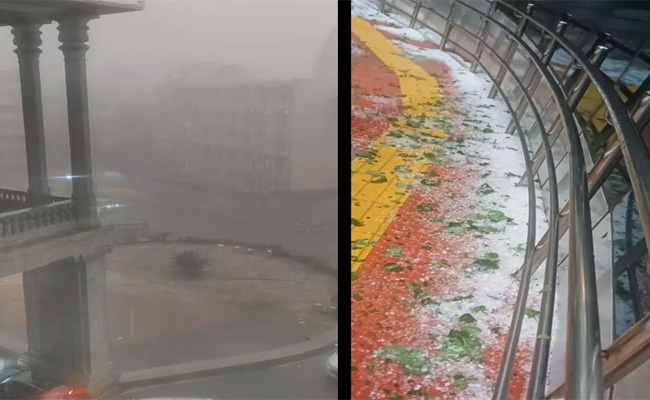
Bengaluru (PTI): Bringing much relief to the people battered by the scorching summer, heavy rains coupled with hailstorm lashed the city on Wednesday.
The thunderous downpour with stormy wind cooled the city, where the temperature had soared to 37 degree.
With the rains, the city, from being parched, witnessed waterlogging in just two hours.
There was waist-deep water in many areas in the city such as Richmond Town and Shanthinagar resembling a river.
The unexpected rain did not spare Vidhana Soudha, the seat of power, as water gushed inside the government offices from the lobby. The office of the Leader of the Opposition in the Karnataka Assembly R Ashoka was also flooded.
Since the downpour occurred in the evening, many office goers struggled to return home.
Uprooting of trees was reported in many parts of the city, including Malleswaram, Shanthinagar and Seshadripuram.