One manual scavenging death every five days: Official data
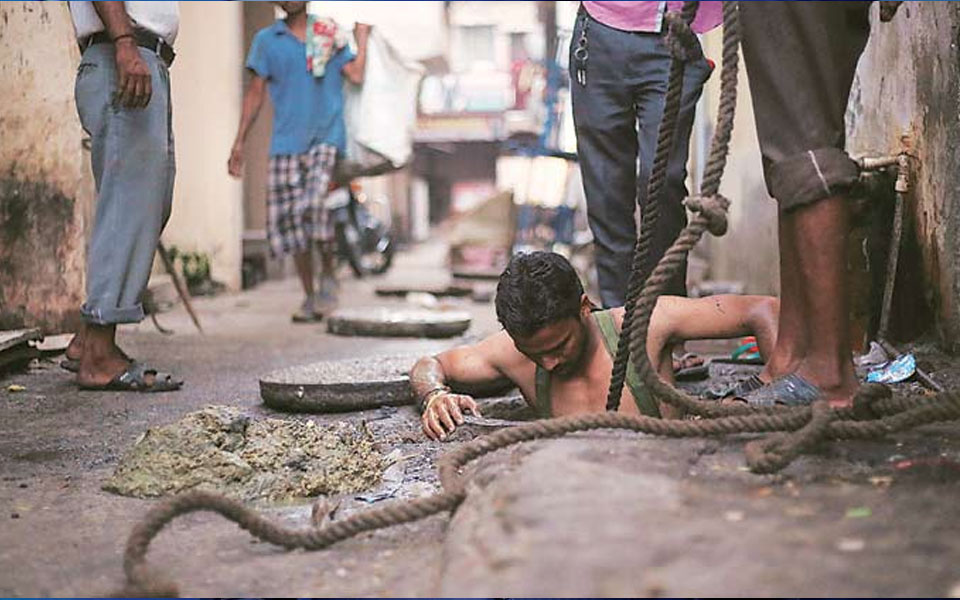
New Delhi : SINCE JANUARY 1, 2017, one person has died every five days, on an average, while cleaning sewers and septic tanks across the country, according to numbers collated by the National Commission for Safai Karamcharis (NCSK), the statutory body that was set up by an Act of Parliament for the welfare of sanitation workers.
The data, which is based mostly on newspaper reports and numbers supplied by a few state governments, is the first such official attempt to account for the deaths of sewer and septic tank cleaners.
According to NCSK, 123 people employed in hazardous forms of manual scavenging lost their lives while at work since January 2017. The last one week alone has seen a total of six deaths in the National Capital Region. Officials involved in the exercise admit, however, that even this number could be a gross under-estimation, considering the lack of data.
There are no numbers available on those employed in sewer and septic tank cleaning. All previous and ongoing exercises at compiling data have been restricted to accounting for those removing human excreta from dry latrines, open drains, and single pit toilets in villages.
The more hazardous forms involving the often fatal task of entering toxic sewerage systems, mainly in urban areas, have not been documented officially. This, despite the fact that the 1993 law outlawing manual scavenging in India was amended in 2013 to include sewer and septic tank cleaning.
Of the 28 states and seven union territories, the NCSK data has reported deaths from only 13 states and UTs.
“The death count is based on figures we could collate from a few states and mostly English and Hindi newspapers. There might have been several instances of similar stories in regional language papers which were weren’t able to account for,” said an official involved in the exercise.
This is evident in the reported instances which are high in in Haryana, Uttar Pradesh, Delhi, and Gujarat, in that order. On the other hand, the NCSK data shows Maharashtra as having had just two deaths in this period. As per the Socio-Economic Caste Census (SECC) 2011, rural Maharashtra alone has 65,181 households where at least one person is employed as a manual scavenger, the highest in the country, accounting for 35 per cent of the total 1.82 lakh such households in rural India.
SECC data doesn’t include urban India where sewer cleaning is more frequent. The state with the second highest number of manual scavenging in its villages — Madhya Pradesh at 23,105 as per SECC — doesn’t show any deaths in the NCSK data.
“We have repeatedly asked states to identity those involved in these jobs but the states deny the existence of manual scavenging as the practice is banned under law. As a result, in many cases, the families of the dead don’t even get the compensation,” said NCSK chairperson Manhar Valjibhai Zala.
As per NCSK data, the Rs 10 lakh compensation that is mandated under law in case of manual scavenging deaths, has been paid in only 70 of the 123 cases.
The paucity of data is evident in the count of people involved in manual scavenging, an exercise being carried out by an inter-ministerial task force led by the Ministry of Social Justice and Empowerment. The count is limited to only 170 districts in 18 states. Again, it excludes sewer cleaners entirely as well as any form of manual scavenging in urban areas.
The counting process was to be carried out by central government teams holding survey camps in districts where those engaged in manual scavenging could come forward for a self-declaration process. Following this, the states were to confirm the numbers identified.
While the exercise was to be over by June-end, officials confirmed that it has been significantly delayed as central government teams and state governments have so far acknowledged the existence of only 20,000 out of around 50,000 people identified.
Data obtained by The Indian Express shows that only 109 of the 170 districts have filed their response, and only 62 have identified at least one manual scavenger.
Bezwada Wilson, founder of Safai Karamchari Andolan (SKA), said that the central government has ignored repeated recommendations for extending the survey to include another 300 districts and sewer-septic tank cleaners. Wilson was part of the team that assisted the central government in carrying the recent survey in 170 districts.
“Their deaths are under-counted and so are their lives. Even the National Crime Records Bureau was agreeable to our suggestion that they should document the deaths separately. But nothing has happened on the front, either,” he said.
According to data and post-mortem reports maintained by the SKA, the actual death count since January 2017 is about 300.
“The Social Justice Ministry, which is in charge of this subject, mostly deals with the issue of compensation post deaths and rehabilitation of the handful identified as doing this job. Ministries such as Housing and Urban Affairs should be looking into the complete mechanisation of sewage cleaning, which is the only way to eliminate the practice of getting people to clean it manually. But they have never taken responsibility for the deaths,” Wilson said.
courtesy : indianexpress.com
Let the Truth be known. If you read VB and like VB, please be a VB Supporter and Help us deliver the Truth to one and all.
CM Siddaramaiah alleges ‘criminal conspiracy’ in Sringeri recount, vows legal action
Bengaluru (PTI): Alleging a “criminal conspiracy” by BJP candidate D N Jeevaraj in the Sringeri Assembly poll recounting, Karnataka CM Siddaramaiah on Tuesday said the outcome was manipulated after valid postal ballot votes in favour of Congress leader T D Raje Gowda were tampered with during the recounting process.
Following a Karnataka High Court order on an election petition filed by Jeevaraj, challenging Raje Gowda’s election, the reverification and recounting were conducted on Saturday.
After the reverification and recount of postal ballots for the Sringeri Assembly constituency, votes polled in favour of Raje Gowda were reduced by 255, the returning officer said.
A report on the matter has been submitted to the Election Commission of India for further action, the officer added.
Congress leader Raje Gowda had won the 2023 Assembly polls from Sringeri by 201 votes, defeating his nearest rival Jeevaraj.
Addressing a press conference in Bengaluru, Siddaramaiah said the High Court had directed the recounting of postal ballots and that irregularities were noticed during the exercise conducted on May 2.
“This is a clear case of criminal conspiracy,” Siddaramaiah said, alleging that valid votes cast in favour of Raje Gowda were altered after being accepted by counting agents of all parties, including Congress, BJP, and JD(S).
He claimed that during the recounting of postal ballots, 255 votes were initially accepted as valid by all agents but were later tampered with by subordinate officials.
“There is a second mark on the votes polled in favour of Raje Gowda. They had accepted these as valid votes. Subsequently, another mark was made by officials. This is a clear case of criminal conspiracy,” he said.
When asked who was behind the alleged conspiracy, the CM replied, “It was hatched by Jeevaraj and others. It is planned.”
Siddaramaiah further alleged that the returning officer acted improperly by declaring the result despite the presence of an Election Commission observer during the recounting.
“Immediately after the counting, the returning officer announced the result. He should not have done so; this is against the law,” he said.
He pointed out that Raje Gowda had originally won by 201 votes, but after the recounting, the BJP candidate was declared the winner by 52 votes.
“The BJP has committed a criminal act of conspiracy. This is not vote chori but vote dacoity,” he alleged.
The CM said a police complaint had already been filed by Raje Gowda’s election agent, Sudhir Kumar, and emphasised the need for electoral integrity.
“We want transparency and free and fair elections. That is what our Constitution mandates,” he added.
Stating that the government would pursue legal remedies, Siddaramaiah said, “We are preparing an appeal challenging the returning officer’s announcement in a court of law.”
Responding to a separate query on elections in other states, the CM said there appeared to be an anti-incumbency factor in West Bengal, while results in Tamil Nadu were “surprising,” adding that Vijay’s party was emerging as the largest there.
Following the victory of party candidates in Bagalkote and Davanagere South, Siddaramaiah expressed confidence about future electoral prospects in Karnataka.
“Even in 2028, we will win the Assembly elections. We will come back,” the CM said.
Siddaramaiah added that he would order a forensic examination into the alleged tampering of postal ballots.