ONGC to start oil production from USD 5 bn deep-water project this month
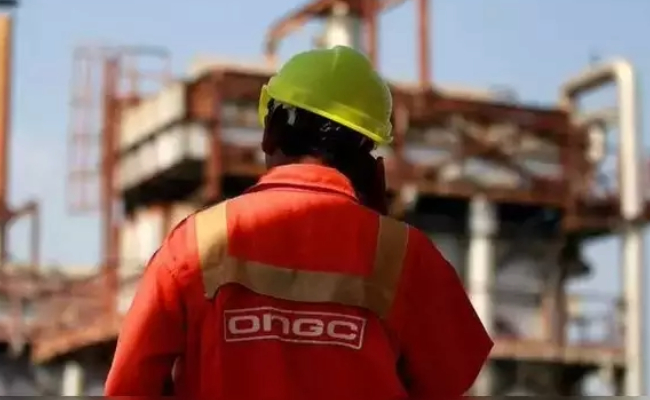
New Delhi (PTI): State-controlled Oil and Natural Gas Corporation (ONGC) will kick off oil production from its much-delayed flagship deepsea project in Krishna Godavari basin in Bay of Bengal this month, helping reverse years of decline in output, a senior company official said.
"We plan to start producing from the Cluster-2 project in KG-DWN-98/2 block this month and slowly ramp up," ONGC Director (Production) Pankaj Kumar told PTI here.
A floating production unit, called FPSO, which will be used to produce oil, is already in the block. After several missed deadlines, ONGC has told Shapoorji Pallonji Oil & Gas (SPOG) that its floating production, storage and offloading vessel (FPSO) Armada Sterling-V should prepare to receive the first oil this month.
Oil production from Cluster-2 should have begun by November 2021, but was delayed because of the pandemic.
Kumar said ONGC plans to start producing from 3 to 4 wells initially and slowly connect others. "Initial production could be 8,000 to 9,000 barrels per day."
KG deepsea is treacherous terrain and ONGC is mindful of not repeating mistakes of neighbouring KG-D6 block of Reliance Industries.
While gas production is not so complex in the area, sand and water ingress in wells may happen if oil valves are opened too fast. The trick is to drill more wells and produce at the optimal quantities, not rushing in to produce bigger volumes, an official explained.
Kumar said ONGC will ship the first consignment of crude oil to subsidiary Mangalore Refinery and Petrochemicals Ltd (MRPL).
The crude will be tested and yields will determine its grade and pricing, he said.
ONGC has hired Armada Sterling-V, owned 70 per cent by SPOG and 30 per cent by Malaysia's Bumi Armada, for producing oil from below seabed.
The FPSO has been waiting to receive oil since January 2, 2023, after she was hooked up on December 27, 2022. ONGC previously set May 2023, as the first Cluster-2 oil deadline, extended to August 2023, September 2023, and finally, October 2023.
"These are extremely complex reservoirs and we need to be sure about everything before we start production," Kumar said.
The five M field wells, identified for the initial oil flow, sit in water depths of about 400 meters. Flexible hoses will connect the M field wells to the FPSO. Later, the A and P1 oilfield wells will be connected.
In all, 13 wells yielding oil and oil with associated gas will eventually be connected to Armada Sterling-V. Peak oil of 45,000 barrels per day is expected sometime in 2024-25. At peak, a tanker will berth alongside FPSO every two weeks to transport oil to a refinery where it will be turned into fuels like petrol and diesel.
Kumar said some 2 mmscmd of gas would also flow with oil but actual gas output will start in May 2024, when 7-8 mmscmd production is expected.
For that to happen, contractor McDermott needs to install the much-delayed Control and Process Platform (CPP) with Living Quarters and Upstream Platform (LQUP), which Malaysia's Sapura ENergy is manufacturing.
The giant structure is ready to sail from Malaysia and should be in Indian waters early next year. Gas production would start in the middle of 2024.
The production estimates are, however, much lower than what was originally projected. When the project was conceived in April 2018, ONGC had said the estimated capital expenditure would be USD 5.07 billion and operational expenditure would be USD 5.12 billion over a field life of 16 years.
Kumar said the company hopes to arrest the decline in crude oil production in the next fiscal, while natural gas output is likely to see a rise.
ONGC's KG-DWN-98/2 or KG-D5 block, which sits next to Reliance Industries' KG-D6 block in the KG basin, has a number of discoveries that have been clubbed into clusters.
It is situated offshore the Godavari river delta in the Bay of Bengal. It is located 35-km off the coast of Andhra Pradesh in water depths ranging from 300-3,200 metres. The discoveries in the block are divided into three clusters -- Cluster-1, 2 and 3. Cluster 2 is being put to production first.
The Cluster 2 field is divided into two blocks namely 2A and 2B, which as per the original investment decision were expected to produce 23.52 million metric tonnes of oil and 50.70 billion cubic metres (bcm) of gas over the life of the field.
Cluster 2A was estimated to contain reserves of 94.26 million tonnes of crude oil and 21.75 bcm of associated gas, while Cluster 2B is estimated to host 51.98 bcm of gas reserves.
Cluster 2A was anticipated to produce 77,305 barrels of oil per day (bopd) and associated gas at a rate of 3.81 million metric standard cubic metres per day (mmscmd) over 15 years.
Cluster 2B is expected to produce free gas of 12.75 mmscmd from eight wells and has a 16-year life. But now the output estimate is lower - 45,000 bpd of oil and up to 2.5 mmscmd from Cluster 2A and around 9 mmscmd from Cluster 2B.
Let the Truth be known. If you read VB and like VB, please be a VB Supporter and Help us deliver the Truth to one and all.
UDF leaders see local body poll trends as pointer to 2026 Assembly elections in Kerala
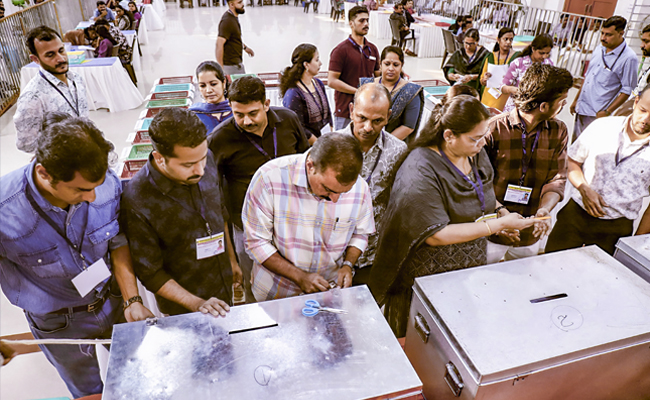
Thiruvananthapuram (PTI): Buoyed by the strong performance of the Congress-led UDF in the local body polls, KPCC president Sunny Joseph said on Saturday that the front's results indicated the people had rejected the LDF government.
According to early trends, the UDF was leading in more grama panchayats, block panchayats, municipalities and corporations than the LDF.
The local body polls were held in two phases in the state earlier this week.
ALSO READ: Cong candidate who moved Kerala HC for name reinstatement in voter list, wins
Speaking to reporters here, Joseph said the people of Kerala had extended their support to the UDF.
"We could expose the LDF government’s anti-people stance and the people understood it. The LDF’s fake propaganda was rejected by the people. The UDF is moving towards a historic victory," he said.
He said a united effort, proper preparations, good candidate selection and hard work had resulted in the Congress and the UDF’s victory in the elections.
Asked about the prospects in the Thiruvananthapuram Corporation, Joseph said the party was studying the matter and would comment later.
LDF convenor T P Ramakrishnan said the results would be closely examined.
According to him, the government had done everything possible for the people.
"Why such a verdict happened will be examined at the micro level. People’s opinion will be considered and further steps will be taken," he said.
He added that decisions would be taken after analysing the results. "If any corrective measures are required, we will initiate them and move forward," he said.
AICC leader K C Venugopal said the results showed that people had begun ousting those who, he alleged, were responsible for the loss of gold at Lord Ayyappa’s temple.
"This trend will continue in the Assembly elections as well. It is an indication that the people are ready to bring down the LDF government," he said.
Venugopal said the UDF had registered victories even in CPI(M) and LDF strongholds.
"I congratulate all UDF workers for their hard work. Congress workers and leaders worked unitedly," he said.
Referring to remarks made by Chief Minister Pinarayi Vijayan against the Congress on polling day, Venugopal said the voters had responded through the verdict.
"I do not know whether the chief minister understands that the people are against him. Otherwise, he does not know the sentiment of the people. The state government cannot move an inch further," he said.
He said the results indicated a strong comeback for the UDF in Kerala.
Asked whether the Sabarimala gold loss issue had affected the LDF in the local polls, Venugopal said the CM and the CPI(M) state secretary did not take the issue seriously.
"We took a strong stand on the matter. The BJP played a foul game in it," he alleged.
On the BJP's role in the local body elections, Venugopal alleged that the party operated with the CPI(M) 's tacit support.
"The CPI(M) supported the central government on issues such as PM-SHRI, labour codes and corruption in national highway construction. The CPI(M) is facing ideological decline, and the state government’s policies are against the party’s own decisions," he said.
Meanwhile, LDF ally Kerala Congress (M) leader Jose K Mani said the party could not win all the wards it had expected in the elections.
He congratulated winners from all parties and said the party would closely examine the losses and identify shortcomings. "Later, we will take corrective measures," he added.
Senior Congress leader and MP Rajmohan Unnithan said the trends in the local body elections indicated that the UDF would return to power in the 2026 Assembly elections.
"We will win 111 seats as in 1977 and return to power in 2026. The anti-government sentiment of the people is reflected in the elections," he said.
Unnithan said the people were disturbed and unhappy with the present government.
"The trend indicates the end of the LDF government," he added.
CPI(M) MLA M M Mani said the people had shown ingratitude towards the LDF despite benefiting from welfare schemes.
"After receiving all welfare schemes and living comfortably, people voted against us due to some temporary sentiments. Is that not ingratitude," he asked.
Mani said no such welfare initiatives had taken place in Kerala earlier.
"People are receiving pensions and have enough to eat. Even after getting all this, they voted against us. This is what can be called ingratitude," he said.
Muslim League state president Panakkad Sayyid Sadiq Ali Shihab Thangal said the results were beyond expectations.
"The outcome points towards the Secretariat in Thiruvananthapuram, indicating that a change of government is imminent. We are going to win the Assembly election," he said.