Operation Sindoor discussion: JP Nadda apologises to Kharge, takes back his words
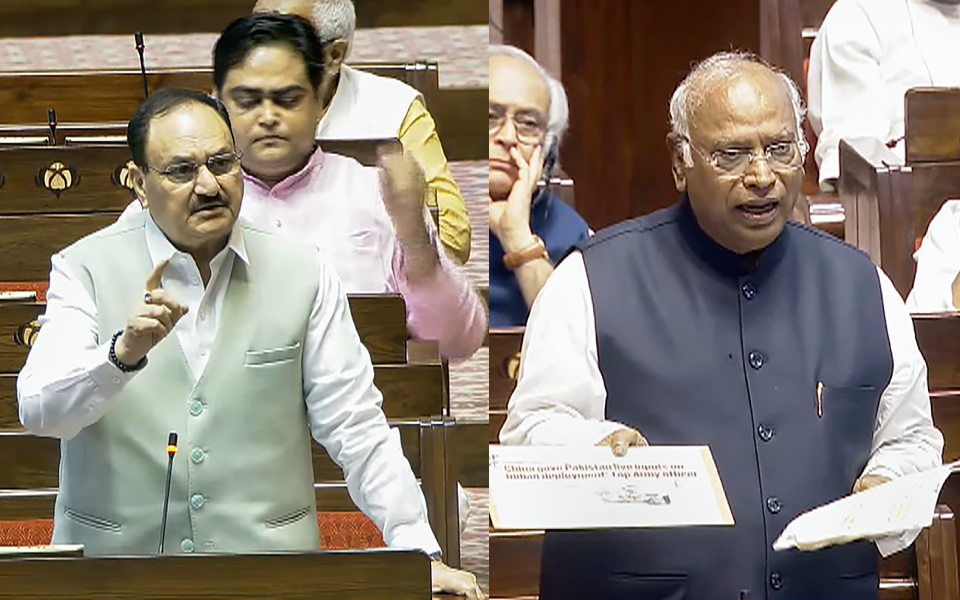
New Delhi, Jul 29 (PTI): The Rajya Sabha witnessed heated exchanges between the Opposition and treasury benches after Leader of the House J P Nadda made some objectionable remarks against Leader of the Opposition Mallikarjun Kharge that he later withdrew and apologised.
Rising soon after Kharge spoke over one hour during the discussion on Operation Sindoor and the Pahalgam terror attack, Nadda first accused him of "losing his mental balance" as he made some remarks against Prime Minister Narendra Modi.
Nadda demanded that Kharge's remarks on the Prime Minister be expunged from the records as they were made in a "flow of emotions".
However, Kharge as well as Opposition benches made strong objections to Nadda's "mental balance" remark and demanded an apology.
Kharge also said that Nadda is one of the ministers in the NDA government whom he respected, but said it was a matter of shame that he made such remarks against him and demanded his apology.
Nadda soon got up to say that he has already withdrawn his words, and offered an apology.
"Prime Minister Narendra Modi is the most popular leader in the world and not just the BJP takes pride in it, the entire nation does," Nadda said, adding that Kharge has not taken care of the prime minister's stature and made the remarks, which were objectionable.
"I have already taken back my words, but if they have hurt his (Kharge's) feelings, I apologise for the same. However, Kharge did cross his limits and made certain remarks against the prime minister in passion and out of emotion, which need to be expunged," Nadda said.
"He has long experience. The choice of words used during his speech did not reflect his stature. The kind of words used by him were below his stature. Therefore, I urge you to expunge those words," Nadda urged the chair.
Let the Truth be known. If you read VB and like VB, please be a VB Supporter and Help us deliver the Truth to one and all.
AIITA welcomes Karnataka’s ban on obscene songs in school events
Bhatkal: The Karnataka unit of the All India Ideal Teachers Association (AIITA) has welcomed the Karnataka government’s decision to strictly ban school children from dancing to obscene songs during educational and cultural programmes in government, aided, and private schools across the state.
AIITA Karnataka State President M. R. Manvi congratulated the government for taking what he termed an important step to preserve the sanctity of education.
“Such decisions to safeguard the dignity of school children and uphold the values of education are the need of the hour. This rule should not be limited to government schools alone but must be strictly implemented in all private educational institutions as well,” he said.
He further urged the government to address other concerns within school programmes.
“The government should not only prohibit obscene dances in the name of school anniversaries, but also ensure that plays and dialogues that incite religious hatred are avoided. Schools should be centres of harmony, not platforms for spreading hatred,” he added.
According to a recent circular issued by the Department of School Education and Literacy, obscene dances are adversely affecting the mental health and moral values of students.
In this regard, schools have been advised to use songs that promote nationalism, positive thinking, the greatness of Kannada culture, and value-based traditions instead of inappropriate content during programmes.
The circular also emphasises that students should be dressed in decent attire.
AIITA also backed the department’s warning that disciplinary action would be taken against head teachers if such guidelines are violated. The association has further demanded that district Deputy Directors of Public Instruction strictly monitor the implementation of these rules.