Opponents desperate to silence me: Rahul Gandhi on defamation cases
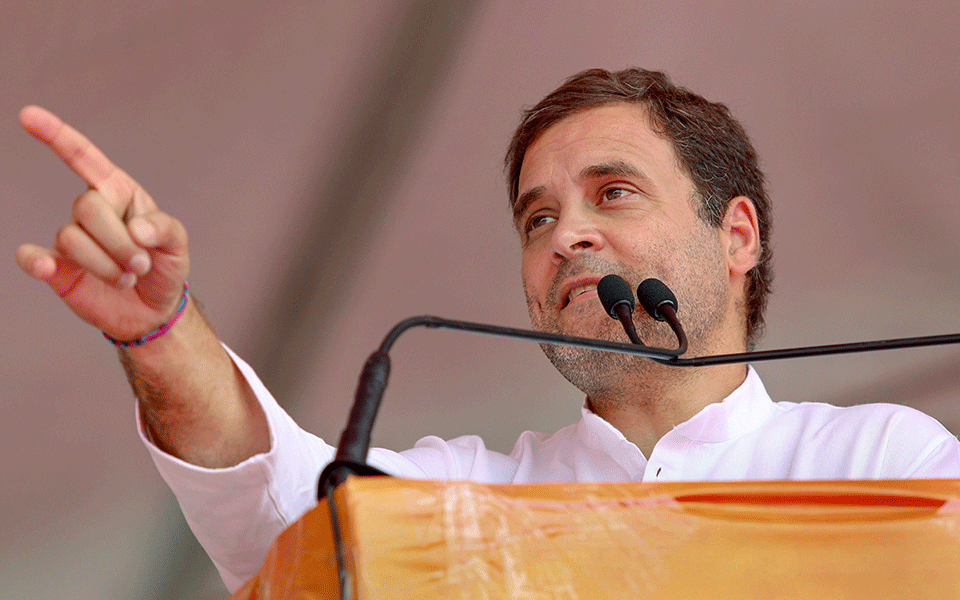
Surat: Congress leader Rahul Gandhi on Thursday said defamation cases filed against him were an attempt by his political rivals deperate to silence him. Gandhi, who appeared before a magisterial court here and pleaded not guilty in a criminal defamation case filed against him for his "why do all thieves share the Modi surname" remarks, made the charge in a tweet.
"I am in Surat today to appear in a defamation case filed against me by my political opponents, desperate to silence me. I am grateful for the love & support of the Congress workers who have gathered here to express their solidarity with me," Gandhi tweeted.
He appeared before the court of Chief Judicial Magistrate B H Kapadia here and pleaded not guilty when asked by the court whether he accept the charges, levelled against him by BJP legislator from Surat-West, Purnesh Modi.
After Gandhi's plea was recorded, his lawyers moved an application seeking a permanent exemption from personal appearance in the next hearings. After Modi's lawyers raised objection to the exemption plea, the court said it will decide on the plea on December 10.
The court said Gandhi is not required to remain present during the next hearing on that date.
During the last hearing in July, the court had granted Gandhi exemption from personal appearance for that hearing and fixed October 10 as the next date of hearing.
In his complaint, the BJP legislator had alleged the Congress leader had defamed the entire Modi community with his remarks, made during the Lok Sabha campaign this year.
The court, while admitting the suit, had held that there was a prima facie case of criminal defamation against the Lok Sabha member from Wayanad.
At a campaign rally at Kolar in Karnataka on April 13, Gandhi had said, "Nirav Modi, Lalit Modi, Narendra Modi... how come they all have Modi as common surname? How come all thieves have Modi as common surname?"
In his complaint, Purnesh Modi had said the Congress leader had defamed the entire Modi community with his statement. Gujarat Congress president Amit Chavda on Tuesday held a meeting with local party leaders in view of Gandhi's visit.
Let the Truth be known. If you read VB and like VB, please be a VB Supporter and Help us deliver the Truth to one and all.
NIA court to complete framing of charges against 2010 hand-chopping case accused on May 15

Kochi (PTI): A special court here will complete proceedings for framing charges against the prime accused in the 2010 hand-chopping case involving professor T J Joseph, in which PFI activists were accused of attacking him at Muvattupuzha.
Ernakulam Special Court for NIA cases judge P K Mohandas, on April 30, heard the arguments of counsel for accused Savad and Shafeer C and decided to proceed with framing charges against the duo.
A group chopped off Thodupuzha Newman College professor Joseph's right hand in July 2010, accusing him of religious blasphemy in a question paper he had prepared.
The case, later taken over by the National Investigation Agency (NIA), resulted in the conviction of 19 accused.
The first accused, Savad, who allegedly chopped off Joseph’s palm, was arrested in Berram in Mattannur, Kannur, in January 2024, where he had allegedly been hiding under the pseudonym Shajahan.
The NIA also arrested Shafeer, who allegedly arranged shelter and provided logistical support to Savad at Chakkad and Mattannur in Kannur since 2020.
On April 30, the court heard the counsel for the accused and the NIA prosecutor on framing charges against the duo.
"On going through the documents and evidence in the case and on hearing the counsel for the accused and the prosecutor, I am of the opinion that there are grounds for presuming that the first accused has committed offences punishable under provisions of the IPC, the Explosive Substances Act and the Unlawful Activities (Prevention) Act, and that the second accused has committed offences punishable under the IPC and the UAPA, and there are materials for framing charges under these provisions against the accused," the court said.
The court directed that Savad be produced and Shafeer, who is on bail, appear before it on May 15 for recording their pleas as part of the charge-framing process.
After framing the charges, the court will schedule the trial in the case.