Opposition criticises Central government's push for lateral entry via UPSC
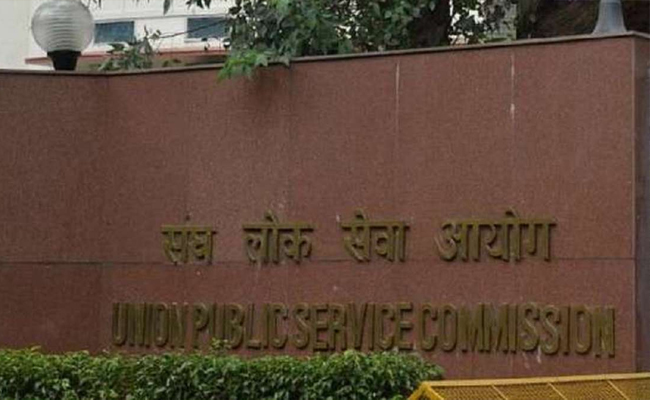
New Delhi: The decision by the Central government, led by Prime Minister Narendra Modi, to recruit 45 positions of Secretary, Deputy Secretaries, and Director through lateral entry has sparked significant political controversy.
The Union Public Service Commission (UPSC) recently issued a notification inviting applications for these positions across 24 central ministries.
Key opposition parties, including the Congress and the Rashtriya Janata Dal (RJD), have strongly criticised this move.
Congress President Mallikarjun Kharge condemned the decision, labeling it a "double attack" on the reservation system. He accused the government of deliberately bypassing the reservation provisions for Scheduled Castes (SCs), Scheduled Tribes (STs), Other Backward Classes (OBCs), and Economically Weaker Sections (EWS) by filling these positions through lateral entry.
Former Bihar Deputy CM Tejashwi Yadav, echoed similar sentiments, calling the decision a "dirty joke" on the Constitution and alleging that it undermines the rights of marginalized communities. He further urged people from these communities to recognize and oppose the government's alleged systematic efforts to dismantle the reservation system.
The UPSC's recruitment drive includes 10 Joint Secretary positions and 35 Director/Deputy Secretary positions across various ministries, such as Finance, Home Affairs, Agriculture, and Education.
Let the Truth be known. If you read VB and like VB, please be a VB Supporter and Help us deliver the Truth to one and all.
Vartha Bharati–Sankalp predictions align closely with Karnataka bypoll results
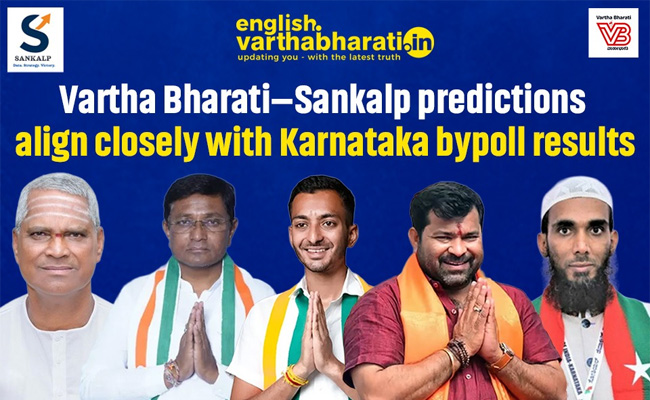
Bengaluru: The Vartha Bharati–Sankalp election analysis has shown a high level of accuracy in predicting the outcome of the recent Karnataka Assembly by-elections held in May 2026, correctly calling winners in both constituencies and closely estimating vote share trends.
The by-elections were held in Bagalkot and Davanagere South, drawing significant political attention as both seats were seen as key tests for the ruling Congress and opposition BJP.
According to the analysis, Vartha Bharati–Sankalp had made three major projections ahead of the results the winning party, vote share percentages, and margin of victory.
In both constituencies, the platform accurately predicted that the Congress would emerge victorious. The outcome matched the projections, with Congress candidates winning in Bagalkot and Davanagere South.
In terms of vote share, the predictions were largely in line with the final results. In Bagalkot, the BJP’s vote share was forecast in the range of 40 to 46 per cent, while the actual figure stood at 42.9 per cent. The Congress vote share, however, exceeded expectations, with the party securing 55.4 per cent against a projected range of 43 to 48 per cent.
The margin of victory in Bagalkot turned out to be significantly higher than anticipated. While the projection had placed the margin between 2,000 and 3,500 votes, the final margin was around 22,332 votes.
In Davanagere South, the predictions also remained largely accurate. The Congress vote share was projected between 43 and 51 per cent, and the final figure stood at 43.9 per cent. The BJP was expected to secure between 42 and 50 per cent but ended with 40.3 per cent.
The analysis had also identified the role of SDPI as a potential spoiler in the constituency. While its vote share was estimated around 6 per cent, the party eventually secured around 12 per cent of the vote.
The margin of victory in Davanagere South was predicted to be between 1,500 and 2,600 votes. The actual margin was higher at around 5,708 votes, though the contest remained relatively close as anticipated.
Overall, the performance of Vartha Bharati–Sankalp stood out for correctly identifying the winning parties in both seats and maintaining close accuracy in vote share estimates, with only limited deviations in specific cases.