Opposition criticises government on Aadhaar amendments
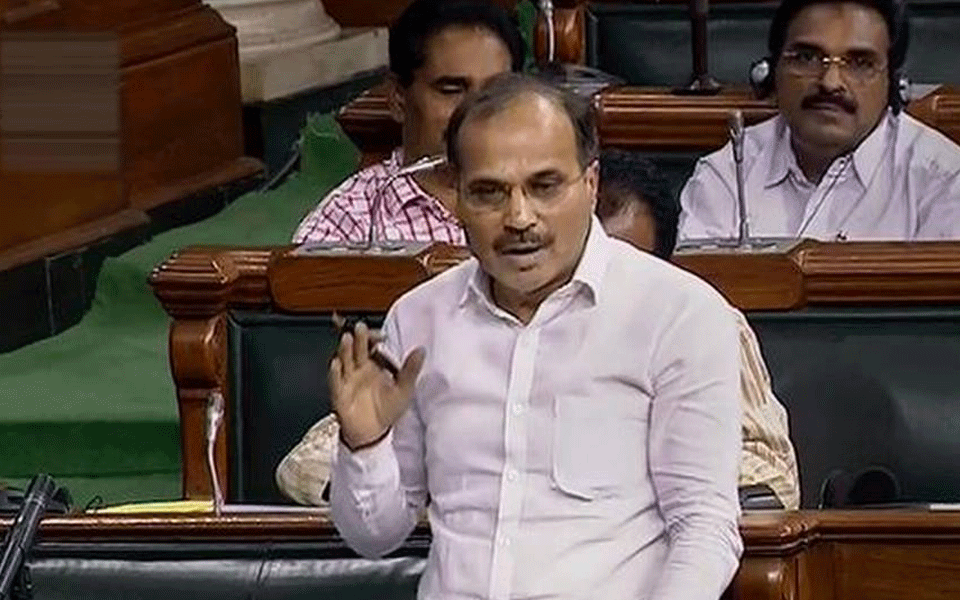
New Delhi: The Opposition on Thursday criticised the government during the discussion on amendments to provide legal backing for voluntary seeding of biometric Aadhaar ID with mobile numbers and bank accounts.
Opposing the bill, Adhir Ranjan Chowdhury, Leader of the Congress in the Lok Sabha, said the government used the ordinance route to bring in the legislation.
He said the ordinance was issued by the last government (from 2014-19) and the current government has brought it as a legislation.
The government is "resorting to the ordinance route without any rhyme and reason".
Chowdhury said it was the UPA government, which brought in the law, to which Law Minister Ravi Shankar Prasad said the NDA government gave legal status to Aadhaar.
"You have loaned the concept of Aadhaar from us (Aapne Aadhaar udhaar liya hain)," he said.
Chowdhury said the Supreme Court had also rapped the government for violating privacy in Aadhaar. Prasad said, "Under you (the UPA), Aadhaar lacked any backing (Aadhaar niradhar tha). We made a law for it".
The minister said Rs 7.84 lakh crore was sent through Direct Benefit Transfer (DBT) to beneficiaries under different schemes. Nearly 1.41 lakh crore have been saved from middle men.
He said 123.81 crore people have Aadhaar cards and nearly 6.91 crore bank accounts have been linked to it.
Let the Truth be known. If you read VB and like VB, please be a VB Supporter and Help us deliver the Truth to one and all.
Oil prices sink, US stock futures jump as US, Iran agree to 2-week ceasefire

New York (AP): Oil prices plunged below USD 100 a barrel and Asia markets and US stock futures jumped after the US and Iran agreed to a two-week ceasefire that includes the reopening of the Strait of Hormuz.
Japan's benchmark Nikkei 225 rose 4.8% and South Korea's Kospi gained 5.6%. Futures for the S&P 500 advanced 2.3% as of 9:30 pm EDT, while Dow futures rose 2%.
Futures for US crude oil sank 14.3% to $96.83 a barrel and Brent crude oil, the international standard, dropped 13.3% to $94.74. Oil prices had spiked because the war snarled the production and transportation of crude in the Persian Gulf. Much of that oil exits the gulf through the Strait of Hormuz to reach customers around the world, but Iran had blocked it to enemies.
Late Tuesday, Trump said he was holding off on his threatened attacks on Iranian bridges, power plants and other civilian targets. Iran's foreign minister said passage through the strait would be allowed for the next two weeks under Iranian military management.
The dramatic moves in prices are just the latest swings to hit financial markets since late February because of constantly shifting signals about when the conflict may end.
Even with word of a ceasefire, neither Iran nor the United States said when it would begin, and attacks took place in Israel, Iran and across the Gulf region early Wednesday.