Opposition leaders say 6-day delay for poll results okay if 50% VVPAT slips counted
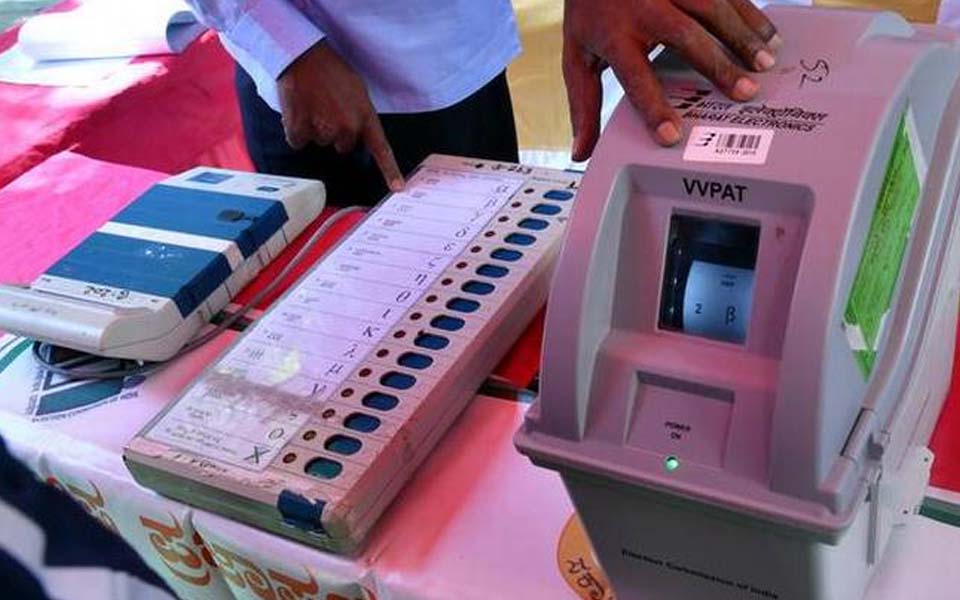
New Delhi, Apr 7: Leaders of 21 opposition parties have told the Supreme Court they do not mind a delay of six days in declaration of Lok Sabha election results for counting of 50 per cent of VVPAT slips, saying it is not a "serious delay" if it ensures integrity of the electoral process.
The submission was made in a counter-reply filed by the opposition leaders, led by TDP chief Chandrababu Naidu, in response to the claim of Election Commission that the verification of 50 per cent of VVPAT slips would delay the declaration of election results by "5.2 days".
The leaders it "is not a serious delay in any manner if it ensures integrity of electoral process".
"If delay of 5.2 days is to be balanced with the integrity of electoral process, the balance will certainly tilt towards the latter," they said in an affidavit submitted to the court.
The Commission follows a system of counting of VVPAT slips in one polling booth per assembly constituency in Vidhan Sabha elections and in one polling booth in each assembly segment for Lok Sabha polls.
A bench headed by Chief Justice Ranjan Gogoi is scheduled to hear on Monday the petition filed by Naidu and others seeking that VVPAT slips of at least 50 per cent of voting machines in each assembly constituency be matched during counting this general election.
The opposition leaders said the delay of 5.2 days, as the EC claims, will occur only if the Commission choose to not increase its present workforce but the delay would be substantially reduced if the workforce is increase by even one person.
They clarified that this is not an adversarial litigation and the plea was filed in public interest with the sole intention of ensuring free and fair elections.
"The petitioners are not casting any aspersions on the election commission of India but are merely seeking a direction that will not only give proper effect to the earlier orders passed by this Court but will also instil a certain sense of confidence in the minds of the general public to the effect that elections shall be free and fair," they said in the affidavit.
The affidavit stated that the issue raised is not of credibility of EVMs but of public confidence in the integrity of the electoral process.
"The petitioners respectfully submit that the election commission which is saddled with the responsibility of ensuring free and fair elections should in all fairness welcome the petitioners' prayers and itself offer to increase the aforesaid numbers/percentage rather than robustly opposing the same in an adversarial manner," it said.
Replying to the EC affidavit, in which the poll panel has justified the use of the present system of random counting in one poll booth per assembly segment, the leaders said, "The present guideline issue by ECI makes VVPAT completely ineffective and merely ornamental in nature".
"It defeats the entire purpose of introducing VVPAT and renders the judgement and directions passed by the court completely otiose," they claimed.
With regard to EC's claim of "insurmountable difficulties" of larger manpower and space for additional six days, they asserted that sensitising additional poll officials and finding larger counting halls are not an insurmountable difficulty by "any stretch of imagination".
"The petitioners submit that even if just one official per booth has been sensitised, it is not difficult at all, much less an 'insurmountably' difficult, to sensitise one or two officials and the ECI should not be permitted to resist increase of percentage or numbers of EVMs to be verified/checked against VVPAT on this ground," they said in their submission to the court.
On April 1, the apex court asked the opposition leaders to file within a week their reply on the EC's affidavit on their plea.
The EC has submitted to the court that any increase in the sample size of verification from the existing norm of one polling booth per assembly segment would lead to very negligible gain in the confidence level, which is way above 99.99 per cent.
It has stated that increased VVPAT slip counting will require extensive training and capacity building of election officials.
"It is further submitted that when the polls are imminent and polling is to commence from April 11, 2019, to now seek to alter the system adopted by the Election Commission of India at this stage might not be feasible," the poll panel has said.
Let the Truth be known. If you read VB and like VB, please be a VB Supporter and Help us deliver the Truth to one and all.
Real Madrid fines Valverde and Tchouaméni half a million euros each for altercation

Barcelona (AP): Real Madrid slapped players Federico Valverde and Aurélien Tchouaméni with half-a-million-euro ($588,000) fines on Friday for their altercation during practice.
The massive fines came a day after the midfielders tussled when the team trained. Valverde said in a post on social media on Thursday that no punches were thrown. But Valverde knocked his head on a table and he suffered a small cut that required a brief hospital visit.
On social media, Valverde initially called it a “meaningless fight” with a teammate and said “everything has been blown out of proportion."
His employers, however, considered it a significant enough breach of team discipline to nail both Valverde and Tchouaméni with fines that bite even the bank account of a top soccer player. The half-a-million euro penalties reflect the reputational damage the club was enduring in a chaotic end to a disappointing season.
In a statement, the 15-time European champion said its disciplinary action was concluded after both players expressed to the club “their complete remorse for what happened and apologized to one another.”
Madrid added they also apologized to their teammates, the coaching staff and club supporters, as well as showing their willingness to accept whatever disciplinary action the club deemed “opportune.”
Tchouaméni was back training with Madrid on Friday, two days before they play at Barcelona in a clasico. Madrid has to win otherwise Barcelona will be crowned La Liga champion.
After being notified of the fine, he posted a public apology to the club and its fans on social media.
“What happened this week in training is unacceptable,” Tchouaméni wrote. "I say this while thinking about the example we are expected to set for young people, whether in football or at school.
“Above all, I am sorry for the image we projected of the club.”
Valverde was not at practice due to the head knock.
Both players are set to play in the World Cup next month, with Tchouaméni playing for France and Valverde for Uruguay.
Chaotic end to a poor season
===================
The run-in between the players, who for seasons have played side by side in Madrid's midfield, came after they argued this week in previous training sessions. But tempers boiled over on Thursday. Spanish media was rife with reports that the players previously disagreed over the club's decision to let coach Xabi Alonso go after just months on the job.
It was not the only altercation involving Madrid players during training this week. Álvaro Carreras confirmed he was in a “minor” incident with a teammate. Spanish media said he and fellow defender Antonio Rüdiger got into a scuffle.
Álvaro Arbeloa, the coach who was promoted from Madrid's reserve team when Alonso was fired in January, will face tough questions on what went wrong inside the changing room when he gives a press conference on Saturday ahead of the clasico at Camp Nou.
Madrid is facing a second consecutive campaign without a major trophy amid rumors in the Spanish media that club president Florentino Pérez is considering bringing back Jose Mourinho to straighten out his underperforming team.