Opposition parties question setting up of PM CARES Fund, allege it lacks transparency
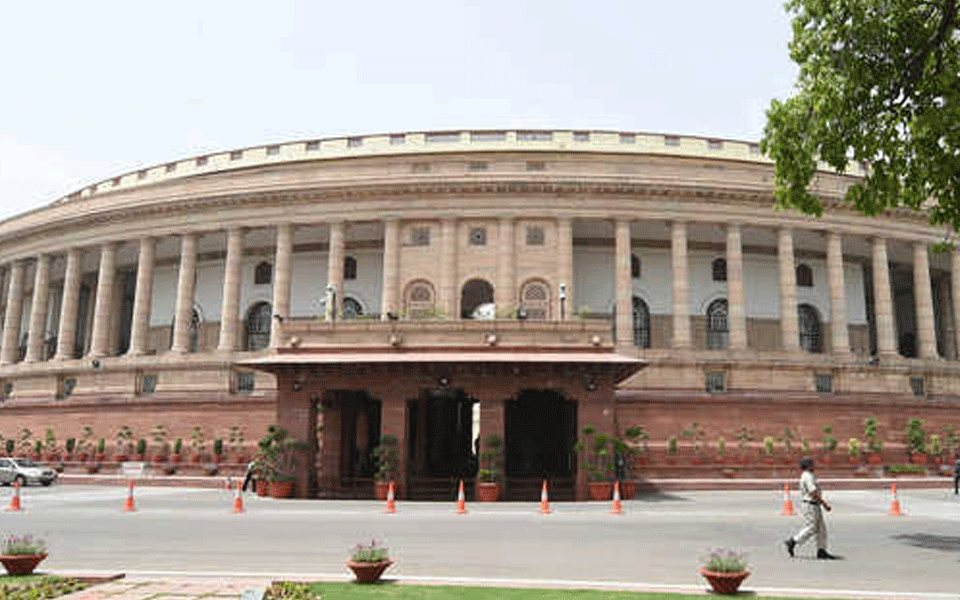
They were participating in a debate on the bill for giving effect to various compliance relief measures for taxpayers, including extending time limits for filing returns, in the wake of the coronavirus crisis and tax benefits for donations to PM CARES Fund.
"I can't understand the logic to have a separate fund. What is the difference between the Prime Minister's National Relief Fund and the PM CARES Fund," said N K Premachandran (RSP), who initiated the debate on The Taxation and Other Laws (Relaxation and Amendment of Certain Provisions) Bill, 2020.
"Eight different Acts are being modified means substantial changes took place in eight Acts and one of the major Acts is the Income Tax Act of 1961," he said.
He alleged the PM CARES Fund "lacks transparency as it is not audited by Comptroller and Auditor General (CAG). Further is also not applicable".
"The question of transparency and accountability is the main issue I want to highlight," he said.
Opposing the Bill, Manickam Tagore (Congress) also raised the issue of transparency in the PM CARES Fund.
He wondered if a chief minister of any state can say that he will not disclose the spending under the Chief Minister's Relief Fund.
But PM CARES Fund is outside the ambit of Parliament and CAG, he said.
"What was the need of a private trust with the Council of Ministers as trustee indicating a conflict of interest," Tagore said.
He alleged that just like demonetisation, the Modi government is providing another opportunity "to convert black money into white".
Without naming anyone, he said "AA battery" is running the Modi government which is why "most of the government contracts are going to some particular companies".
Echoing similar views, Gautham Sigamani Pon (DMK) alleged that the PM CARES Fund is "clearly a private trust".
Considering the trying times, Sigamani said, the government should consider reducing tax rather than cutting TDS.
Mahua Moitra (TMC) too opposed the Bill. She said the PM CARES Fund is against public interest as it is not answerable to Parliament even though it collects funds from the public.
She said that 38 public sector companies contributed Rs 2,100 crore to the Fund.
This is 70 per cent of the total corpus, she said, adding it should therefore be answerable to Parliament.
She also alleged that the Fund got money from Chinese firms like TikTok banned by India and wondered why the government did not return the donations from such companies.
Moitra questioned the need to institute a new fund (PM Cares Fund) when one already exists?
"Prime Ministers will come and go, but the existence of a fund is not up for discussion? What is this need to name everything after one individual.
"First, you are raising a fund on the basis of a public office. By saying it is not open you are running away from transparency," Moitra said.
The Bill amends the provisions of the Income Tax Act to provide the same tax treatment to PM-CARES Fund as available to the Prime Minister's National Relief Fund.
"The donation made to the PM CARES Fund shall be eligible for 100 per cent deduction under section 80G of the IT Act. Further, the limit on deduction of 10 per cent of gross income shall also not be applicable for donation made to PM CARES Fund," an official statement had said.
Shriniwas Patil (NCP) also said there should be more transparency in the PM Cares Fund.
Backing the fund, Bhartuhari Mahtab (BJD) said he hoped the PM CARES Fund is not only created to tackle COVID-19 but also for different calamities.
"Such type of calamity relief funds are nothing new in our country. I doubt in any other country such a clamour has been made to target a philanthropic trust, the manner in which it is being done in the country," Mahtab said.
Arvind Sawant (Shiv Sena) said the way tax relief has been given to those who donate money to the PM CARES Fund, similar relief should be extended to the fund created by the Maharashtra government.
Supporting the bill, Subhash Chandra Baheria (BJP) said it proposes faceless assessment which is a big step in the interest of taxpayers.
The Bill, introduced in Lok Sabha on Friday, proposes to extend the faceless assessment scheme to at least eight processes in income tax law.
It proposed faceless assessment of income escaping assessment, rectification, amendments and issuance of notice or intimation.
Besides, collection and recovery of tax, revision and effect of orders and approval or registration.
Baheria further said that the government should take steps to bring down difficulties faced by GST taxpayers.
Citing a specific example of GST law being overtaken by Rules with regard to Input Tax Credit, he said the government should take steps to correct this anomaly.
Let the Truth be known. If you read VB and like VB, please be a VB Supporter and Help us deliver the Truth to one and all.
AIITA welcomes Karnataka’s ban on obscene songs in school events
Bhatkal: The Karnataka unit of the All India Ideal Teachers Association (AIITA) has welcomed the Karnataka government’s decision to strictly ban school children from dancing to obscene songs during educational and cultural programmes in government, aided, and private schools across the state.
AIITA Karnataka State President M. R. Manvi congratulated the government for taking what he termed an important step to preserve the sanctity of education.
“Such decisions to safeguard the dignity of school children and uphold the values of education are the need of the hour. This rule should not be limited to government schools alone but must be strictly implemented in all private educational institutions as well,” he said.
He further urged the government to address other concerns within school programmes.
“The government should not only prohibit obscene dances in the name of school anniversaries, but also ensure that plays and dialogues that incite religious hatred are avoided. Schools should be centres of harmony, not platforms for spreading hatred,” he added.
According to a recent circular issued by the Department of School Education and Literacy, obscene dances are adversely affecting the mental health and moral values of students.
In this regard, schools have been advised to use songs that promote nationalism, positive thinking, the greatness of Kannada culture, and value-based traditions instead of inappropriate content during programmes.
The circular also emphasises that students should be dressed in decent attire.
AIITA also backed the department’s warning that disciplinary action would be taken against head teachers if such guidelines are violated. The association has further demanded that district Deputy Directors of Public Instruction strictly monitor the implementation of these rules.