'Over 100 experts from friendly nations trained for clinical trials of Indian COVID-19 vaccine'

New Delhi, Dec 16: Over 100 experts from friendly neighbouring nations have so far been trained to strengthen capacities in their countries for facilitating phase-3 clinical trials of Indian COVID-19 vaccine, a senior official of the department of biotechnology said on Wednesday.
Addressing a webinar organised by the Confederation of Indian Industry, Alka Sharma, an adviser with the Department of Biotechnology, said the partnership for advancing clinical trials (PACT) initiative is being carried out in association with the external affairs ministry.
"...The PACT is under the initiative of Department of Biotechnology and Ministry of External Affairs to strengthen capacities for facilitating phase-3 clinical trials of Indian COVID vaccine in friendly neighbouring countries," she said.
Under this initiative, so far two training modules have been successfully completed.
"More than 100 participants from Afghanistan, Bhutan, Maldives, Mauritius, Nepal, Sri Lanka took part in this training programme," she said.
The plan is to have the next round of training programme with more number of participants, she added.
She said currently 30 groups are actively involved in development of the coronavirus vaccine.
Six vaccines are in various stages of clinical trials, of which four are being indigenously developed she said.
Sharma said the clinical trails by Bharat Biotech are in phase-3, while the one which is being developed by Zydus Cadila is in phase-2 clinical trial.
Vaccine candidate of Biological E is in it phase-1 clinical trials while Gennova biopharmaceuticals is in the process of getting approvals at various levels.
Serum Institute of India (SII) is also conducting phase 2 and 3 clinical trials of the Oxford-Astrazeneca vaccine.
Similarly, Dr Reddy's Laboratories is conducting phase 2 and 3 clinical trials for Russian vaccine Sputnik V, she said.
Let the Truth be known. If you read VB and like VB, please be a VB Supporter and Help us deliver the Truth to one and all.
Indian startup's 'Drishti' satellite launched aboard SpaceX rocket
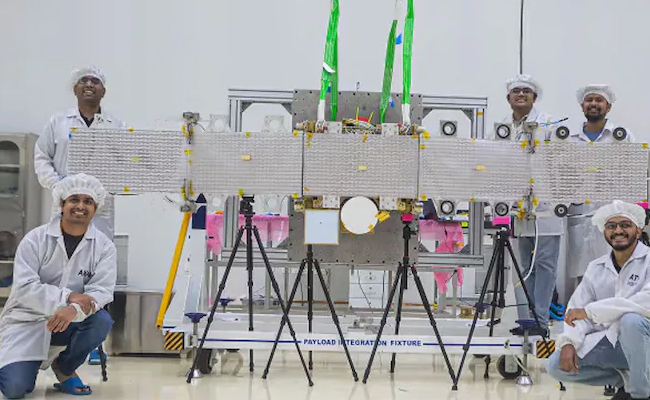
New Delhi (PTI): Bengaluru-based space start-up GalaxEye's Mission Drishti satellite was launched on Sunday aboard SpaceX's Falcon 9 rocket from California.
Mission Drishti is the world's first OptoSAR satellite, integrating electro-optical (EO) and synthetic aperture radar (SAR) sensors into a single operational platform, according to the company.
While EO sensors capture high-resolution images during sunlight and clear skies, SAR sensors provide all-weather and all-time images, using radar pulses.
In a statement, Suyash Singh, founder and CEO of GalaxEye, said, "With the satellite (Mission Drishti) now successfully in orbit, our immediate focus is on completing its commissioning. As we move through this phase, we are already witnessing strong global interest in the differentiated datasets enabled by our OptoSAR payload."
The satellite will help address long-standing limitations of conventional systems and enable more reliable and consistent data acquisition across diverse environmental conditions, the company said.
As a dual-use Earth observation satellite, the mission will support use cases across defence, agriculture, disaster management, maritime monitoring, and infrastructure planning.
The satellite is also expected to complement India's broader initiatives, including the 29 active Earth Observation satellites outlined in ISRO's recent annual report.
The launch came after five years of indigenous research and development, and extensive environmental testing and performance validation of the Mission Drishti.
In a statement, Lt Gen AK Bhatt (Retd), director general of Indian Space Association (ISpA), said, "GalaxEye has achieved what only a few global players have, which is seamlessly combining optical and SAR capabilities on a single platform to enable persistent, all-weather intelligence."
What stands out is not just the technology, but its broader impact on how downstream applications will increasingly define value in the space economy, particularly in Earth observation, where timely, decision-grade insights are critical," he added.
ISpA is the premier industry association of space and satellite companies in the country.
Union Minister Jitendra Singh also took note of the Mission Drishti launch, saying the development marked a significant milestone in India's space journey.
In a post on X, the minister said, "The successful launch of the world's first OptoSAR satellite, and the largest privately-built satellite in the country, reflects the immense potential of our young innovators driving nation-building."
GalaxEye aims to scale up Mission Drishti to a constellation of 10 satellites by 2030, developing a robust and sovereign Earth observation infrastructure for India.