Over 11,000 scientists worldwide declare global climate emergency
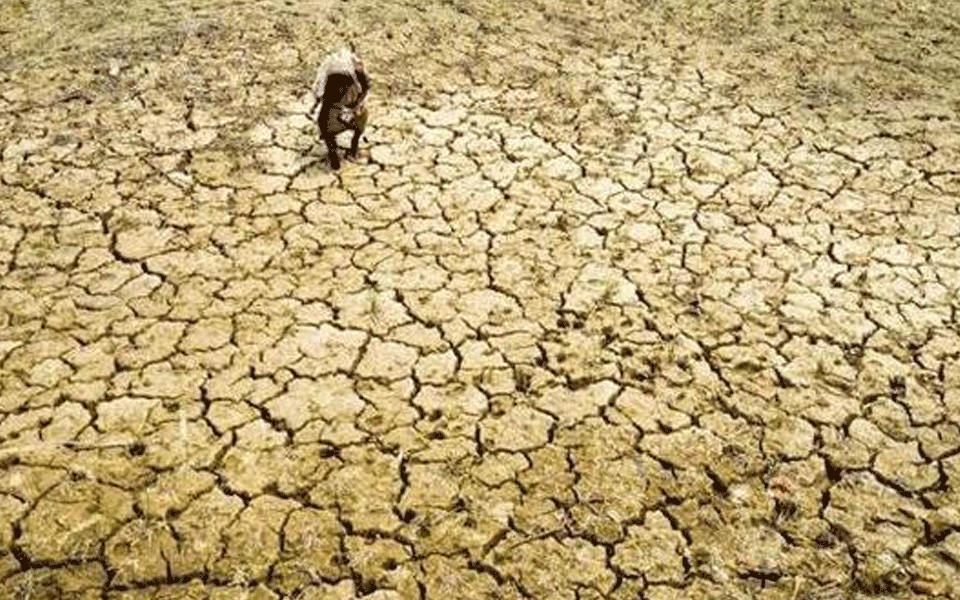
New Delhi: Declaring a global climate emergency, more than 11,000 scientists from 153 countries have warned that "untold suffering" is inevitable without deep and lasting shifts in human activities that contribute to greenhouse gas emissions and other factors related to climate change.
In a paper published on Tuesday in the peer-reviewed journal BioScience, 11,258 signatories, including 69 from India, present trends in climate change and provide a set of effective mitigating actions.
The declaration of a climate emergency is based on scientific analysis of more than 40 years of publicly available data covering a broad range of measures, including energy use, surface temperature, population growth, land clearing, deforestation, polar ice mass, fertility rates, gross domestic product and carbon emissions.
"Despite 40 years of major global negotiations, we have continued to conduct business as usual and have failed to address this crisis," said William J Ripple, a professor of ecology in the Oregon State University (OSU) College of Forestry in the US.
"Climate change has arrived and is accelerating faster than many scientists expected," Ripple said in a statement.
The global coalition of scientists led by Ripple and Christopher Wolf from OSU point to six areas in which humanity should take immediate steps to slow down the effects of a warming planet.
These are energy, short-lived pollutants, nature, food, economy, and population.
The basic quest for all of us is to provide adequate food and energy supplies and sustain it. For that we are exploiting our nature to the best of our ability, which has caused tremendous damage to the nature, Gyan Prakash Sharma, assistant professor at the University of Delhi and one of the signatories, told PTI.
Referring to the India context, he said many things, including the monsoon, have changed in the environmental pattern.
"There is a tremendous change in the monsoon pattern across the country, which has triggered the changes in agricultural practices, Sharma explained.
According to the paper, mitigating and adapting to climate change while honouring the diversity of humans entails major transformations in the ways global society functions and interacts with natural ecosystems.
The signatories said they are encouraged by the recent surge of concern.
"Governmental bodies are making climate emergency declarations. Schoolchildren are striking, according to the declaration... Ecocide lawsuits are proceeding in the courts. Grassroots citizen movements are demanding change, and many countries, states and provinces, cities, and businesses are responding," they said.
"As an Alliance of World Scientists, we stand ready to assist decision makers in a just transition to a sustainable and equitable future," the scientists added.
According to Thomas Newsome at the University of Sydney, scientists have a moral obligation to warn humanity of any great threat.
"From the data we have, it is clear we are facing a climate emergency," Newsome said in a statement.
Graphics in the paper illustrate several key climate-change indicators and factors over the 40 years since scientists from 50 nations met at the First World Climate Conference in Geneva in 1979.
The scientists noted that multiple global assemblies in recent decades have agreed that urgent action is essential, but greenhouse gas emissions are still rapidly rising.
Other ominous signs from human activities include sustained increases in per-capita meat production, global tree cover loss and number of airline passengers, they explained.
There are some encouraging signs -- such as decreases in global birth rates, decelerated forest loss in the Brazilian Amazon and increases in wind and solar power -- but even these are tinged with worry, the scientists noted.
The decline in birth rates has slowed over the last 20 years, for example, and the pace of Amazon forest loss appears to be starting to increase again, they wrote.
"Global surface temperature, ocean heat content, extreme weather and its costs, sea level, ocean acidity, and area burned in the United States are all rising," Ripple said.
"Globally, ice is rapidly disappearing as demonstrated by decreases in minimum summer Arctic sea ice, Greenland and Antarctic ice sheets, and glacier thickness. All of these rapid changes highlight the urgent need for action," he said.
Let the Truth be known. If you read VB and like VB, please be a VB Supporter and Help us deliver the Truth to one and all.
Ayush signs off with silver at Badminton Asia Championships

Ningbo (China) (PTI): India's Ayush Shetty signed off with a silver medal after his giant-killing run ended in a straight-game loss to world No. 2 Shi Yu Qi in the final of the Badminton Asia Championships here on Sunday.
The 20-year-old from Mangalore struggled to find his rhythm, going down 8-21, 10-21 to the reigning world champion from China, as India's 61-year wait for a men's singles gold at the event continued.
Despite the loss, it was a creditable campaign from the unseeded youngster, who became only the second Indian men's singles player after Dinesh Khanna to reach the final of the continental showpiece.
Khanna remains the only Indian singles champion at the event, having won the title in 1965. Since then, only the men's doubles pair of Satwiksairaj Rankireddy and Chirag Shetty have lifted the trophy, winning it in 2023.
World No. 25 Ayush entered the contest on the back of defeats to Shi at the Malaysia Super 1000 earlier this year and the Indonesia Masters last season. However, he had played with far greater control and attacking clarity this week, toppling world No. 1 Kunlavut Vitidsarn, world No. 4 Jonatan Christie and world No. 7 Li Shi Feng en route to the final.
However, the Indian, a product of the Padukone-Dravid Centre for Sports Excellence in Bengaluru, failed to counter the tactical discipline of Shi, who used his repertoire of strokes and deception to deny Ayush the opportunity to play his natural attacking game.
Shi dictated the geometry of the court from the outset, controlling the net exchanges and forcing Ayush into the forecourt battle early. The variation in the Chinese player’s game blunted the Indian’s attack, as his smashes lacked precision and he succumbed to scoreboard pressure, leading to rushed shot-making.
Shi Yu Qi logged the opening points with two fine net dribbles to race to a 4-0 lead, as Ayush’s smashes lacked precision early on and he trailed 2-6. A long rally ended with the Chinese player going wide, offering the Indian some respite. A deceptive net shot helped Shi move to 7-4, and he extended the lead to 11-6 as Ayush struggled for control, committing a string of unforced errors.
Shi mixed it up effectively, producing a lovely drop shot and repeatedly drawing the Indian to the forecourt with cross returns like a metronome, forcing errors. Two down-the-line smashes gave Shi a massive cushion of game points, and he sealed the opening game when Ayush sprayed a return wide.
The Indian needed a complete reset to stay alive, and he responded with a thunderous straight smash before diving on both flanks to keep the shuttle in play and move to 3-1 in the second game. Shi continued to test Ayush with backhand deceptive net strokes and pushes to the deep, but the Indian managed to retrieve everything and even found his precision in time, with an on-the-line smash confirmed by Hawk-Eye and a well-constructed rally taking him to 7-2.
However, he couldn't hold on to the momentum as the Chinese clawed back to 7-7 after two long shots and a smash into the net from Ayush. A return that kissed the backline from Shi, followed by another error from Ayush at the net and a return into the net, handed the Chinese the advantage once again at the interval, as he led 11-8.
Shi’s ability to place the shuttle into empty spaces with his repertoire of strokes, often punctuated by a fierce smash, made life difficult for the Indian as he stretched the lead to 13-8. Soon, the Chinese was up 15-9 with another powerful smash.
A body return followed by a straight smash took him to 17-9, and another long shot from Ayush further dented his chances. A perfectly angled smash into the forehand corner brought Shi within two points of victory. He then unleashed a cross-court smash to earn 10 match points and sealed the contest with a return that cramped the Indian, targeting his hip.