Over 130 hectares of tribal reserve land to be diverted for arterial road in Great Nicobar

New Delhi, Aug 7 (PTI): The construction of an arterial road as part of a mega infrastructure project on the Great Nicobar Island will involve the diversion of over 238 hectares of land, including more than 130 hectares of tribal reserve, the Environment Ministry told Parliament on Thursday.
Responding to a question in the Rajya Sabha, Minister of State for Environment Kirti Vardhan Singh said the proposed road will pass through 149 hectares of protected forest and 10.6 hectares of deemed forest, along with government revenue and private land.
The total tribal reserve land to be diverted is 130.4 hectares.
Around 853 square km of the island's total 910-square km area is designated as a tribal reserve under the Andaman and Nicobar (Protection of Aboriginal Tribes) Regulation, 1956.
In tribal reserves, the tribal communities own the land and have full rights to use it for their daily needs. However, transferring, acquiring or selling land in these areas is strictly prohibited.
The arterial road project is expected to lead to the felling of over 12,428 trees in its first phase.
The minister said compensatory afforestation and the realisation of Net Present Value (NPV) are part of the conditions for forest diversion.
Additional ecological safeguards such as soil and moisture conservation, catchment area treatment and wildlife management plans will also be implemented, he said.
The mega infrastructure project, titled Holistic Development of Great Nicobar, involves the construction of a transshipment port, an international airport, a township and a power plant over more than 160 sq. km of land.
This includes around 130 sq. km of pristine forest inhabited by the Nicobarese, a Scheduled Tribe (ST), and the Shompens, a Particularly Vulnerable Tribal Group (PVTG), whose population is estimated to be between 200 and 300.
Asked whether free, prior and informed consent of these communities had been obtained as per the Forest Rights Act and the Andaman & Nicobar (Protection of Aboriginal Tribes) Regulation, the minister said that "land is a state subject" and it is the responsibility of the Union Territory to comply with relevant laws before issuing a final diversion order.
"As per the provisions of the Van (Sanrakshan Evam Samvardhan) Rules, 2023, the state government or Union territory administration, as the case may be, shall issue order for diversion of forest land, only after fulfilment and compliance of the provisions of all other Acts and rules made thereunder, as applicable including ensuring settlement of rights under the Scheduled Tribes and Other Traditional Forest Dwellers (Recognition of Forest 15 Rights) Act, 2006,” the minister said.
To safeguard the interests of local tribal communities, the environmental clearance mandates the creation of three oversight committees -- one dedicated to the welfare of the Shompen and Nicobarese, and two others to monitor pollution and biodiversity impacts.
Let the Truth be known. If you read VB and like VB, please be a VB Supporter and Help us deliver the Truth to one and all.
Rain wreaks havoc in Bengaluru, kills 10
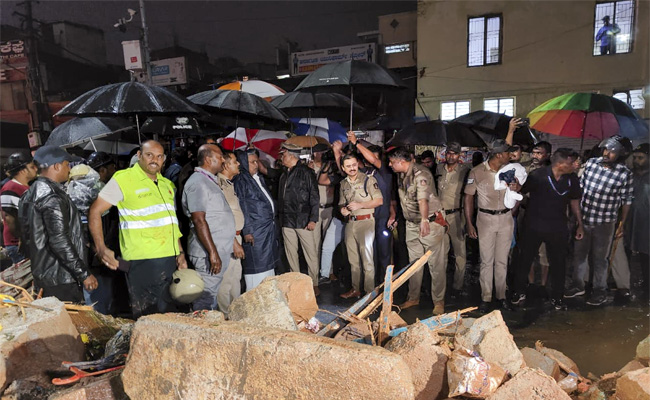
Bengaluru (PTI):The rains in Bengaluru on Wednesday evening wreaked havoc, killing 10 people, authorities said.
Heavy rains coupled with a hailstorm and gusty winds uprooted trees, flooded many key stretches and threw traffic out of gear, they said on Thursday.
Large parts of the city witnessed sudden, intense rainfall for nearly an hour, bringing down trees and electric poles, crushing parked vehicles and inundating low-lying areas, while several roads were rendered impassable, severely disrupting vehicular movement during peak hours.
Seven people, including a six-year-old girl, were killed when a compound wall of the Bowring and Lady Curzon Hospital collapsed amid the downpour.
Among the deceased, two were from Kerala who were on a study tour. They had taken shelter near the wall when it gave way, they said.
ALSO READ: ICSE, ISC results: Girls outperform boys, pass rate over 99%
In another incident, a 35-year-old man, identified as Raghu, died of electrocution on Bannerghatta Road near Vega City Mall.
In a separate case in Yarab Nagar, a student, Syed Sufiyan died after coming into contact with a live electric wire while attempting to park his motorcycle during the rain, police said.
One more fatality was reported from Chamarajapet, where Manjunath died on the spot after a cement block fell and pierced through the roof of a house during the storm.
The sudden spell of rain left a trail of destruction across the city.
“So far, 10 people have died due to rain-related incidents in Bengaluru,” police said, attributing the deaths to wall collapse, electrocution and structural damage triggered by the storm.
Civic authorities said at least 87 trees were uprooted and 131 branches snapped across the city, disrupting daily life.
Of these, 60 trees and 98 branches had been cleared, while restoration work was ongoing.
Several cars and two-wheelers parked along roadsides were crushed under fallen trees.
Key junctions and underpasses were waterlogged, with the KR Circle underpass completely submerged, forcing police to barricade the stretch due to lack of drainage.
Fallen branches and stalled vehicles further worsened traffic congestion, leaving commuters stranded for hours.
Officials said buildings suffered partial damage in several areas, while the sudden and unanticipated nature of the storm caught many residents off guard. Authorities have issued a rain alert for the next three days.