Over 30 hours gone, 20 teams at work, but no trace of Saif Ali Khan’s attacker
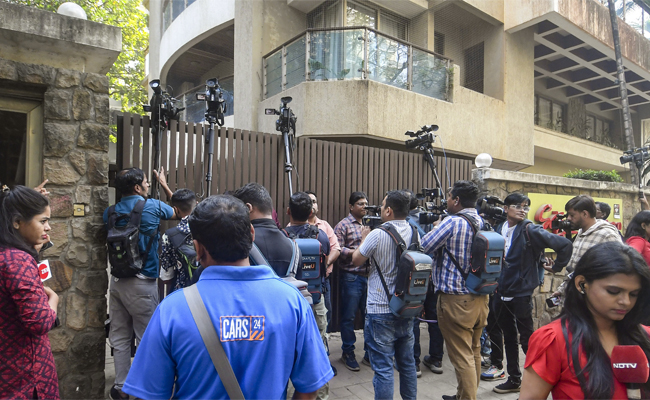
Mumbai (PTI): More than 30 hours have passed but the Mumbai police have yet to arrest the man who repeatedly stabbed actor Saif Ali Khan in his plush apartment in the city’s Bandra area, an official said on Friday.
The city police have formed 20 teams to track down and nab the intruder and are tapping their network of informers to locate him, officials have said.
The crime branch and the local police have gathered technical data, including how many mobile phones were active in the area when the actor was attacked during a “burglary attempt” in his apartment housed in ‘Satguru Sharan’ building, the police official said.
Evidence has been collected from Khan’s home and the building with the help of forensic teams and the dog squad and searches were conducted at many places in Mumbai to track down the attacker, he said.
The 54-year-old actor received six stab injuries, including in his neck, in the attack around 2.30 am on Thursday. He was out of danger following an emergency surgery at the Lilavati Hospital where he was rushed, according to doctors treating him. He continues to be in the hospital.
Police are examining the CCTV footage of the building showing the intruder, who was armed with a wooden stick and a long Hexa blade, fleeing after the attack.
The footage, captured at 2.33 am, clearly showed the young suspect’s face. He is seen wearing a brown T-shirt with a collar and a red scarf while scurrying down the stairs on the sixth floor of the building. The actor lives on the 12th floor.
Besides Khan, a 56-year-old staff nurse at the house, Eliyama Philip, who is the complainant, and a domestic help suffered blade injuries in the incident, said an official on Thursday.
The entire family - Khan, his wife and fellow star Kareena Kapoor, and their two sons, four-year-old Jeh and eight-year-old Taimur - were home in the 12th-floor apartment along with their five house helps. In a statement to the police, Jeh's nanny Philip, who first encountered the armed attacker, said he asked for Rs 1 crore.
The intruder did not force his entry or break into the actor's flat but possibly sneaked in at some point during the night with the intention of robbery, police officials said.
The man, she said, pointed a finger at her and warned her, "Koi awaaz nahin (don't make any noise).
Hearing her scream, Khan and Kareena rushed out of their room. The intruder, who Philip said was between 35-40 years old, then attacked Khan with a knife.
Let the Truth be known. If you read VB and like VB, please be a VB Supporter and Help us deliver the Truth to one and all.
Massive turnout in assembly polls across states, women voters outnumber men: EC data
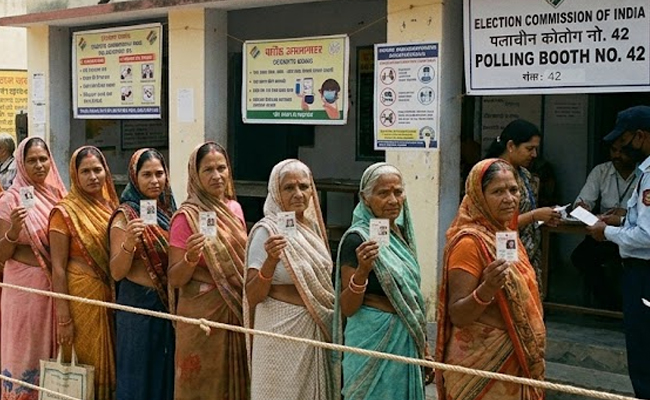
New Delhi (PTI): The recently-concluded assembly elections witnessed exceptionally high voter participation across states, with women voters outnumbering men in turnout percentages, according to Election Commission data.
West Bengal recorded the highest voter turnout among states, with 93.71 per cent polling in 293 constituencies where counting has been completed. The state saw over 6.38 crore votes cast, including postal ballots, against a total of more than 6.81 crore electors.
Women voters recorded a turnout of 93.8 per cent in the West Bengal Assembly polls, slightly higher than the 92.06 per cent participation among men.
The data for West Bengal does not include the figures for the Falta assembly constituency, which is scheduled for repolling.
Tamil Nadu registered an 85.01 per cent turnout, with nearly 4.8 crore votes polled from an electorate of 5.74 crore. Women voters recorded a turnout of 86.2 per cent, higher than the 83.77 per cent among men.
Assam also witnessed robust participation, with the final turnout touching 85.74 per cent. More than 2.15 crore votes were cast in the state, while female turnout at 86.53 per cent marginally exceeded the 84.95 per cent recorded among male voters.
Kerala registered a turnout of 78.11 per cent, with over 2.12 crore votes polled. Female voter participation stood at 81.17 per cent against 74.9 per cent among men.
Puducherry recorded a turnout of 89.82 per cent, with women voters again leading participation at 91.39 per cent. More than 8.5 lakh votes were polled in the Union territory.
Yet, women's representation among elected candidates remained modest.
Tamil Nadu elected 23 women MLAs (9.83 per cent) out of 234 members, West Bengal elected 37 women legislators (12.62 per cent) out of 293, while Kerala returned only 11 women MLAs (7.85 per cent) in the 140-member House.
Only two third-gender candidates contested the elections - one each from Tamil Nadu and Kerala, and both lost, forfeiting their deposits.
The elections also reflected extensive electoral mobilisation infrastructure. West Bengal had the highest number of polling stations at 85,092, followed by Tamil Nadu with 75,064 and Assam with 31,490.
In terms of candidates, Tamil Nadu saw the largest contest with 4,023 candidates in the fray across 234 constituencies, averaging 17 candidates per seat and peaking at 79 contestants in one constituency.
West Bengal pitted 2,920 candidates for 293 constituencies, while Kerala had the fewest contestants among the major states, with 883 candidates for 140 seats.
The data also showed relatively low NOTA votes across states. Tamil Nadu recorded the lowest NOTA share at 0.4 per cent of total votes polled, while Assam recorded the highest at 1.23 per cent. In West Bengal, 0.78 per cent of the total votes polled were NOTA, while it 0.77 per cent and 0.57 per cent of the electorate opted for None of the Above (NOTA) in Puducherry and Kerala, respectively.