Pak military pleaded for cessation of fighting during Operation Sindoor: India
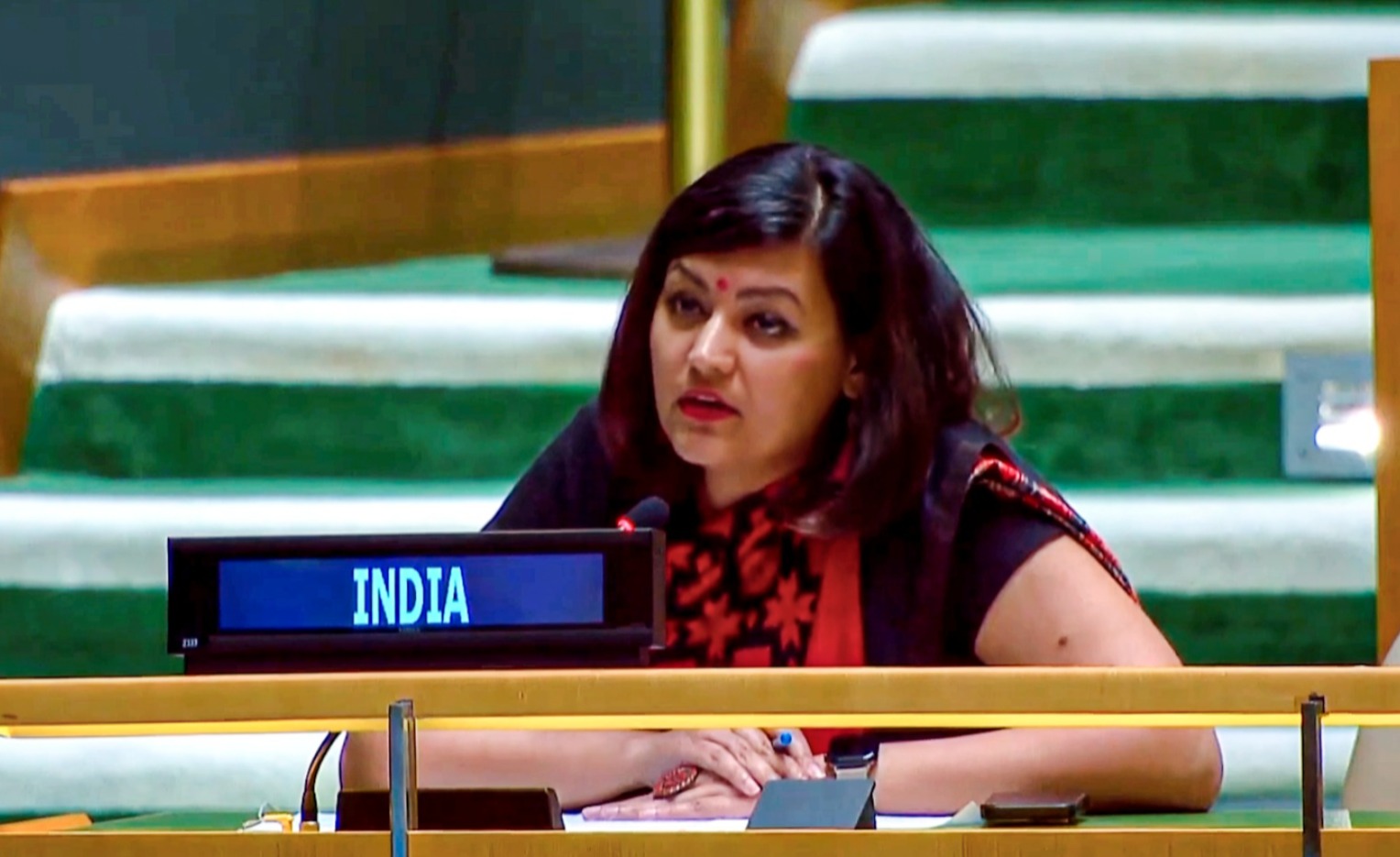
United Nations (PTI): Pakistan’s military “pleaded” for a cessation of fighting during Operation Sindoor in May, India has said in a hard-hitting response from the United Nations General Assembly, asserting that there is “no room for any third party” to intervene in issues between New Delhi and Islamabad.
“This assembly witnessed absurd theatrics in the morning from the prime minister of Pakistan, who once again glorified terrorism that is so central to their foreign policy,” First Secretary in India’s Permanent Mission to the UN Petal Gahlot said, delivering India’s Right of Reply in the UN General Assembly on Friday.
Pakistan Prime Minister Shehbaz Sharif advanced a “bizarre” account of the recent conflict when India had launched Operation Sindoor targeting terror infrastructure in Pakistan and Pakistan-occupied Kashmir in retaliation for the April 22 Pahalgam terror attack that killed 26 civilians, she said.
The Resistance Front (TRF), an offshoot of Pakistan-based terrorist group Lashkar-e-Taiba (LeT), had claimed responsibility.
India said, “Till May 9, Pakistan was threatening more attacks on India. But on May 10, its military pleaded with us directly for a cessation to the fighting. The intervening event was the destruction caused to multiple Pakistani airbases by Indian forces. The pictures of that damage are, of course, publicly accessible.”
India slammed Pakistan after Sharif said his country “won the war” during the recent conflict with India, referred to the “ceasefire” facilitated by US President Donald Trump and raised the issue of Kashmir in his address to the UN General Assembly on Friday morning.
Sharif had also said that the Pakistani forces had repulsed India’s attacks and claimed that seven Indian jets were turned to “scrap and dust”.
In a sharp retort, India said that “if destroyed runways and burnt-out hangars look like victory, as the prime minister claimed, Pakistan is welcome to enjoy it”.
Gahlot said in the UNGA hall that “we saw many pictures of terrorists slain in Bahawalpur and Muridke terror complexes by Indian forces during Operation Sindoor”.
“When senior Pakistani military and civilian officials publicly glorify and pay homage to such notorious terrorists, can there be any doubt about the proclivities of this regime,” she said.
Following Operation Sindoor, a viral photograph showed Lashkar-e-Taiba terrorist Hafiz Abdul Rauf leading prayers for those killed in strikes on the LeT’s headquarters in Muridke, with the funeral being attended by members of the Pakistan Army.
India further said that there is no room for any third party intervention in matters between New Delhi and Islamabad.
“India and Pakistan have long agreed that any outstanding issue between them will be addressed bilaterally. There is no room for any third party in that regard,” Gahlot said.
Sharif had claimed that while Pakistan was in a “position of strength”, it agreed to a ceasefire facilitated by Trump’s “bold and visionary leadership” and thanked the American leader and his team for “their active role in bringing about the ceasefire”.
India has consistently maintained that the understanding on cessation of hostilities with Pakistan was reached following direct talks between the Directors General of Military Operations of the two militaries.
Gahlot highlighted at the UN General Assembly that it was Pakistan that had in the UN Security Council on April 25 “shielded” ‘The Resistance Front’, from the responsibility of carrying out the barbaric massacre of tourists in Jammu and Kashmir.
“No degree of drama and no level of lies can conceal the facts,” she said. Following the Pahalgam attack, the 15-nation UN Security Council had on April 25 issued a press statement in which the members had underlined the need to hold perpetrators, organisers, financiers and sponsors of the reprehensible act of terrorism accountable and bring them to justice.
However, the press statement did not mention TRF as the group responsible for the attack after Pakistan managed to get the name removed.
“We have exercised the right to defend our people against such actions and have brought the organisers and perpetrators to justice,” she said.
She accused Pakistan of “deploying and exporting terrorism” and said it has no shame in advancing the most ludicrous narratives to that end.
“Let us recall that it sheltered Osama bin Laden for a decade, even while pretending to partner in the war against terrorism. Its ministers have just recently acknowledged that they have been operating terrorist camps for decades,” she said.
She underscored that where terrorism is concerned, India is making it clear that there will be no distinction between the terrorists and their sponsors.
“Both will be held accountable. Nor will we allow terrorism to be practised under the cover of nuclear blackmail. India will never bow to such threats. India’s message to the world is clear; there must be zero-tolerance for terrorism,” Gahlot said.
Responding to Sharif’s remarks that his country stands ready for a “composite, comprehensive and result-oriented” dialogue with India on all outstanding issues, Gahlot said if he is indeed sincere, the pathway is clear.
She said Pakistan must immediately shut down all terrorist camps and hand over terrorists wanted in India.
India said it is also ironic that a country which "wallows in hate, bigotry and intolerance” should preach to the UN General Assembly on matters of faith.
"The political and public discourse of Pakistan reflects its true nature. Clearly, a look by them at the mirror is long overdue,” Gahlot said.
Let the Truth be known. If you read VB and like VB, please be a VB Supporter and Help us deliver the Truth to one and all.
Putin meets Iran's FM Araghchi, says Russia ready to do its best to help bring peace to West Asia
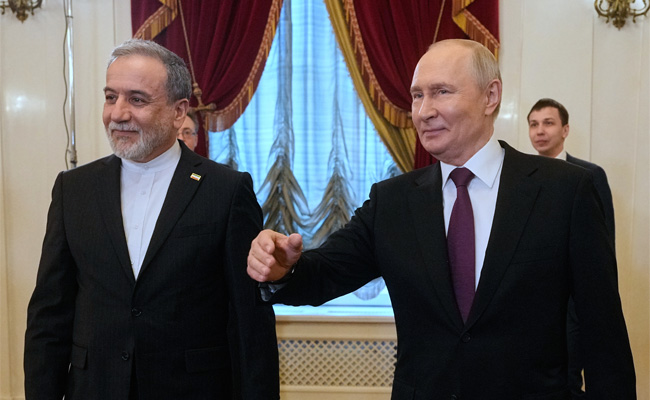
Moscow (PTI): Iran's Foreign Minister Abbas Araghchi on Monday met Russian President Vladimir Putin, who hailed the Iranian people for fighting bravely and heroically for their sovereignty and said Moscow is ready to do its best to help bring peace to West Asia as soon as possible.
Araghchi, who held talks with Omani and Pakistani leadership before arriving in Russia, met Putin in St. Petersburg and thanked him for supporting Iran, state-owned TASS news agency reported.
"Russia is ready to do everything in its power to ensure that peace in the Middle East is achieved as soon as possible," Putin said during his meeting with Araghchi, which was also attended by Russian Foreign Minister Sergey Lavrov.
Revealing that he received a message from Iranian Supreme Leader Mojtaba Khamenei last week, Putin asked Araghchi to convey his "gratitude for this message and best wishes for his health and well-being."
He praised the Iranian people for fighting "bravely and heroically" for their sovereignty, Iran's state-run PRESS TV reported.
"We really hope that, based on the courage and desire for independence, the Iranian people, under the guidance of the new leader, will weather this difficult period of trials and peace will come,” Putin said.
He also stressed that Russia “intends to maintain” its strategic relations with Iran.
Araghchi said that the world witnessed Iran’s strength in countering the US during the recent war, and that the Islamic Republic is a "stable and powerful establishment."
"With their courage, the Iranian people succeeded in resisting the US aggression and will be able to endure it,” he said.
He said that it became clear that Iran has “great friends and allies” like Russia, and conveyed “warmest greetings” from Supreme Leader Mojtaba Khamenei and President Masoud Pezeshkian to the Russian leader.
Araghchi said relations between Moscow and Tehran represent a “strategic partnership at the highest level” and will continue to develop "regardless of circumstances."
"We are grateful to you for the solid and strong positions in support of the Islamic Republic of Iran," he said.
Foreign Minister Lavrov said that the talks between President Putin and the Iranian Foreign Minister were "useful and constructive."
Kremlin Spokesman Dmitry Peskov later said that Russia is "ready to provide any good offices, any mediation services that are acceptable to the parties."
"We will be ready to do everything so that ultimately peace ensues, guaranteed peace, and that there is no return to hostilities," Peskov was quoted as saying by TASS.
He was asked how Moscow can assist in future negotiations on the Iranian settlement.
Araghchi arrived in Russia after his whirlwind trip to Islamabad, which, according to him, was “very productive” and involved “good consultations" with Pakistan's Army Chief Field Marshal Asim Munir, amid uncertainty over the second round of peace talks to resolve the war in West Asia.
"We held good consultations with our friends in Pakistan. The trip was successful. We assessed the outcome of our recent (meetings) and discussed in what direction and under what conditions talks can move on,” Araghchi said in a video posted on his Telegram channel upon his arrival in St Petersburg.
Referring to the second round of talks between the US and Iran to resolve the conflict in West Asia, Araghchi said: "Developments have taken place in the negotiations."
"Despite some progress in earlier rounds, the talks failed to reach their objectives due to the Americans' approach, the excessive demands they made, and the wrong approaches they adopted. Therefore, it was necessary to consult with our friends in Pakistan to review the latest situation,” Iran's official news agency IRNA quoted him as saying.
He said that the trip to Pakistan was a good opportunity to review developments related to the US-Israeli war against Iran, expressing confidence that “these consultations and coordination between the two countries will be highly significant.”
Araghchi arrived at St. Petersburg's Pulkovo Airport early Monday, where he was welcomed by Russian officials and Iran’s ambassador to Russia, Kazem Jalali, the report said.
The first round of peace talks between Iran and the US, held on April 11 and 12, failed to bring the desired result for the parties to the conflict.
The Iranian minister arrived in Islamabad for the second time on Sunday after a short visit to Oman, where he held talks with Sultan Haitham bin Tariq al-Said on security in the Strait of Hormuz and diplomatic efforts to end the Iran-US conflict.
After Araghchi left Pakistan for Oman on Saturday, President Donald Trump announced that US negotiators Steve Witkoff and Jared Kushner would no longer be going to Islamabad for talks with Iran, contending that Washington held all the cards on the matter.
Trump on Sunday reiterated that the US and Iranian officials can talk by phone for a peace solution to the conflict.
On Tuesday, Trump extended the two-week ceasefire with Iran indefinitely to give Tehran more time to prepare a unified proposal to end the war, just hours before the truce was set to expire.
The war began when the US and Israel jointly attacked Iran on February 28, killing Iranian Supreme Leader Ayatollah Ali Khamenei and several top commanders. The retaliation by the Islamic Republic extended the war to the entire Gulf region.