Pak threatens nuclear response if India attacks or disrupts water flow
Moscow(PTI): Pakistan will respond with "full spectrum of force", including nuclear, if it is attacked or its vital water flow disrupted, Pakistan's ambassador here has warned amid tensions between New Delhi and Islamabad after the Pahalgam terror attack.
Muhammad Khalid Jamali made the comments during an interview with Russia's state-run TASS news agency on Sunday.
Warning that Pakistan was prepared to respond to any aggression, the ambassador said, “We in Pakistan will use the full spectrum of force, both conventional and nuclear.”
Ties between India and Pakistan plummeted following the April 22 Pahalgam terror attack in Jammu and Kashmir that killed 26 people, mostly tourists.
Jajamali reiterated Islamabad’s position regarding the Indus Water Treaty, a key agreement between India and Pakistan, which New Delhi suspended last week as a part of its diplomatic response to the terror attack.
“Any attempt to usurp the water of the lower riparian, or to stop it, or to divert it would be an act of war against Pakistan and would be responded to with full force, including nuclear,” he said.
The envoy, however, urged de-escalation, noting the potential danger given that both countries possess nuclear weapons.
“As the two countries are two nuclear powers, there is all the more need to de-escalate the tensions,” he said.
Pakistan earlier called for “neutral and credible investigations” into the Kashmir attack. “I think the role of the international community comes in. And in this regard, we expect that powers like China and Russia can participate in those investigations,” Jajamali said.
"I believe that the root cause of the problem in Jammu and Kashmir is the right to self-determination for the Kashmiri people, which was promised to them by the international community through various UN Security Council resolutions," he claimed.
"This needs to be addressed for a permanent, sustainable and durable peace," he added.
When asked whether Pakistan was preparing a formal appeal to Russia to take part in the investigation into the terrorist attack, the ambassador said, "We are open [to it]. We want this investigation to be conducted and this blame game to stop. There are incidents from time to time, and without addressing the root causes, Pakistan is blamed for this.”
He said Moscow has pointed at the need to address the "root causes" in the Russia-Ukraine conflict.
"Similarly, when political disputes fester for a long time, resentment arises and such incidents are likely to occur. It's always very easy to blame and make someone a scapegoat," he said.
Late Sunday evening, Pakistan's Deputy Prime Minister and Foreign Minister Ishaq Dar held a telephone conversation with Russian Foreign Minister Sergei Lavrov seeking Moscow's help in de-escalating tensions between the two nuclear-armed neighbours.
Following the Pahalgam attack, India, among other punitive actions, announced the suspension of the 1960 Indus Accord, which governs water sharing between the two countries.
Earlier on April 24, Prime Minister Narendra Modi vowed to punish the terrorists involved in the terror attack and their backers.
In a high-level meeting with the top defence brass on April 29, Modi asserted that the armed forces have “complete operational freedom” to decide on the mode, targets and timing of India’s response to the terror attack, according to government sources.
Let the Truth be known. If you read VB and like VB, please be a VB Supporter and Help us deliver the Truth to one and all.
India describes attack on Fujairah 'unacceptable'
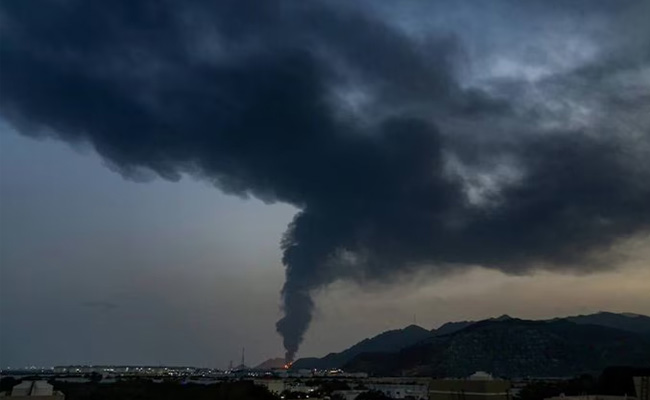
New Delhi (PTI): India on Tuesday described the wounding of three Indians in an attack on the United Arab Emirates' port city of Fujairah as "unacceptable" and pressed for an immediate cessation of hostilities targeting innocent civilians.
New Delhi's reaction came a day after the Indians were injured after a drone attack caused a fire at a major oil industry zone in Fujairah. The UAE had accused Iran of carrying out the strike.
"The attack on Fujairah that resulted in injury to three Indian nationals is unacceptable," External Affairs Ministry spokesperson Randhir Jaiswal said.
"We call for immediate cessation of these hostilities and the targeting of civilian infrastructure and innocent civilians," the spokesperson said.
Jaiswal said India continued to stand for dialogue and diplomacy to deal with the situation so that peace and stability could be restored across West Asia.
"We also call for free and unimpeded navigation and commerce through the Strait of Hormuz in keeping with international law. India stands ready to support all efforts for a peaceful resolution of issues," he said.
The attack on Fujairah city came as the ceasefire between the US and Iran came under strain in the Strait of Hormuz.
The Strait of Hormuz, through which roughly one-fifth of the world's oil and gas pass, remains a major sticking point in the talks. Shipping through the narrow Gulf waterway has been severely disrupted by the conflict, triggering a sharp increase in oil prices and energy shortages in several countries.
The UAE's defence ministry on Monday said its air defence systems engaged 12 ballistic missiles, three cruise missiles and four drones launched from Iran.
The ministry affirmed that it "remains fully prepared and ready to deal with any threats and will firmly confront anything that aims to undermine the security of the country."