Pakistan violated Indian Airspace, used civilian planes as shield: MEA
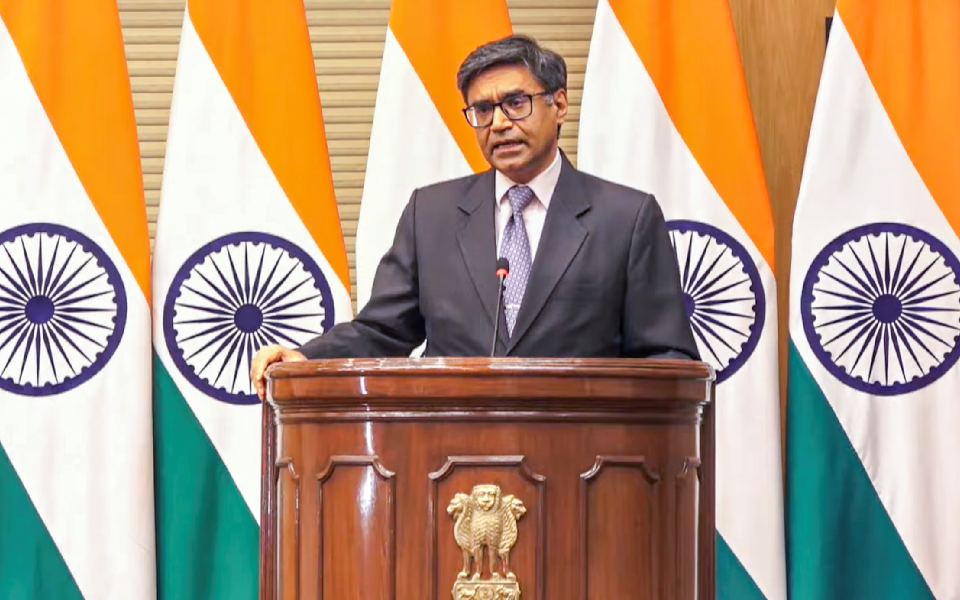
New Delhi, May 9: The Ministry of External Affairs (MEA), in a detailed press briefing on Friday, said that Pakistan had carried out multiple airspace violations across India’s western border during the night of May 7 and 8, with the apparent intention of targeting Indian military infrastructure. These actions, which involved the use of hundreds of drones and heavy artillery, led to a calibrated and proportionate response from the Indian armed forces under "Operation Sindoor".
Airspace Violations Across Entire Western Border
Addressing the media, Colonel Sofiya Qureshi said the Pakistani army violated Indian airspace several times, aiming to test Indian air defence capabilities and gather intelligence.
“On the night of May 7 and 8, the Pakistani army violated Indian airspace at multiple points across the entire western border. Around 300 to 400 drones were deployed to infiltrate at nearly 36 locations. Many of these drones were successfully intercepted and neutralised using both kinetic and non-kinetic measures,” she said.
Preliminary forensic investigations into the wreckage of the downed drones indicate that they were Turkish-origin Asisguard Songar models.
Use of Civil Airliners as Shields
In a serious revelation, Wing Commander Vyomika Singh accused Pakistan of deliberately endangering civilian lives by keeping its airspace open for civil aircraft even while launching unprovoked aerial attacks.
“Despite initiating a drone and missile assault on India at 8:30 pm on May 7, Pakistan chose not to shut its civil airspace. It is using civil airliners as shields, risking the lives of passengers aboard both domestic and international flights. In contrast, India declared an air defence alert and ensured its airspace was completely free of civil air traffic,” she said.
She added that flight radar data clearly showed civilian aircraft flying between Karachi and Lahore during the period when India’s airspace in Punjab sector was completely cleared as a precaution.
Indian Response and Damage to Pakistani Installations
India responded swiftly to Pakistan’s provocative actions. Armed drones were launched at four air defence sites in Pakistan, and one drone reportedly destroyed an air defence radar installation.
In addition to the air response, Pakistan also launched artillery shelling across the Line of Control (LoC), deploying heavy-calibre guns and armed drones. This led to casualties and injuries among Indian Army personnel. However, Pakistan’s military suffered significantly heavier losses during India’s retaliatory fire.
MEA Slams Pakistan’s Denial and Duplicity
Foreign Secretary Vikram Misri strongly criticised the Pakistani establishment for its attempts to deny the attacks and shift the narrative.
“These provocative and escalatory actions taken by Pakistan targeted not only Indian military bases but also civilian infrastructure and cities. Despite this, Pakistan's official machinery has blatantly denied their involvement, which is yet another example of their duplicity and the new depths they continue to sink to,” he said.
Let the Truth be known. If you read VB and like VB, please be a VB Supporter and Help us deliver the Truth to one and all.
Maharashtra sets up state vaccination task force to strengthen immunisation programme

Mumbai (PTI): The Maharashtra government has set up a State Vaccination Task Force to strengthen the regular immunisation programme and review the progress of related campaigns, a health department official said on Monday.
The State Vaccination Task Force will comprise at least 29 members and will be headed by the administrative head of the health department, he informed.
The government has also constituted separate district-level and municipal vaccination task forces to improve implementation and address challenges at the grassroots level, he said.
Municipal task forces, chaired by respective civic commissioners, have been constituted in view of the vast urban population in Maharashtra and the role of civic bodies in implementing different health programmes.
The district-level task forces will function under the chairmanship of collectors.
"Complete immunisation of children at the appropriate age is an extremely simple, cost-effective and highly effective measure to reduce child mortality and the prevalence of diseases among kids. Immunisation is a powerful tool for reducing illness in children," maintained the official.
To ensure full vaccination of all children, the state government implements various campaigns from time to time as per the central government guidelines, he pointed out.
"Active participation and cooperation of other relevant government departments are essential (in making these campaigns successful)," according to the official.
The state-level body will review the regular immunisation programme, associated campaigns and vaccine-preventable diseases in detail. It will also conduct focused assessments of high-risk districts and municipal corporations, including vacancies at district, municipal and sub-district levels, availability of cold chain equipment, resource gaps and training requirements, he noted.
The state task force will review allocation and utilisation of funds for immunisation and ensure timely action by officers concerned based on reports from district and municipal task forces and state-level monitoring mechanisms, the official said.
It will also ensure active coordination and participation of other government departments in immunisation drives, while district and municipal task forces will carry out similar functions at their respective levels, the official added.