Pan-India cheque truncation system to be implemented by Sep: RBI
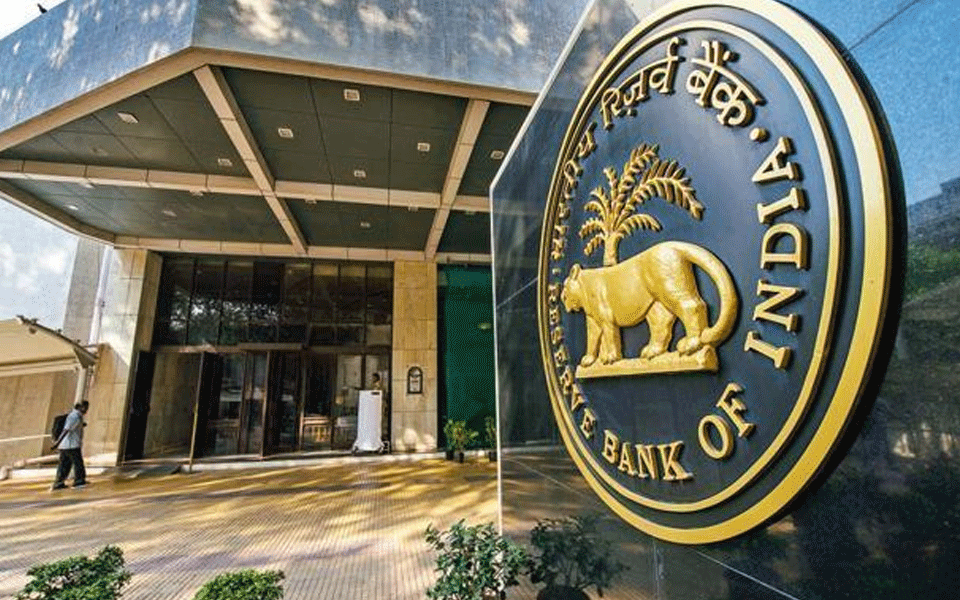
Mumbai: In a bid to accelerate clearance of cheques, the Reserve Bank of India (RBI) on Thursday said it has decided to implement a cheque truncation system (CTS) across the country by September this year.
RBI introduced this system in 2010. At present, it is operational in some major cities.
"The CTS, which is currently operational at the major clearing houses of the country, has stabilised well and it has made large efficiency gains. In view of this, a pan-India CTS will be made operational by September 2020," according to the Statement on Developmental and Regulatory Policies released by RBI.
Observing that digital payments in India have been growing rapidly, RBI said a digital payments index (DPI) will be launched soon.
The Reserve Bank shall construct and periodically publish a composite DPI to capture the extent of digitisation of payments effectively, it said.
"The DPI would be based on multiple parameters and shall reflect accurately the penetration and deepening of various digital payment modes. The DPI will be made available from July 2020 onwards," it said.
With substantial growth in digital payments and maturity gained by entities in the payment ecosystem, it is desirable to have a self-regulatory organisation (SRO) for orderly operations of the entities in the payment system, it said.
The Reserve Bank will put in place a framework for establishing an SRO for the digital payment system by April 2020 with a view to fostering best practices on security, customer protection and pricing, among others, it said.
The SRO will serve as a two-way communication channel between the players and the regulator/supervisor, it added.
To give a fillip to digital banking and enabling regional rural banks (RRBs) to provide cost effective and user-friendly solutions to their customers, it has been decided to allow RRBs, like other commercial banks, to act as merchant acquiring banks, using Aadhaar Pay BHIM app and POS terminals.
Detailed instructions in this regard will be issued later in the day.
In continuation of efforts to facilitate interoperability of government securities depositories, as announced in the Union Budget 2019-20, the RBI will modify its government securities registry (the PDO-NDS system) to include constituent details in the Constituent Subsidiary General Ledger (CSGL) accounts.
This is expected to fuel interest of retail investors to invest in government securities, it said, adding, the upgrade is expected to be made operational by end of July 2020.
Let the Truth be known. If you read VB and like VB, please be a VB Supporter and Help us deliver the Truth to one and all.
TCS orders probe, engages external experts in Nashik Case

Mumbai: Tata Consultancy Services on Friday said it has initiated a formal internal investigation into allegations linked to its Nashik unit and engaged independent external experts to ensure transparency in the process.
Chief Executive Officer and Managing Director K Krithivasan was quoted by The Observer Post as saying that the company has appointed Deloitte and Trilegal as independent counsel to support the probe. The internal investigation is being led by Aarthi Subramanian.
The company has constituted a supervisory committee chaired by independent director Keki Mistry, which will oversee the process. The committee will also review findings and monitor the implementation of recommendations.
Krithivasan said a preliminary review of the company’s internal systems and records had not revealed any complaints of the nature being alleged through its ethics or POSH channels.
He also clarified that an employee named in media reports, Nida Khan, was not part of the human resources function and did not hold any leadership role. He informed that she worked as a process associate.
The company has also rejected reports suggesting that operations at the Nashik facility had been suspended. It asserted that the unit continues to function without disruption with a zero-tolerance policy towards misconduct.