Parents, teachers scramble for ways to teach as e-learning remains a dream in rural India
New Delhi: In a newly acquired daily ritual, students in Haryana's Jhamri village open their textbooks at the sight of the cart that arrives near their homes, filling the vacuum left by the closure of schools due to the lockdown and lack of digital infrastructure such as feeble internet connectivity.
To maintain social distancing, the students take notes from their homes as a teacher imparts lessons using the loudspeaker attached to the cart. The innovative way to ensure that students catch up with the syllabus they have missed since classes were suspended has been initiated by Satyanarayan Sharma, who runs a school in the village in the state's Jhajjar district.
"The bigger issue is not the effect on students' learning levels but that they should not drop out, Sharma told PTI. I have arranged for a loudspeaker system on a cart. The teachers are asked to turn-wise go with the cart and park it at a feasible location and impart lessons from there. It cannot match up to classroom learning but will ensure some learning," he said.
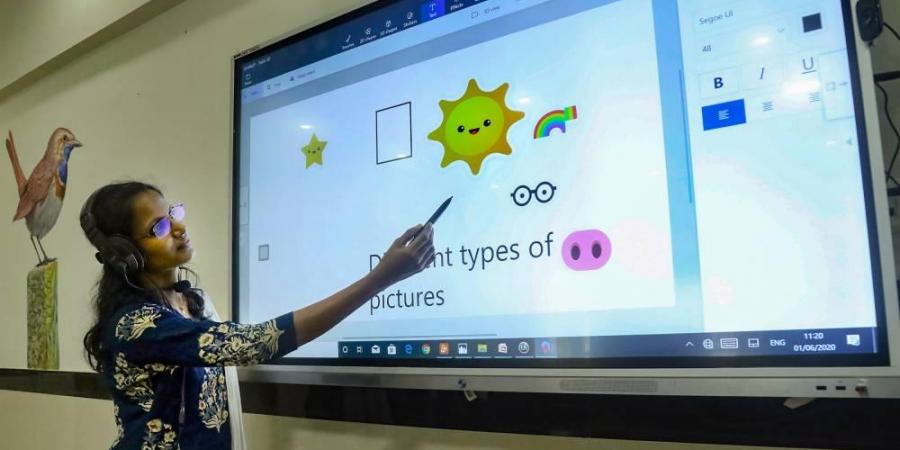
This strange new way of educating school students is not uncommon in the country's rural parts. The lockdown induced by COVID-19 in March prompted schools and colleges to move to the virtual world for teaching and learning activities. But weak internet penetration has turned e-education into a distant dream for many children in rural areas. As per official statistics, there are over 35 crore students in the country. But it is not clear how many of them have access to digital devices and the internet.
Ghanshyambhai, a teacher in Janan village, Gujarat, has started using the public announcement system of the village panchayat to share stories, songs, guidelines for parents on how to deal with children during the lockdown period, the importance of exercising and much more. "During this challenging time, we can't expect students to just grab their parents' smartphones and start attending classes, he told PTI.
He said while it is not possible to explain complex subjects like mathematical problems through loudspeakers, the method is at least ensuring that learning is not totally disrupted. "I also announce when I'll be at Panchayat Bhawan so students or parents who want to clear any doubts or to interact can see me there, while maintaining social distancing," he added.
In Maharashtra's Bhadole village, teachers have identified students who have access to smartphones and have formed groups clubbing them with students without any access.
"It works if one among ten students has access to a phone and lives near the other students' homes," said Shano Devi, one of the teachers in the group. The teachers send lessons on the phones of the parents who have phones. The other students note down the lessons from the phones of their friends' parents, complete assignments at their homes and send them back using the same device.
The teachers have directed students to not gather at once at the homes of those with phones but in slots to ensure social distancing, Devi said. "We teachers have also pooled in money to get data recharges for parents who are enabling the group to study so they are not discouraged because of the expense," said Devi. Experts say the digital divide in the country may turn online classes into an operational nightmare.
Anindit Roy Choudhary, director of programmes and policy impact, Save the Children (India), said India has a clear digital divide and rural areas are far beyond the digital outreach. "Education and learning are very clearly related to the environment the child is in. When a child is in school, a learning environment is created. That environment permits the child to learn," he said.
Noting that many households either may not have a smartphone or children don't have access to digital devices.
"The phone is owned by the man of the house. A father or older brother may not handover the phone to the child to learn. The problem with digitisation that we are taking for granted is that a certain group of children will be missed out," he said.
Choudhary said there is a need to build a campaign to bring back children in a learning environment. "Even if schools are not operational, the Anganwadi centres can be functional in a multi-time way. Coronavirus is here to stay. We need to create opportunities for these children to come into a learning environment where they can maintain physical distance from each other, wear masks, have sanitised hands and sit in the learning environment to learn," he said.
In many other parts of the country, teachers and parents are still scrambling to look for ways for the students to continue their studies.
Imran Khan, a farmer, has started spending his evenings teaching his 12-year-old son. With low internet accessibility in his Khair village in UP, he has to go near the panchayat office where internet connectivity is better. Khan, who has studied till class 10 and had to drop out of school to help his father at the farm, said he downloads pdfs of various subjects and learns from them during the day to teach his son in the evenings.
"I want my son to become an engineer. With this pandemic I can't let his studies get affected," he said. While Khan's ordeal is not uncommon, the real question is how many parents in rural parts have the capacity to turn into teachers for their children.
Let the Truth be known. If you read VB and like VB, please be a VB Supporter and Help us deliver the Truth to one and all.
Putin meets Iran's FM Araghchi, says Russia ready to do its best to help bring peace to West Asia
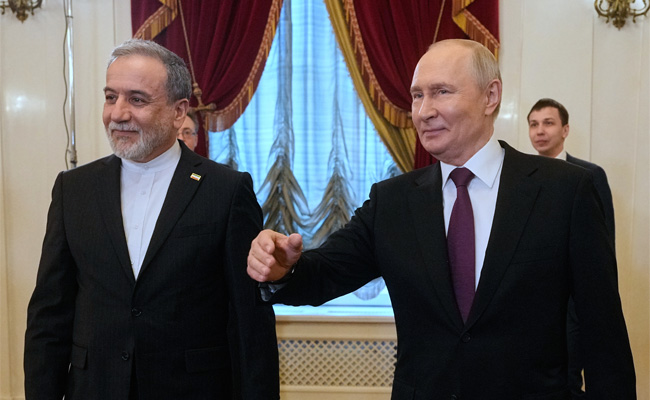
Moscow (PTI): Iran's Foreign Minister Abbas Araghchi on Monday met Russian President Vladimir Putin, who hailed the Iranian people for fighting bravely and heroically for their sovereignty and said Moscow is ready to do its best to help bring peace to West Asia as soon as possible.
Araghchi, who held talks with Omani and Pakistani leadership before arriving in Russia, met Putin in St. Petersburg and thanked him for supporting Iran, state-owned TASS news agency reported.
"Russia is ready to do everything in its power to ensure that peace in the Middle East is achieved as soon as possible," Putin said during his meeting with Araghchi, which was also attended by Russian Foreign Minister Sergey Lavrov.
Revealing that he received a message from Iranian Supreme Leader Mojtaba Khamenei last week, Putin asked Araghchi to convey his "gratitude for this message and best wishes for his health and well-being."
He praised the Iranian people for fighting "bravely and heroically" for their sovereignty, Iran's state-run PRESS TV reported.
"We really hope that, based on the courage and desire for independence, the Iranian people, under the guidance of the new leader, will weather this difficult period of trials and peace will come,” Putin said.
He also stressed that Russia “intends to maintain” its strategic relations with Iran.
Araghchi said that the world witnessed Iran’s strength in countering the US during the recent war, and that the Islamic Republic is a "stable and powerful establishment."
"With their courage, the Iranian people succeeded in resisting the US aggression and will be able to endure it,” he said.
He said that it became clear that Iran has “great friends and allies” like Russia, and conveyed “warmest greetings” from Supreme Leader Mojtaba Khamenei and President Masoud Pezeshkian to the Russian leader.
Araghchi said relations between Moscow and Tehran represent a “strategic partnership at the highest level” and will continue to develop "regardless of circumstances."
"We are grateful to you for the solid and strong positions in support of the Islamic Republic of Iran," he said.
Foreign Minister Lavrov said that the talks between President Putin and the Iranian Foreign Minister were "useful and constructive."
Kremlin Spokesman Dmitry Peskov later said that Russia is "ready to provide any good offices, any mediation services that are acceptable to the parties."
"We will be ready to do everything so that ultimately peace ensues, guaranteed peace, and that there is no return to hostilities," Peskov was quoted as saying by TASS.
He was asked how Moscow can assist in future negotiations on the Iranian settlement.
Araghchi arrived in Russia after his whirlwind trip to Islamabad, which, according to him, was “very productive” and involved “good consultations" with Pakistan's Army Chief Field Marshal Asim Munir, amid uncertainty over the second round of peace talks to resolve the war in West Asia.
"We held good consultations with our friends in Pakistan. The trip was successful. We assessed the outcome of our recent (meetings) and discussed in what direction and under what conditions talks can move on,” Araghchi said in a video posted on his Telegram channel upon his arrival in St Petersburg.
Referring to the second round of talks between the US and Iran to resolve the conflict in West Asia, Araghchi said: "Developments have taken place in the negotiations."
"Despite some progress in earlier rounds, the talks failed to reach their objectives due to the Americans' approach, the excessive demands they made, and the wrong approaches they adopted. Therefore, it was necessary to consult with our friends in Pakistan to review the latest situation,” Iran's official news agency IRNA quoted him as saying.
He said that the trip to Pakistan was a good opportunity to review developments related to the US-Israeli war against Iran, expressing confidence that “these consultations and coordination between the two countries will be highly significant.”
Araghchi arrived at St. Petersburg's Pulkovo Airport early Monday, where he was welcomed by Russian officials and Iran’s ambassador to Russia, Kazem Jalali, the report said.
The first round of peace talks between Iran and the US, held on April 11 and 12, failed to bring the desired result for the parties to the conflict.
The Iranian minister arrived in Islamabad for the second time on Sunday after a short visit to Oman, where he held talks with Sultan Haitham bin Tariq al-Said on security in the Strait of Hormuz and diplomatic efforts to end the Iran-US conflict.
After Araghchi left Pakistan for Oman on Saturday, President Donald Trump announced that US negotiators Steve Witkoff and Jared Kushner would no longer be going to Islamabad for talks with Iran, contending that Washington held all the cards on the matter.
Trump on Sunday reiterated that the US and Iranian officials can talk by phone for a peace solution to the conflict.
On Tuesday, Trump extended the two-week ceasefire with Iran indefinitely to give Tehran more time to prepare a unified proposal to end the war, just hours before the truce was set to expire.
The war began when the US and Israel jointly attacked Iran on February 28, killing Iranian Supreme Leader Ayatollah Ali Khamenei and several top commanders. The retaliation by the Islamic Republic extended the war to the entire Gulf region.