Partial lunar eclipse to take place on Saturday night
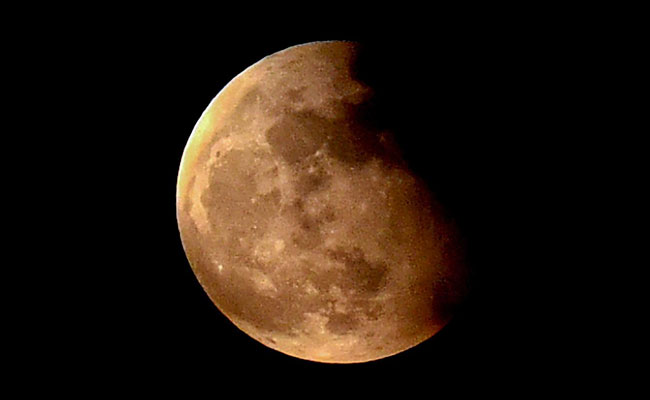
Kolkata (PTI): West Bengal along with other parts of India, the whole of Asia, Europe, Africa, and Russia will witness a partial lunar eclipse on Saturday night.
The celestial phenomenon will continue till the early hours of October 29, astrophysicist Debi Prasad Duari said.
People in West Bengal will celebrate Laksmi puja on Saturday night.
"There is going to be a partial lunar eclipse on the night of October 28 which can be experienced by people in India along with the entire Asia, Europe, Africa, and Russia. The eclipse will occur during late night of October 28 and will continue till the early hours of October 29," Duari told PTI.
He said that on October 28, the moon will be partially eclipsed by the shadow of the earth for some time and will give people in India a chance to experience a partial lunar eclipse.
A lunar eclipse is marked by two stages of the moon coming under the shadow of the earth. When it enters a partially shadowed region of the earth it is known as the penumbral eclipse, when the moon remains partly lighted.
"The change in brightness is not very much noticeable. After this phase moon will partially enter the actual dark part of the earth's shadow which is termed an umbral lunar eclipse and is considered the actual eclipse by most people," he added.
On October 28 night though the penumbral eclipse will start at around 11:31 pm Indian Standard Time (IST), but the partial Umbral eclipse, which is more noticeable, will start in the early hours of October 29, at around 1:05 am IST, he said.
"It will become maximum at around 1:44 am and will end by 2:23 am. The magnitude of the partial lunar eclipse will be around 0.12 marked by the maximum obscuration of the lunar disc," the astrophysicist said.
On October 14 there was an annular solar eclipse which was experienced by the people of mostly North and South America when the ring of fire was observed across a large part of the western hemisphere.
"It occurred when it was night over India and Asia and could not be experienced by people in this region. The day was a New Moon day and marked the beginning of Navratri, celebrated in major parts of India as the beginning of the Durga Puja Festival. In West Bengal and around it was the day of Mahalaya when people offered their prayers to their ancestors ushering in the most celebrated Durga Puja Festival," Duari added.
Let the Truth be known. If you read VB and like VB, please be a VB Supporter and Help us deliver the Truth to one and all.
ICSE, ISC results: Girls outperform boys, pass rate over 99%
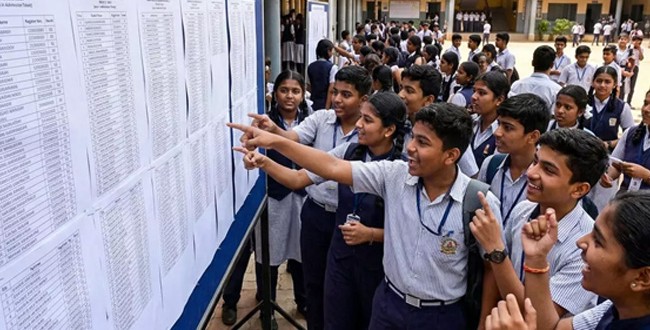
New Delhi (PTI): The Council for the Indian School Certificate Examinations on Thursday announced the Class 10 and Class 12 results for 2026, with overall pass percentages of 99.18 per cent and 99.13 per cent, respectively.
A total of 2,58,721 candidates appeared for the Indian Certificate of Secondary Education (ICSE), or Class 10, examination.
About 1,03,316 students took the Indian School Certificate (ISC), or Class 12, exam.
Girls outperformed boys in both examinations.
In ICSE, girls recorded a pass percentage of 99.46 per cent compared to 98.93 per cent for boys.
In ISC, girls achieved a 99.48 per cent pass percentage, while those of boys stood at 98.81 per cent.
Students can now access their scorecards on the official website cisce.org.