Partial solar eclipse on October 25 will be visible from most parts of India
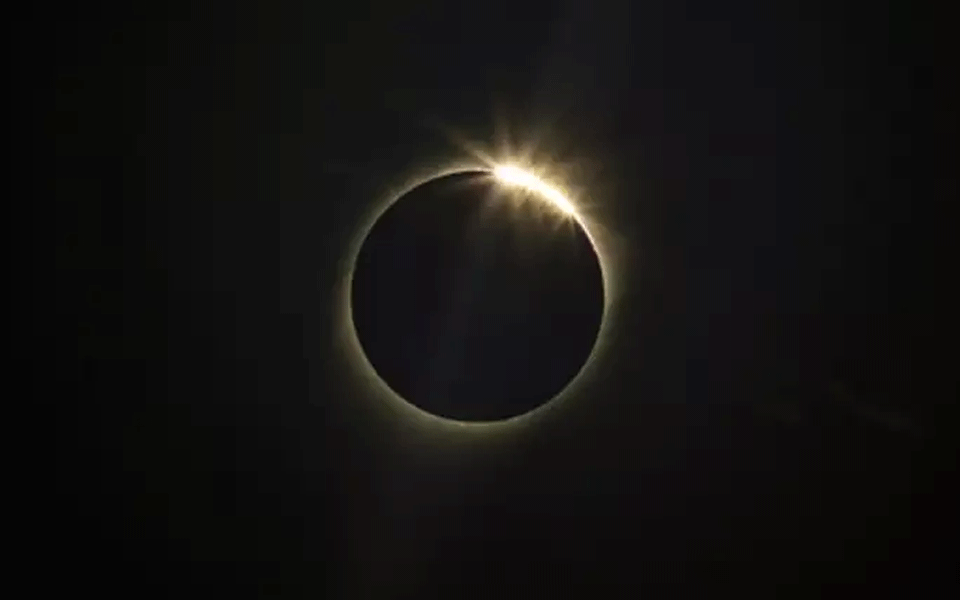
Kolkata (PTI): During the Diwali festival on October 25, there will be a partial solar eclipse which will be visible from the city as well as from most parts of the country, astrophysicist Debi Prasad Duari said.
The eastern metropolis, however, will be able to witness the partial solar eclipse, the second in 2022, for a very small duration, the celestial phenomenon will be better observed in the northern and western regions of the country, he said.
The eclipse will not be observed from north eastern India as the celestial phenomenon will be occurring after the sunset in those regions, Duari said.
Apart from India, the October 25-partial cosmic affair will be visible from most parts of Europe, northern Africa, the Middle East, and parts of Asia, Duari elaborated.
"The partial solar eclipse will begin in Iceland at around 14:29 hours IST and will be seen at its maximum from Russia at 16:30 hours (IST). It will end at around 18:32 hours (IST) over the Arabian Sea," he told PTI while sharing information on the celestial event.
"The eastern part of the country will see the partial eclipse only marginally, that also during the sunset. The northern and western part of the country is a better location to observe the partial eclipse with a better view and for a longer period of time.
"During the new moon (Amavasya) the Sun, Moon, and Earth almost come in a linear configuration, whereby from earth we can see the moon without any sunlight falling on it. But at times, as on October 25, the Sun, Moon, and Earth will almost be on the same plane resulting in the moon appearing to cover the Sun partially for a period of time causing a partial Solar Eclipse," he explained.
In and around the metropolis, the partial eclipse will begin at around 16:52 hours, the maximum occurring at 17:01 hours, and will cease to be seen at 17:03 hours at the sunset, Duari said.
"Even at the maximum eclipse, only 4 percent of the lighted disc of the setting Sun will be covered by the Moon," he said.
In the north Bengal town of Siliguri, the celestial phenomenon will be occurring between 16:41 and 16:59 hours and during the maximum eclipse (at around 16:56 hours) about 8.91 percent of the Sun will be covered by the Moon's disc, Duari stated.
"In New Delhi, it will commence at around 16:29 hours and end with the sunset at 18:09 hours with the maximum eclipse to occur at 17:42 hours when the Sun will be obscured by the Moon by an amount of only 24.5 percent," Duari said.
Jaisalmer in Rajasthan will experience the eclipse from 16:26 hours to 18:09 hours with the maximum at around 17:30 hours. when the disc of the Sun will be obscured by 42.5 percent.
"In Mumbai, the eclipse will begin at 16:49 hours with the maximum occurring at around 17:42 hours. It will end at 18:09 hours, when the Sun appears to go down the Arabian Sea at sunset. Here, the Sun's disc will be covered by about 24.5 percent," he added.
In southern and central India, the eclipse will be again observed just before the sunset with Nagpur experiencing the eclipse during 16:49 to 17:42 hours. In Bengaluru, the eclipse will begin at 17:12 hours, reaching its maximum at 17:49 hours and ending at 17:55 hours during the sunset. Chennai will have the eclipse during 17:14 to 17:44 hours, the astrophysicist said.
The next major solar eclipse to be visible from India will be an annular eclipse on May 21, 2031 when the annularity can be observed from a narrow patch of land in south India, he said.
Three years later, on March 20, 2034, the next total solar eclipse will be visible from India and the totality will be observed from the northernmost part of Kashmir.
On both occasions, the whole country will observe a partial eclipse of varying magnitude depending upon its geographical location, Duari said.
Another partial eclipse can be seen from the northern part of India on June, 1, 2030.
Referring to the harm caused to the eyes by Sun's rays during an eclipse, Duari cautioned the sky enthusiasts to take "extreme precaution" while observing it.
"Even if the degree of the partial eclipse is not appreciable in most of the country, extreme precaution has to be taken by everybody who wants to observe this cosmic event. The Sun's rays can be very harmful to the eye and can become critical," he said.
Let the Truth be known. If you read VB and like VB, please be a VB Supporter and Help us deliver the Truth to one and all.
KSCA expresses disappointment over missing IPL playoffs, says it was ready to host matches in B’luru
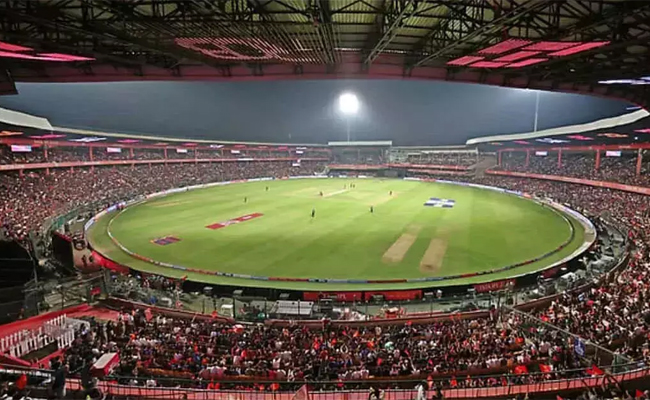
Bengaluru: The Karnataka State Cricket Association (KSCA) has issued a clarification stating that it was fully prepared to host the IPL playoffs and final matches in Bengaluru but the fixtures were allotted to other venues.
In a media note, KSCA said it was disappointed with the decision. The association stated that its president, former India cricketer Venkatesh Prasad, had been in touch with the Board of Control for Cricket in India (BCCI) and had formally conveyed the association’s readiness and interest in hosting the matches at the M. Chinnaswamy Stadium.
KSCA said the IPL matches held in Bengaluru this season were appreciated for smooth conduct, crowd management and overall experience for spectators. It said this reflected its ability to handle high-profile matches.
The association also stated that it had sent a detailed communication to the BCCI explaining its preparedness and the operational arrangements followed during the current IPL season. According to KSCA, these systems have been in place since the start of the Indian Premier League in 2008 and were followed consistently, including during previous playoff matches hosted in Bengaluru.
The clarification added that the communication sent to the BCCI was only meant to provide factual and operational details and to bring clarity on logistical and stakeholder-related requirements involved in hosting such matches.
KSCA said that although it had shown willingness and preparedness, the BCCI has decided to allocate the playoff matches to other venues. It added that the reasons for this decision have not been formally shared with the association, but it respects the authority of the board in taking such decisions.
The association further said it remains ready to host matches of national and international importance and will continue to cooperate with the BCCI, franchises, government authorities and other stakeholders for conducting cricket events.
The statement was issued by KSCA official spokesperson Vinay Mruthyunjaya, who also thanked the media and cricket fans for their continued support.