Passengers flying to Goa must carry COVID negative certificate

Panaji: Passengers arriving at the Goa Airport must carry a certificate from an ICMR-recognised laboratory showing that they have tested negative for coronavirus, the authorities said on Wednesday.
The Airports Authority of India, which manages the Goa airport, also said in an advisory that the passengers who do not have a COVID-19 negative certificate will have to undergo 14 days' home or paid quarantine on arrival in the state.
Besides, all symptomatic passengers will have to undergo coronavirus test and stay in institutional quarantine till the test results are available.
The COVID-19 negative certificate must be issued by a lab recognised by the Indian Council of Medical Research which is not older than 48 hours prior to the arrival in Goa, the advisory said.
The passenger can also opt for a swab test upon arrival at a cost of Rs 2,000 and remain quarantined at a centre or at home till the results are available.
If passengers are tourists, they must have a pre- booking at hotels registered with the state Department of Tourism.
"Any tourist exhibiting sickness or COVID-19 related symptoms upon arrival will be subjected to a test at designated testing centres/hospitals at the tourist's cost," the advisory said.
Let the Truth be known. If you read VB and like VB, please be a VB Supporter and Help us deliver the Truth to one and all.
Karnataka School Edu Dept prohibits children from being made to dance to obscene songs
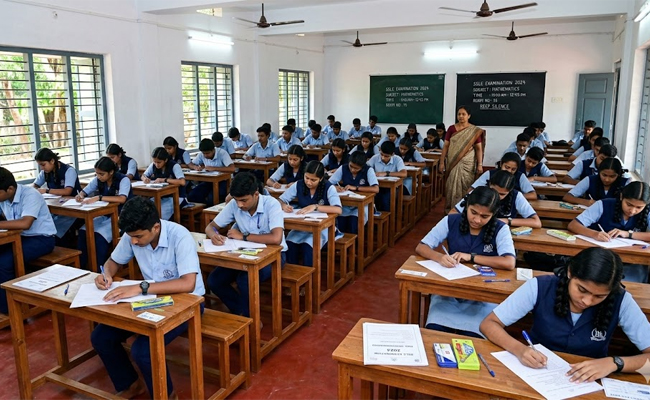
Bengaluru (PTI): The Karnataka School Education Department has issued a circular strictly prohibiting children from being made to dance to obscene songs in educational and cultural programmes.
It stated that such dances would negatively impact students' mental health and moral values. It will create indiscipline and harm the sanctity of education.
"All the Deputy Directors (Administration) of the state's School Education Department have been asked to take strict measures to prevent children or students from dancing to obscene songs in all government, aided and unaided schools in the state," the office of the commissioner of the School Education Department said in a recent circular.
"If it is found that children are being made to dance to obscene songs, appropriate action will be taken against the headmaster or management of such school," it added.
The department also listed certain measures in this regard, which include: strictly prohibiting children from being made to dance to obscene songs during educational and cultural programmes; selecting songs that are inspiring, positive, instilling national pride in children and reflecting the greatness, dignity, values, culture, and morality of the state.
Stating that the school headmaster and management are responsible for selecting songs and dances for cultural programmes, it said, they should also ensure that students wear decent clothes in dance or cultural programmes.