Sharad Pawar asks why upcoming state polls not being held together, says no truth in what PM utters

Nagpur, Aug 17: NCP (SP) chief Sharad Pawar on Saturday wondered why the upcoming state elections are not being held simultaneously despite Prime Minister Narendra Modi pushing for ‘one nation one election’.
Speaking to journalists in Nagpur on the sidelines of an event, the 82-year-old politician said there is no “truth in what PM Modi says”.
Modi in his Independence Day speech had pitched for ‘one nation one election’, he said.
The Election Commission on Friday announced three-phase polls in J&K and a single-round voting in Haryana in September-October. It said assembly elections in Maharashtra, which were held along with Haryana in 2019, will be announced later due to security requirements for J&K.
“Election dates in two states (J&K and Haryana) have been announced but polls in Jharkhand and Maharashtra have not been declared. Hence, there is no truth in what he (PM Modi) says,” said the NCP (SP) chief.
The opposition Maha Vikas Aghadi (MVA) allies Shiv Sena (UBT) and the NCP (SP) had earlier criticised the Election Commission over the poll schedule and said it seemed the BJP-led Mahayuti wanted more time to "fool" the people of Maharashtra with its fake promises.
To a query about tensions in Nashik and Chhatrapati Sambhajinagar over alleged objectionable remarks by Hindu religious leader Ramgiri Maharaj against Prophet Mohammad and Islam, Pawar said it is not in the interest of society.
The religious leader has said that he made the statement in reaction to the atrocities against Hindus in Bangladesh.
“There is a need for peace today, and society and politicians should be patient and cautious about it,” Pawar said. The responsibility of the government and the home department should be fixed, he said.
About the regime change in Bangladesh, Pawar said that there have been some reactions to it in a few places in India. “However, we never felt that reactions would come from Maharashtra on what happened in Bangladesh,” he added.
Let the Truth be known. If you read VB and like VB, please be a VB Supporter and Help us deliver the Truth to one and all.
Vartha Bharati–Sankalp predictions align closely with Karnataka bypoll results
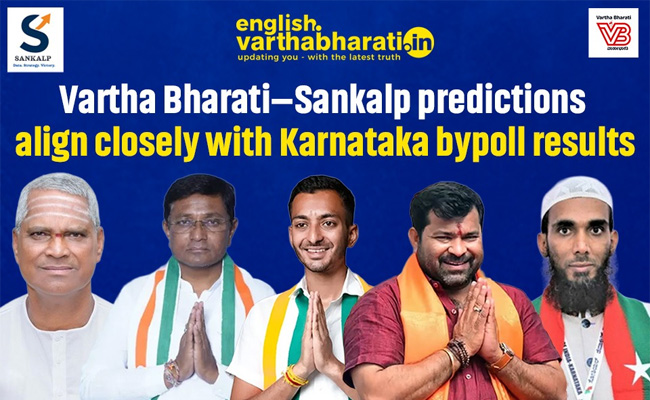
Bengaluru: The Vartha Bharati–Sankalp election analysis has shown a high level of accuracy in predicting the outcome of the recent Karnataka Assembly by-elections held in May 2026, correctly calling winners in both constituencies and closely estimating vote share trends.
The by-elections were held in Bagalkot and Davanagere South, drawing significant political attention as both seats were seen as key tests for the ruling Congress and opposition BJP.
According to the analysis, Vartha Bharati–Sankalp had made three major projections ahead of the results the winning party, vote share percentages, and margin of victory.
In both constituencies, the platform accurately predicted that the Congress would emerge victorious. The outcome matched the projections, with Congress candidates winning in Bagalkot and Davanagere South.
In terms of vote share, the predictions were largely in line with the final results. In Bagalkot, the BJP’s vote share was forecast in the range of 40 to 46 per cent, while the actual figure stood at 42.9 per cent. The Congress vote share, however, exceeded expectations, with the party securing 55.4 per cent against a projected range of 43 to 48 per cent.
The margin of victory in Bagalkot turned out to be significantly higher than anticipated. While the projection had placed the margin between 2,000 and 3,500 votes, the final margin was around 22,332 votes.
In Davanagere South, the predictions also remained largely accurate. The Congress vote share was projected between 43 and 51 per cent, and the final figure stood at 43.9 per cent. The BJP was expected to secure between 42 and 50 per cent but ended with 40.3 per cent.
The analysis had also identified the role of SDPI as a potential spoiler in the constituency. While its vote share was estimated around 6 per cent, the party eventually secured around 12 per cent of the vote.
The margin of victory in Davanagere South was predicted to be between 1,500 and 2,600 votes. The actual margin was higher at around 5,708 votes, though the contest remained relatively close as anticipated.
Overall, the performance of Vartha Bharati–Sankalp stood out for correctly identifying the winning parties in both seats and maintaining close accuracy in vote share estimates, with only limited deviations in specific cases.