People across country revel in Diwali; Delhi defies firecracker ban
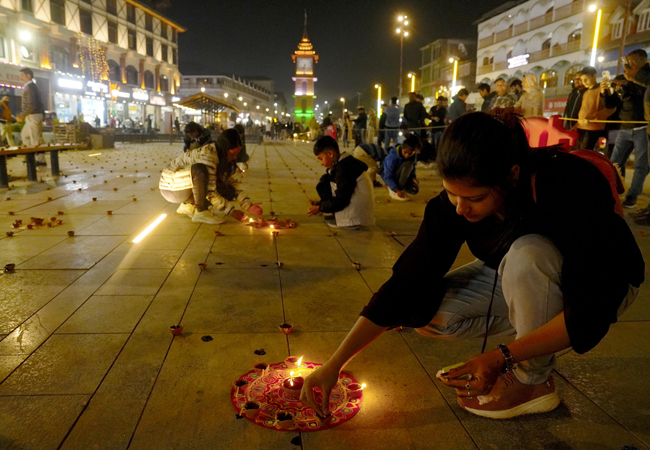
New Delhi (PTI): Colourful lights decked up buildings and diyas (earthen lamps) dotted houses as people across the country celebrated Diwali with great enthusiasm on Thursday.
In the national capital, Delhiites defied the firecracker ban as the city's air quality remained in the 'very poor' category with an AQI of 327 at 9 pm.
Keeping up his tradition of celebrating the festival with soldiers, Prime Minister Narendra Modi visited Sir Creek near the Indo-Pak border in Gujarat's Kutch district and offered sweets to jawans.
Modi said India cannot compromise on even an "inch" of land on its borders, adding the people believe in the strength of its armed forces for defending the country.
"In the past, attempts were made to turn this region into a battlefield. The enemy has set its eyes on this region for a long time. But we are not worried as you are guarding the nation. Our enemy also knows it well," he asserted.
"People of India feel their country is safe because of you; when the world sees you, it sees India's strength, when enemies see you, they see the end of their sinister plans," the prime minister said, addressing personnel of the Border Security Force, Army, Navy and Air Force.
Modi also called on President Droupadi Murmu and Vice President Jagdeep Dhankhar separately and greeted them on Diwali.
One of the most popular Hindu festivals, Diwali is associated with the day Lord Ram is believed to have returned to Ayodhya with his wife Sita and brother Lakshman after defeating demon king Ravana during his 14 years in exile. The festival is seen as a celebration of the victory of good over evil.
Dressed in traditional attire, people greeted each other, exchanged sweets and gifts, and visited temples.
Meanwhile, troops of India and China exchanged sweets at several border points along the Line of Actual Control (LAC), including at locations in eastern Ladakh, on the occasion of Diwali.
The exchange took place at all the five Border Personnel Meeting (BPM) points along the LAC -- Bum La and Wacha/Kibithu in Arunachal Pradesh, Chushul-Moldo and Daulat Beg Oldi in Ladakh and Nathu La in Sikkim -- among several other locations, sources said.
The celebrations across the country were largely incident free. However, in Uttar Pradesh, six people, including four of a family, were killed when a tempo they were travelling in was hit by a tractor in the Mujaria area of Budaun, police said. The victims, who worked as vegetable vendors in Noida, were returning home to celebrate Diwali.
In Andhra Pradesh, a man died after the firecrackers he was carrying on a two-wheeler exploded in Eluru town, police said.
In UP, Chief Minister Yogi Adityanath celebrated Diwali with the forest dwellers of Vantangiya village in Gorakhpur.
He said people dividing society along caste, regional, and linguistic lines have the "DNA of Ravan and Duryodhan", and warned that anyone who attempts to disrupt peace or get involved in crime against women would be dealt with strictly.
During his visit to the area, the chief minister inaugurated 74 development projects valued at Rs 185 crore across various gram panchayats.
In the national capital, the sky lit up as people celebrated Diwali defying a ban on firecrackers.
Areas including Lajpat Nagar, Kalkaji, Chhatarpur, Jaunapur, East of Kailash, Saket, Rohini, Dwarka, Punjabi Bagh, Vikas Puri, Dilshad Garden, Burari and many other neighbourhoods of east and west Delhi saw firecrackers being burst.
With the 24-hour AQI recorded at 328 at 4 pm, the city experienced its worst air quality on Diwali in the last three years.
In West Bengal, Kali Puja and Diwali were celebrated with gaiety and fervour, with decorated pandals creating a festive spirit across the state.
With only green fireworks allowed by the administration as per the earlier orders of a court, police and state pollution control board officials kept vigil to prevent flouting of the rule.
Long queues were seen at the famed Tarapith, Dakshineswar, Kalighat, Thanthania, and other Kali temples across the state.
In Uttarakhand, Chief Minister Pushkar Singh Dhami visited the Lansdowne cantonment to celebrate Diwali with army soldiers, saying he felt "fortunate" to be with them on the auspicious occasion.
Paying tribute to the martyrs by offering a wreath at the war memorial there, Dhami said, "We can light diyas at our homes on Diwali only because our brave soldiers live away from their families to protect the country's borders."
Dhami also distributed sweets and gifts among the soldiers, widows of martyrs and their children.
In Rajasthan, the festival of light was celebrated with great enthusiasm. Markets were vibrant and bustling until late Wednesday night with people flocking to buy new clothes, sweets, firecrackers and other festive items.
CM Bhajanlal Sharma and other leaders extended Diwali greetings on X.
Meanwhile, more than 20 lakh devotees gathered at Chitrakoot on the border of Madhya Pradesh and Uttar Pradesh on the occasion of Diwali, an official said.
According to mythology, Lord Ram spent the better part of his 14-year exile at Chitrakoot, located on the banks of the Mandakini river.
Devotees took a dip in the river and performed `deep-daan' ceremony.
In Odisha, Chief Minister Mohan Charan Majhi wished people on the occasion of Diwali and emphasised his government's commitment to take the state to new heights.
"My heartiest congratulations to all the brothers and sisters of Odisha on the occasion of Diwali, the festival of light and joy," Majhi said in a video message on his X handle.
In the coastal state of Goa, the celebrations took off after the burning of Narakasur demon effigies in the early hours.
As per traditions, the effigies were taken around before they were burnt to mark the victory of good over evil.
Let the Truth be known. If you read VB and like VB, please be a VB Supporter and Help us deliver the Truth to one and all.
Sujit Nair raises concerns over speculation of DMK-AIADMK understanding to block TVK
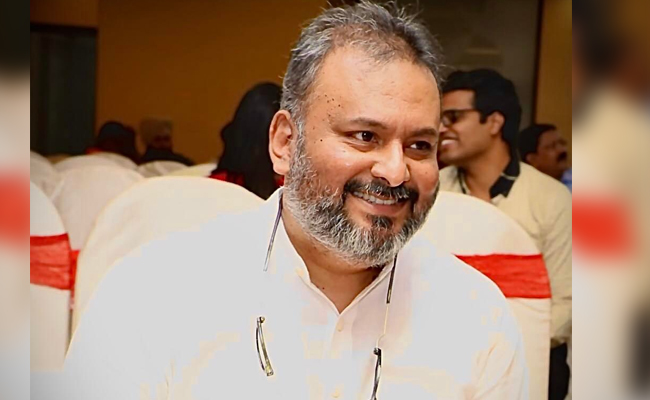
Chennai: Journalist and political commentator Sujit Nair has expressed concern over speculation that the Dravida Munnetra Kazhagam and the All India Anna Dravida Munnetra Kazhagam could explore a post-poll understanding to prevent Vijay-led Tamilaga Vettri Kazhagam from forming the government in Tamil Nadu.
In a social media post, Sujit Nair said the election verdict in Tamil Nadu reflected a clear public demand for political change and argued that the mandate should be respected irrespective of political preferences.
Referring to reports and political discussions surrounding a possible understanding between the DMK and AIADMK, he said he hoped such developments remained only speculative conversations and did not turn into reality.
Nair stated that if such an alliance were to take shape, it would raise serious questions about ideological politics in the country. He said TVK had emerged through a democratic electoral process and that the legitimacy to govern in a parliamentary democracy comes from the people’s verdict.
According to him, attempts to prevent an electoral winner from forming the government through unexpected political arrangements may be constitutionally valid, but many people could view them as politically opportunistic.
He further said that such a move could particularly affect the political image of the DMK, which has historically projected itself around ideology, social justice and opposition politics. Nair said that in ideological terms, the DMK appeared closer to TVK than to the AIADMK, and joining hands with its long-time political rival only to remain in power could weaken its broader political narrative.
He added that the same questions would apply to the AIADMK as well, as the party had spent decades positioning itself against the DMK and such an arrangement could create discomfort among its cadre and supporters.
Drawing a comparison with Maharashtra politics in 2019, Nair said he had expressed similar views when the Shiv Sena formed an alliance with the Indian National Congress and the Nationalist Congress Party after the Assembly elections.
He said post-poll alliances between long-standing political rivals often create a public perception that ideology and electoral mandates become secondary when political power equations come into play.
Nair also said such developments increase public cynicism towards politics and reinforce the belief among voters that ideology is often sidelined after elections.
He maintained that the Tamil Nadu verdict was emphatic and said respecting both the spirit and substance of the mandate was important for the credibility of democratic politics.