People living by river drains more prone to cancer: ICMR cites study
New Delhi, Mar 11 (PTI): A study conducted in 2024 revealed that people dwelling near river drains were highly prone to cancer, with several hazard quotients observed to be above the threshold limit, the ICMR informed Rajya Sabha on Tuesday.
The study revealed that lead, iron, and aluminium exceeded the limit prescribed by the Central Pollution Control Board, Minister of State for Health Prataprao Jadhav said in a written reply.
He said that under an initiative, 19 State Cancer Institutes (SCIs) and 20 Tertiary Care Cancer Centres (TCCCs) have been approved to provide advanced diagnostic and treatment facilities.
The National Cancer Institute in Jhajjar, Haryana, and the second campus of the Chittaranjan National Cancer Institute in Kolkata have been established to further enhance cancer care services, Jadhav said.
In addition, cancer treatment facilities have been approved for all 22 new All India Institutes of Medical Sciences (AIIMS).
Cancer treatment is also covered under the Ayushman Bharat-Pradhan Mantri Jan Arogya Yojana (AB-PMJAY), which provides up to Rs 5 lakh per family annually for secondary and tertiary care, the minister said in response to a question.
The scheme benefits approximately 55 crore people (12.37 crore families) from the bottom 40 per cent of the population, he claimed.
Recently, the PMJAY extended health coverage to everyone aged 70 and above, regardless of income.
The scheme includes over 200 packages, encompassing more than 500 procedures related to medical oncology, surgical oncology, radiation oncology, and palliative medicine within the National Health Benefit Package.
In addition, the Centre has launched the Pradhan Mantri Bhartiya Janaushadhi Pariyojana (PMBJP)to establish dedicated outlets known as Pradhan Mantri Bhartiya Janaushadhi Kendras (PMBJKs), he said.
As of February 28, 2025, a total of 15,057 PMBJKs were opened across the country, providing generic medicines at affordable prices. The scheme lists 2,047 types of medicines and 300 surgical devices, with 87 products specifically available for cancer treatment, Jadhav said.
The Affordable Medicines and Reliable Implants for Treatment (AMRIT) initiative, launched by the Ministry of Health and Family Welfare, aims to provide affordable medicines for cancer, cardiovascular diseases, and other health conditions, said the MoS.
As of January 31, 2025, there were 222 AMRIT Pharmacies across 29 States and Union Territories, offering over 6,500 drugs, including those for cancer, at discounts of up to 50 per cent off market rates.
To combat major non-communicable Diseases (NCDs), including cancer, the National Programme for Prevention and Control of Non-Communicable Diseases (NP-NCD) is being implemented by the Department of Health and Family Welfare, Jadhav said.
The programme focuses on strengthening infrastructure, human resource development, health promotion, early diagnosis, and management. Under NP-NCD, 770 District NCD Clinics, 372 District Day Care Centres, and 6,410 NCD Clinics at Community Health Centres have been established nationwide.
The preventive aspect of cancer is being reinforced through Comprehensive Primary Health Care via Ayushman Arogya Mandir, he said.
The NP-NCD also provides financial support under the National Health Mission for awareness generation activities related to NCDs, including cancer, as outlined in the States/UTs Programme Implementation Plans (PIPs), Jadhav said.
Let the Truth be known. If you read VB and like VB, please be a VB Supporter and Help us deliver the Truth to one and all.
Sujit Nair raises concerns over speculation of DMK-AIADMK understanding to block TVK
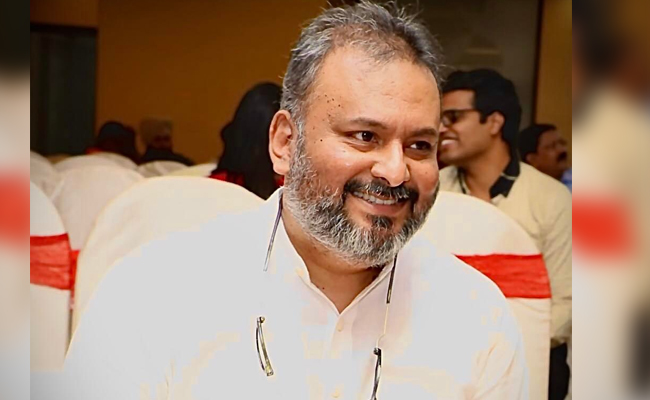
Chennai: Journalist and political commentator Sujit Nair has expressed concern over speculation that the Dravida Munnetra Kazhagam and the All India Anna Dravida Munnetra Kazhagam could explore a post-poll understanding to prevent Vijay-led Tamilaga Vettri Kazhagam from forming the government in Tamil Nadu.
In a social media post, Sujit Nair said the election verdict in Tamil Nadu reflected a clear public demand for political change and argued that the mandate should be respected irrespective of political preferences.
Referring to reports and political discussions surrounding a possible understanding between the DMK and AIADMK, he said he hoped such developments remained only speculative conversations and did not turn into reality.
Nair stated that if such an alliance were to take shape, it would raise serious questions about ideological politics in the country. He said TVK had emerged through a democratic electoral process and that the legitimacy to govern in a parliamentary democracy comes from the people’s verdict.
According to him, attempts to prevent an electoral winner from forming the government through unexpected political arrangements may be constitutionally valid, but many people could view them as politically opportunistic.
He further said that such a move could particularly affect the political image of the DMK, which has historically projected itself around ideology, social justice and opposition politics. Nair said that in ideological terms, the DMK appeared closer to TVK than to the AIADMK, and joining hands with its long-time political rival only to remain in power could weaken its broader political narrative.
He added that the same questions would apply to the AIADMK as well, as the party had spent decades positioning itself against the DMK and such an arrangement could create discomfort among its cadre and supporters.
Drawing a comparison with Maharashtra politics in 2019, Nair said he had expressed similar views when the Shiv Sena formed an alliance with the Indian National Congress and the Nationalist Congress Party after the Assembly elections.
He said post-poll alliances between long-standing political rivals often create a public perception that ideology and electoral mandates become secondary when political power equations come into play.
Nair also said such developments increase public cynicism towards politics and reinforce the belief among voters that ideology is often sidelined after elections.
He maintained that the Tamil Nadu verdict was emphatic and said respecting both the spirit and substance of the mandate was important for the credibility of democratic politics.