RSS attacked because of fear; diversity should be accepted: Bhagwat
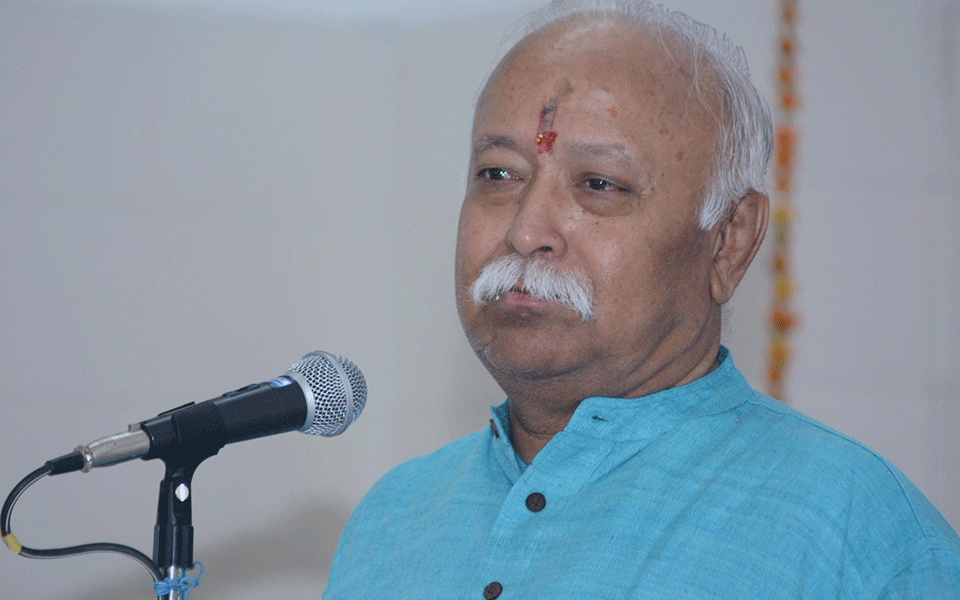
New Delhi, Sep 17 : In a first-of-its-kind outreach from which opposition leaders kept away, RSS chief Mohan Bhagwat on Monday said the organisation has emerged as a "power" in the country and many people target it out of fear but said diversity should be accepted and it should not become a reason for discord.
In a 90-minute speech at the opening of a three-day event "Future of Bharat: An RSS perspective", he traced the history of RSS, expounded on the concept of Hindutva and the participation of women in the outfit that is perceived to be largely male dominated.
"It's (RSS) work gets advertised automatically when its power increases. And when its work gets popular, then people try to learn more about it. And then few people target Sangh out of fear of its increasing power which is quite natural," he said to the gathering at the Vigyan Bhavan, normally reserved for state fucntions.
Those present included several ministers of the Modi government, bollywood personalities like Annu Kapoor, Madhur Bhandarkar, Ravi Kishen and Manisha Koirala and expelled BJD MP Baijayant Panda, Amar Singh, Subramanian Swamy and nominated MP Sonal Mansingh.
"This programme has been organised for people to understand the RSS because today it has emerged as a power in the country which is felt by the world," he said
He said that a lot of debate takes place over RSS. "Debate and discussion should take place but for the debate reality should be known," he said.
"The work of Sangh is unique and beyond comparison," he said. "And thus from known to unknown it is impossible to understand Sangh."
Bhagwat said people perceive Sangh to be a very dictatorial organisaiton and noted that sarsanghchalak is also mistakenly also called chief.
"They think he is chief, he will say and others will follow," he said, adding that people should witness working of Sangh from inside to know how it works.
He said that because RSS had a unique identity, it gets popular amongst people and its workers do not run to advertise its work.
About diversity, the RSS chief said "truth can be realised in several ways and so accept diversity. Do not fear it. Celebrate it. It should not become a reason for discord."
On the frequent criticism about women not being given equal participation in RSS, he said there was different wing for them which works in parallel with the main organisation. If a change has to be made, the suggestion has to come from both sides.
He said words like remote-control are used about the working of Sangh.
"What does a swamaysevak do in his public life, it is for him to decide. He chooses his area of work, we do not tell him which area"to work," he said, adding that RSS also its ---critics.
Against the criticism that RSS controls the BJP-headed governments, Bhagwat said the organisation does not remote-control its affiliates, does not want dominance, does not seek publicity and its effort is to create good swayamsevaks in every village of the country to create a disciplined society that will take the country towards glory.
Apparently dismissing criticism by detractors that the RSS had no role in the independence movement, he said said the first Sarsanghachalak (chief) had worked with freedom fighters, was a member of Indian National Congress and had held Mahatma Gandhi in esteem.
He said RSS workers held the national symbols including the national flag in the highest respect and respects its opponents.
Bhagwat said the purpose of the lecture series was to inform people about RSS which was founded in 1925. He said the RSS builds human character.
"To make good swayamsevaks stand in every village, every street is what Sangh wants. What is meant by a good swayamsevak? It means a person bearing good and reliable character, accepts the entire society as his own and works selflessly and does not look anyone with enmity and gives affection to society. This vision was conceived in 1925. The Sangh is all about this and nothing else," he said.
He said there is need for society to be free of discrimination, corruption, greed and have equality but it will not by wishes alone.
"Our conduct is influenced by people close to us. If in every village of the country, every street there are people whose conduct is such which should be an ideal conduct of every citizen of free India, bearing high moral character, then in that condition the society's behaviour would change. This is Sangh's plan."
He said sanskar was given in Indian families and it made for culture and it is reflected in the deeds.
He said followers of religions that came to India from outside--Islam and Christianity--also practice the same samskar. "This is value-based culture that brings us together."
Referring to Hedgewar, Bhagwat said he used to ask, "what is the main problem of the country".
"He used to say the biggest problem is the Hindu of the country. When we forgot our values, we went down. The country's downfall started with our downfall."
He said the solution to the problem will be called "Hindu thought" by the world outside.
"Due to that culture, there is Hinduness, hence Hindutva binds us together. Hence he said we will organise the entire Hindu society. There are people in that who say I am not Hindu. But if content is to be told, what is the word. There is no other word. Hence he said cleary that Hindustan is Hindu Rashtra and we will organise the Hindu society," Bhagwat said.
"He did not make the announcement because he had to oppose somebody. This was not in reaction to some immediate developments," he added.
He said society without differences is a guarantee of independence and that of national glory, nothing else.
"Ideology, politics, policies have their place but expectation will be met if there are the people with right conduct. In politics, there are allegations, counter allegations. Whatever you may say, something has happened (to develop the country) but why results are not there. "We have to deserve it. We have to be a deserving society."
"A discplined society reaches glory hence it is work of person character building," he said.
He said Hedgewar did all the experiments and had a clear vision.
"He did not do anything except announce that the Sangh to organise the entire Hindu society begins from today", he said, adding that the shakhas, marches to band and drills all came about subsequently following open discussions.
Let the Truth be known. If you read VB and like VB, please be a VB Supporter and Help us deliver the Truth to one and all.
CM Siddaramaiah alleges ‘criminal conspiracy’ in Sringeri recount, vows legal action
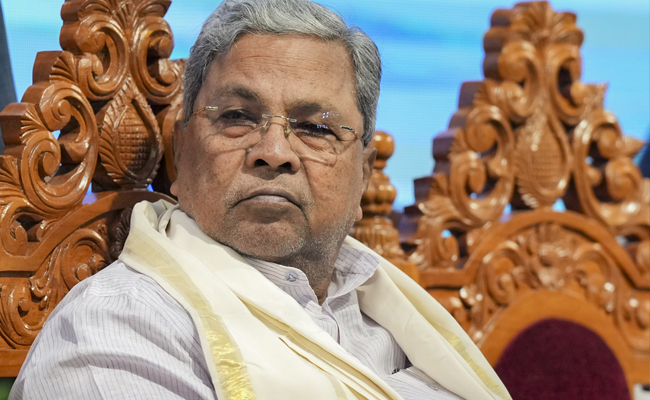
Bengaluru (PTI): Alleging a “criminal conspiracy” by BJP candidate D N Jeevaraj in the Sringeri Assembly poll recounting, Karnataka CM Siddaramaiah on Tuesday said the outcome was manipulated after valid postal ballot votes in favour of Congress leader T D Raje Gowda were tampered with during the recounting process.
Following a Karnataka High Court order on an election petition filed by Jeevaraj, challenging Raje Gowda’s election, the reverification and recounting were conducted on Saturday.
After the reverification and recount of postal ballots for the Sringeri Assembly constituency, votes polled in favour of Raje Gowda were reduced by 255, the returning officer said.
A report on the matter has been submitted to the Election Commission of India for further action, the officer added.
Congress leader Raje Gowda had won the 2023 Assembly polls from Sringeri by 201 votes, defeating his nearest rival Jeevaraj.
Addressing a press conference in Bengaluru, Siddaramaiah said the High Court had directed the recounting of postal ballots and that irregularities were noticed during the exercise conducted on May 2.
“This is a clear case of criminal conspiracy,” Siddaramaiah said, alleging that valid votes cast in favour of Raje Gowda were altered after being accepted by counting agents of all parties, including Congress, BJP, and JD(S).
He claimed that during the recounting of postal ballots, 255 votes were initially accepted as valid by all agents but were later tampered with by subordinate officials.
“There is a second mark on the votes polled in favour of Raje Gowda. They had accepted these as valid votes. Subsequently, another mark was made by officials. This is a clear case of criminal conspiracy,” he said.
When asked who was behind the alleged conspiracy, the CM replied, “It was hatched by Jeevaraj and others. It is planned.”
Siddaramaiah further alleged that the returning officer acted improperly by declaring the result despite the presence of an Election Commission observer during the recounting.
“Immediately after the counting, the returning officer announced the result. He should not have done so; this is against the law,” he said.
He pointed out that Raje Gowda had originally won by 201 votes, but after the recounting, the BJP candidate was declared the winner by 52 votes.
“The BJP has committed a criminal act of conspiracy. This is not vote chori but vote dacoity,” he alleged.
The CM said a police complaint had already been filed by Raje Gowda’s election agent, Sudhir Kumar, and emphasised the need for electoral integrity.
“We want transparency and free and fair elections. That is what our Constitution mandates,” he added.
Stating that the government would pursue legal remedies, Siddaramaiah said, “We are preparing an appeal challenging the returning officer’s announcement in a court of law.”
Responding to a separate query on elections in other states, the CM said there appeared to be an anti-incumbency factor in West Bengal, while results in Tamil Nadu were “surprising,” adding that Vijay’s party was emerging as the largest there.
Following the victory of party candidates in Bagalkote and Davanagere South, Siddaramaiah expressed confidence about future electoral prospects in Karnataka.
“Even in 2028, we will win the Assembly elections. We will come back,” the CM said.
Siddaramaiah added that he would order a forensic examination into the alleged tampering of postal ballots.