Photos of Sikh Kirpan Factory Falsely Circulated On Social Media as PFI Stock of Swords
THIRUVANANTHAPURAM, July 27: Last Thursday when a group of BJP youth wing workers were protesting on the streets here demanding a ban on Popular Front of India (PFI), another group of the saffron outfit was busy – off the streets – in fabricating a false story to malign the Muslim organization in order to strengthen their ban demand. They were circulating images of a Punjab warehouse of Sikh kirpans or swords as the stock of swords prepared by PFI to carry out attack on Hindus. Though a week later, they have been exposed in a media investigation.
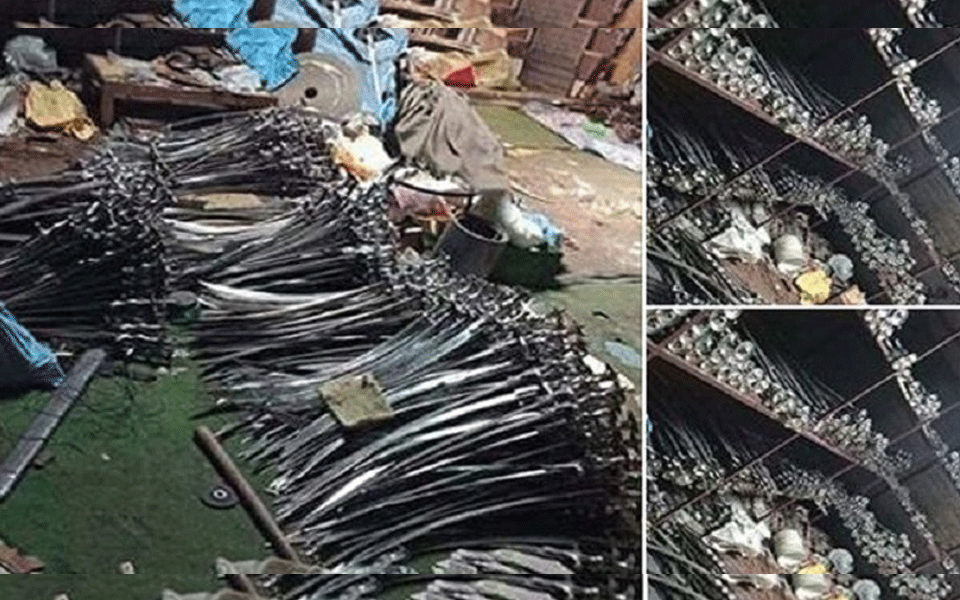
A Facebook account that goes by the name of Bhagwa Diwane posted a collage of photos of the Sikh sword factory with a hateful and provocative comment in Hindi.
“सोते रहो हिन्दुओ तुम्हारे खिलाफ भीषण रक्तपात की तैयारी कर रहा हैं मुस्लिम समुदाय…!!
केरल मे पी.एफ़.आई के जेहादियों की असलाह की फ़ेक्ट्री पर छापा मारकर भारी मात्रा मे हथियारों का जखीरा पकड़ा गया है जहाँ से पूरे भारत की मस्जिद मदरसों और मुस्लिम बहुल इलाको मे हथियार भेजे जा रहे थे यह खबर आपको किसी न्यूज चैनल पर नहीं दिखायी जायेगी” (“Keep sleeping Hindus, Muslims are planning a bloodshed against you. During a PFI factory raid in Kerala, large quantities of weapons were recovered. The arms and ammunition were being supplied to mosques and madrasas in Muslim-dominated areas across India.”)
Very soon the post went viral until the falsehood was exposed. The post had made several false claims: “Police had raided PFI arms factory, and a huge quantity of swords were seized in the raids; these arms were to be sent to mosques, madrasas and Muslim areas; Muslim community is preparing for a bloodbath of Hindus.”
No Raids at PFI office, No Recovery of Swords: Kerala Police
The team of India Today contacted the Kerala police whose officer Anoop VR from the Hi-Tech Crime Enquiry Cell rebutted the facebook post as false.
“There has been no such raid against the PFI where swords have been recovered,” the Kerala police officer said.
PFI’s general secretary Muhammad Basheer said the post was an attempt to denigrate the organisation and PFI had brought the matter into the notice of the cyber cell.
“This is totally fake. It initially came as a Malayalam Facebook post. It’s yet another attempt to malign the image of our organisation,” Basheer of PFI said.
Basheer also shared the screenshots of the post in Malayam language where same kind of messages was circulated.
Photos were of a Sikh sword factory in Punjab’s Patiala district
Then, in search of the origin of the photos of swords factory, the media team reached Patiala district in Punjab. It was discovered that the images were taken from a local Sikh sword factory known as Khalsa Kirpan.
Bachan Singh, the owner of the factory, recalled and confirmed that the photos were of his warehouse and they were taken by a person who was among a group of tourists visiting his factory some years ago.

A worker standing at the Sikh sword factory in Patiala, Punjab (Photo – India Today)
“The store has been here for over 20 years now. We supply material to the whole of Punjab. These swords are given to honour our religious leaders and are also exchanged during fairs. People also keep them in their homes while tourists take them back as souvenirs,” Bachan Singh’s brother Shingara Singh said.
Swords are referred to as kirpans in the Sikh religion and members of the community also carry small-sized kirpans as one of the five articles of faith.
This was first published in caravandaily.com
Courtesy: www.indiatoday.in
Let the Truth be known. If you read VB and like VB, please be a VB Supporter and Help us deliver the Truth to one and all.
Indian sailor killed in dhow fire near Strait of Hormuz

New Delhi (PTI): An Indian sailor was killed and several others injured after their wooden dhow caught fire near the Strait of Hormuz, government sources said on Saturday
Seventeen other Indian crew members were rescued following the incident on Friday, they said, noting that the exact cause of the blaze is still being ascertained.
The crew members were rescued by a vessel which was passing by in the area, the sources said.
The incident came amid increasing hostilities between Iran and the US in the Strait of Hormuz, a vital maritime chokepoint between the Persian Gulf and the Gulf of Oman through which a significant portion of the world's oil supply passes.
"A wooden Dhow, carrying general cargo, with 18 Indian crew capsized yesterday close to the Strait of Hormuz after it caught fire," said a source.
"In this incident, one Indian on the dhow died while four received burn injuries. The injured are receiving medical treatment in Dubai and are safe," the source said.
Officials from the Indian Consulate in Dubai met the rescued Indian nationals last night, said another source.
The consulate is also in touch with the dhow owner and is extending all possible assistance, the sources said.