Phuket bound Air India express flight returns to Hyderabad due to technical issue

Hyderabad: An Air India Express flight from Hyderabad to Phuket had to return shortly after take-off on Saturday morning due to a technical problem, reported The Hindu.
Flight IX 110, operated using a Boeing 737 MAX 8, took off from Rajiv Gandhi International Airport at 6:40 a.m. However, within 17 minutes, the aircraft began descending and returned to Hyderabad. According to flight tracking service FlightRadar24, the plane had reached an altitude of around 10,000 feet before turning back. It landed safely at 6:57 a.m.
Airport authorities confirmed that the decision to return was made after a technical issue was noticed.
Quoting a spokesperson from Air India Express The Hindu reported that, “The crew returned to Hyderabad out of caution after detecting a technical problem. An alternative aircraft was arranged, and the flight has now departed. Refreshments were provided to passengers during the delay. We regret the inconvenience and stress the importance of safety in all our operations.”
Some passengers shared their concerns on social media, mentioning the lack of timely updates during the incident. One passenger wrote that they were initially unsure of what was happening but were later informed that they would be shifted to another plane. Another described the experience as “scary,” saying the flight was airborne for only a short time before returning.
FlightRadar24 data showed that the replacement aircraft left Hyderabad for Phuket at 1:26 p.m. and was on its way to the destination.
Let the Truth be known. If you read VB and like VB, please be a VB Supporter and Help us deliver the Truth to one and all.
Karnataka launches India’s first digital grievance system for gig workers
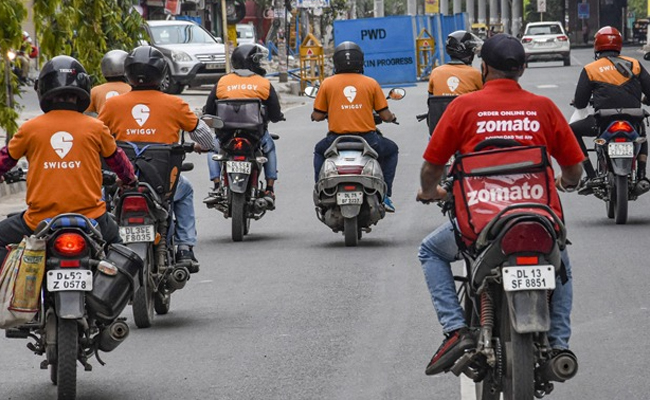
Bengaluru: In a first-of-its-kind initiative in India, the Karnataka government has launched a digital grievance redressal system for gig workers to provide structured support and protection to platform-based workers.
According to The Hindu, the system, developed by the Karnataka Platform-based Gig Workers’ Board in collaboration with the Department of e-Governance, allows workers to file complaints through the Integrated Public Grievance Redressal System (IPGRS).
Gig workers can raise issues related to pay, working conditions, and platform-specific disputes. Complaints will be routed to the Internal Dispute Resolution Committees (IDRCs) of respective platforms and are expected to be resolved within a defined timeframe. This is expected to bring transparency and legal recourse for a workforce that has so far operated without a formal dispute resolution framework.
Under The Karnataka Platform-Based Gig Workers (Social Security and Welfare) Act and Rules, every aggregator platform must constitute an Internal Dispute Resolution Committee (IDRC). Platforms such as Namma Yatri and Yulu have already integrated their IDRC contact details with the government portal.
Around 12 lakh gig workers have been identified in the state, and a unique identification system is being developed to remove duplicate entries. Officials said welfare schemes are also being designed based on type of work, working hours, and contribution.
Labour Minister Santosh Lad said that Karnataka, technology capital of the country, is leveraging this potential for worker welfare as well. “By launching this system, we are ensuring that the gig economy is no longer an informal space, but a structured one where every worker’s voice is heard,” he said.
“The schemes will vary based on the type of platforms. For example, cab rides are mostly undertaken by men whereas urban domestic activity is undertaken mostly by women. It may also be based on the contribution made, and the quantum of gig work done by a gig worker. Some gig workers work for more than eight hours while some may work on a few gigs. So, work load, nature of work, and time period of work could vary,” TH quoted G. Manjunath, Additional Labour Commissioner and CEO of the Board as saying.
“It has to be scientifically structured based on their effort and labour. We are working with experts, including academicians from Briston University, King’s College, and IISc, and other stake holders, including board members,” he said.
Officials added that aggregator platforms will be required to contribute 1 per cent towards worker welfare, with implementation beginning July 5.