PIB's claim on absence of waqf properties in Islamic countries debunked
New Delhi: The Union Minority Affairs Minister, Kiren Rijiju, introduced the Waqf (Amendment) Bill, 2024, and the Mussalman Wakf (Repeal) Bill, 2024, in the Lok Sabha on 8th August. These proposed changes have sparked controversy, with several community leaders, activists, opposition figures, and legal experts raising concerns about potential misuse and threats to minority rights. A joint parliamentary committee has been established to review the proposed amendments, consisting of 31 members from both the Lok Sabha and Rajya Sabha. The committee has invited written suggestions from the public, NGOs, and experts.
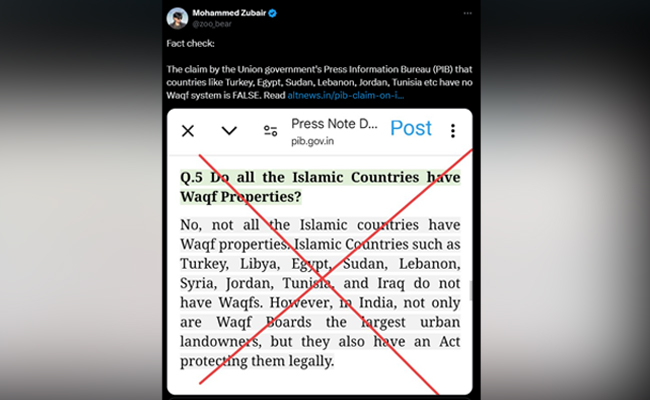
In light of this, the Press Information Bureau (PIB) released an explainer addressing the Waqf Amendment Bill. Among its claims, the PIB stated that several Islamic countries, including Turkey, Libya, Egypt, Sudan, Lebanon, Syria, Jordan, Tunisia, and Iraq, do not have Waqf properties. This claim was widely circulated on social media.
However, upon investigation, the claim was found to be inaccurate. Research on these countries revealed that Waqf properties are present in Turkey, Libya, Egypt, Sudan, Syria, Jordan, Lebanon, Iraq, and Tunisia. Government websites and official documents confirm the existence and management of Waqf properties in these nations.
For instance, in Turkey, the Directorate General of Foundations under the Ministry of Culture and Tourism oversees Waqf properties. Similarly, in Libya and Egypt, respective government bodies manage Waqf matters. In Jordan, the Ministry of Awqaf and Islamic Affairs handles these affairs, while Lebanon’s Dar Al-Fatwa supervises Waqf-related matters. Iraq has separate offices for Sunni and Shia Waqfs, overseeing their respective endowments.
Source: Alt News
Fact check:
— Mohammed Zubair (@zoo_bear) October 16, 2024
The claim by the Union government's Press Information Bureau (PIB) that countries like Turkey, Egypt, Sudan, Lebanon, Jordan, Tunisia etc have no Waqf system is FALSE. Read https://t.co/6YotfftkLX https://t.co/sn71luCt3L pic.twitter.com/PZo1KWZibk
Let the Truth be known. If you read VB and like VB, please be a VB Supporter and Help us deliver the Truth to one and all.
Gold, silver soar as US-Iran deal hopes lift bullion demand

New Delhi (PTI): Gold prices rebounded by Rs 2,900 to Rs 1.55 lakh per 10 grams in the national capital on Wednesday, while silver climbed to Rs 2.54 lakh per kilogram as easing geopolitical tensions triggered a pullback in oil rates, boosting demand for precious metals.
According to the All India Sarafa Association, the yellow metal of 99.9 per cent purity jumped by Rs 2,900, or nearly 2 per cent, to Rs 1,55,400 per 10 grams (inclusive of all taxes) from Tuesday's closing level of Rs 1,52,500 per 10 grams.
Traders attributed the surge in bullion prices to reports that Washington and Tehran are close to finalising a framework agreement to end months of conflict, raising the prospects of smoother flows through the Strait of Hormuz and easing inflation concerns tied to energy markets.
"Gold rallied strongly on Wednesday as easing geopolitical tensions triggered a sharp reversal in key macro drivers that had recently pressured precious metals," Saumil Gandhi, Senior Analyst - Commodities at HDFC Securities, said.
Silver prices also advanced for the third straight session by rising Rs 3,500, or 1.4 per cent, to Rs 2,54,500 per kg (inclusive of all taxes). The metal had settled at Rs 2,51,000 per kg in the previous session, as per the Association.
"The prospect of a diplomatic breakthrough triggered a steep decline in oil prices and the US dollar, easing concerns about inflation while boosting demand for precious metals," Gandhi said.
Globally, spot gold increased by USD 106.15, or 2.33 per cent, to USD 4,663.70 per ounce while silver gained USD 3.40, or 4.68 per cent, to USD 76.24 per ounce.
"Gold witnessed a sharp rally as markets reacted positively to reports that the US and Iran are moving closer to a one-page agreement framework aimed at ending the conflict," Jateen Trivedi, VP Research Analyst - Commodity and Currency, LKP Securities, said.
Despite strong international gains, rupee strength limited the upside in domestic gold prices. The market is now highly focused on final confirmation and execution of the proposed deal, he added.
Any negative surprise or breakdown in negotiations could trigger a sharp sell-off in gold, while a successful agreement and sustained ceasefire could push the bullion prices higher in the near-term, Trivedi said.