PIL in Supreme Court for removal of 'anomalies' in adoption and guardianship
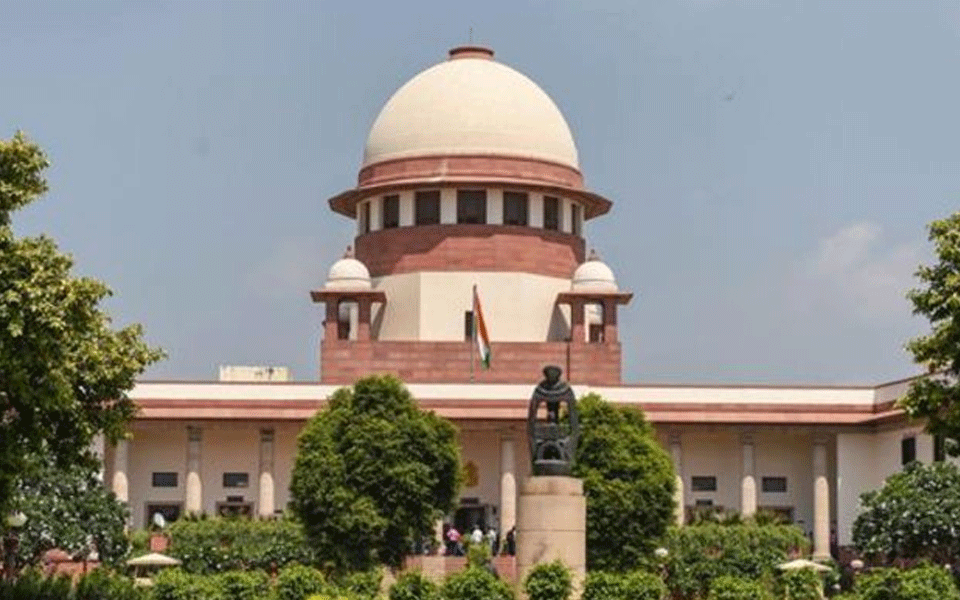
New Delhi: A Public Interest Litigation (PIL) seeking removal of anomalies in the grounds of adoption and guardianship and making them uniform for all citizens has been filed in the Supreme Court.
The plea filed by advocate and BJP leader Ashwini Upadhyay has also sought directions to declare that the discriminatory grounds of adoption and guardianship are violative of Articles 14, 15, 21 of the Constitution and to frame uniform guidelines for adoption and guardianship for all citizens.
Article 14 of the Indian Constitution talks about all citizens' equality before the law, Article 15 prohibits discrimination of Indians on basis of religion, race, caste, sex or place of birth, and Article 21 says no person shall be deprived of his life or personal liberty except according to procedure established by law.
The PIL, filed through advocate Ashwani Kumar Dubey, contended that the current practice of adoption is blatantly discriminatory as Hindus have a codified law of adoption but Muslims, Christians, and Parsis do not have it.
"Adopted child has the right to inherit property under the Hindu law but not under the Muslim, Christian and Parsi law. Adopted child by the Hindus can become a legal heir whereas adopted child by Christians, Muslim, Parsis cannot, the plea said.
"Adopted child by Hindus turn equivalent to a biological child of adoptive parents whereas it's just the opposite in Muslims, Christians and Parsis. Adoptive parents can be the natural guardian of the adopted son and his wife under Hindu Law but not in Muslim, Christian and Parsi Law," the plea said.
It also sought directions to the Law Commission to prepare a report on 'Uniform Grounds of Adoption & Guardianship' within three months, while considering the best practices of laws and international conventions.
The PIL stated that adoption and guardianship is one of the most important and crucial aspects of human life but even after 73 years of independence, India does not have a gender-neutral and religion-neutral law of adoption and guardianship for all citizens.
"Muslims, Christians and Parsis don't have adoption laws even after 73 year of independence and 71 years of India becoming a democratic republic. Due to lack of a common law for all, Muslims, Christians, Parsis approach the Court under Guardians & Wards Act, 1890, the plea said.
"Muslims, Christians and Parsis can take a child under the said Act only under foster care. Once a child under foster care becomes major, he can break away all his relations. Moreover, such a child doesn't have the legal right of inheritance, which creates a lot of hardship and confusion among citizens, which can very easily be solved by having uniform law of adoption and guardianship for all citizens," the plea said.
The petition said in the case of Shia Muslims, the mother is entitled to the custody of a boy until the age of two years and girl until she attains seven years of age if parents are separated.
"The custody after the prescribed period dwells upon the father and after him to grandfather how high soever. The rationale given is that after birth, the mother might have custody of the child but the father has the guardianship, entitling him for the right to take any decision for the future of the child, the petition stated.
It said the father has the ultimate authority to decide matters regarding the future of the child, be it education or contracting marriage. That is why mother living far from the residence of the father was one of the grounds for disqualification of the mother for taking custody," it said.
Referring to Christians, the plea said that they have no adoption laws and have to approach the court under the Guardians and Wards Act, 1890.
Christians can take a child under the said Act only for foster care. Once a child under foster care becomes major, he is free to break away all his relations and also he does not have the legal right of inheritance, it said.
"Parsi law also does not recognize adoption. In the present world when society has changed a lot, the present law does not meet the requisite demand. Section 49 provides that the court has the power to decide interim custody of the child. The court can prescribe such terms and conditions, which it deems necessary for the welfare of the child," the PIL said.
Let the Truth be known. If you read VB and like VB, please be a VB Supporter and Help us deliver the Truth to one and all.
Rickelton's ton in vain as SRH beat MI by 6 wickets
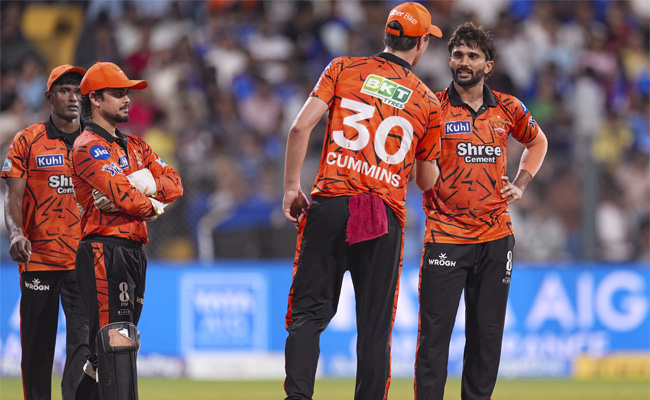
Mumbai (PTI): Ryan Rickelton's whirlwind unbeaten ton was overshadowed by Heinrich Klaasen's unbeaten 65 as Sunrisers Hyderabad defeated Mumbai Indians by six wickets in an IPL match here on Wednesday.
Chasing an imposing 244-run target, Travis Head (76 off 30) and Abhishek Sharma (45 off 24) shared 129 runs for the opening wicket to set the platform for SRH.
Klaasen (65 not out off 30 balls) then displayed his all-round hitting abilities to guide SRH home with the help of Nitish Kumar Reddy (21) and Salil Arora (30 not out off 10) in 18.4 overs.
Earlier, Rickelton's knock powered MI to 243 for five.
MI rode on a 93-run stand between Rickelton (123 not out off 55 balls) and Will Jacks (46 off 22) in 7.1 overs for the opening stand to power the side.
MI skipper Hardik Pandya scored a valuable 31 off 15 balls before being dismissed.
Praful Hinge (2/54), Eshan Malinga (1/29), Sakib Hasan (1/39) and Nitish Kumar Reddy (1/31) were the wicket-takers for SRH.
Brief Scores:
Mumbai Indian: 243 for 5 in 20 overs (Ryan Rickelton 123 not out; Praful Hinge 2/54).
Sunrisers Hyderabad: 249 for 4 in 18.4 overs (Travis Head 76, Heinrich Klaasen 65 not out; AM Ghazanfar 2/51).