Plea in Supreme Court seeks review of EVM VVPAT verdict
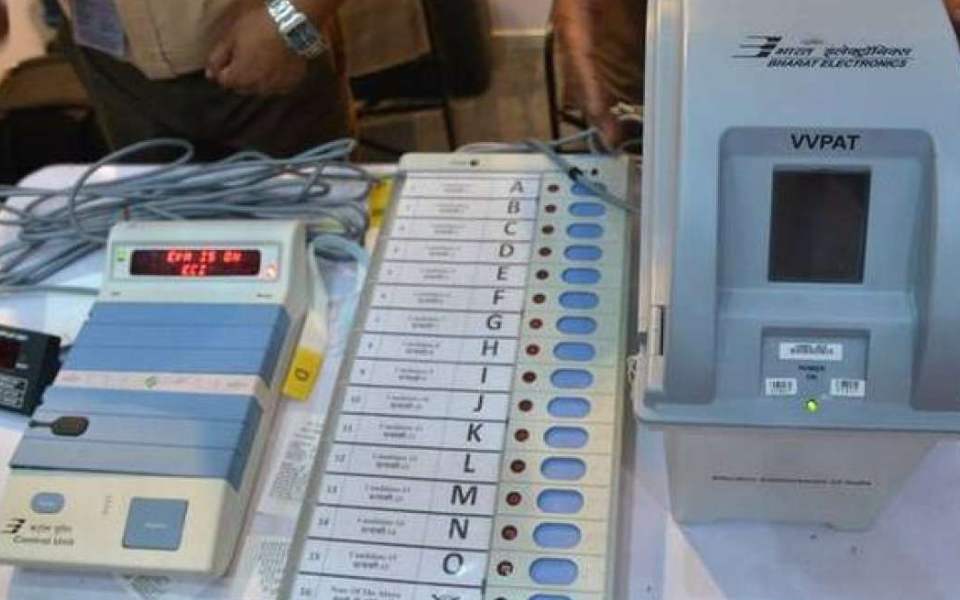
New Delhi, May 13: A plea has been filed in the Supreme Court seeking review of its April 26 judgement by which it had rejected the demand for reverting to the old paper ballot system and the complete cross-verification of votes cast using EVMs with a Voter Verifiable Paper Audit Trail (VVPAT).
The review petition was filed by Arun Kumar Agrawal, who had filed the PIL on the issue earlier, through lawyer Neha Rathi.
The review plea filed on May 10 said, "There are mistakes and errors apparent on the face of the impugned order..., and as such there are sufficient reasons which require review of the impugned order/judgment...
"The petitioner respectfully seeks review on the following issues as have been dealt with in judgment dated April 26, 2024: i) Feasibility of counting of all VVPAT paper slips in terms of time to be taken and additional manpower, ii) Vulnerability of SLU (symbol loading units) and iii) Percentage of VVPAT slips counted for tallying with EVM votes after Chandrababu Naidu...Judgment."
The plea dealt with the feasibility of counting of all VVPAT paper slips in terms of time to be taken and additional manpower and referred to the relevant portion of the judgement.
"During the course of hearing, it was suggested that instead of physically counting the VVPAT slips, they can be counted by a counting machine. This suggestion, including the suggestion that bar-coding of the symbols loaded in the VVPATs may be helpful in machine counting, may be examined by the ECI," the top court had said in the judgement.
Seeking physical counting, the plea said the counting of all VVPAT slips can be done “accurately with a fraction of the employees and at a fraction of cost and within five to eight hours”.
It said the VVPAT paper is of the same size as the thermal print out received when a credit or debit card is swiped on making a payment.
"The counting of the slips after they have been sorted candidate-wise, is in fact easier than counting normal paper because the VVPAT paper slip is sightly curled on account of being thermally printed from a roll. The curling makes the picking up of the paper slip from the surface of a table easy.
"Each slip can be counted while being picked to make bundles of 25 slips as mandated under instructions given in the ECI’s Manual on EVM and VVPAT, 2023," the plea said.
It said EVMs do not allow voters to verify that their votes have been accurately recorded.
"Furthermore, given their very nature, EVMs are especially vulnerable to malicious changes by insiders such as designers, programmers, manufacturers, maintenance technicians, etc. Therefore, in light of the above there are apparent errors on the face of the impugned order dated April 26, 2024 and the impugned judgment, is liable to be reviewed," it said.
On April 26, a bench of Justices Sanjiv Khanna and Dipankar Datta had termed the suspicion of manipulation of the EVMs "unfounded" and trashed the demand for reverting to the old paper ballot system.
The bench had said that the polling devices were "secure" and eliminated booth capturing and bogus voting.
However, the judgement had opened a window for aggrieved unsuccessful candidates securing second and third places in poll results and allowed them to seek verification of micro-controller chips embedded in five per cent EVMs per assembly constituency on a written request upon payment of a fee to the poll panel.
It had directed that from May 1, the symbol loading units should be sealed and secured in a container and stored in a strongroom along with the EVMs for a minimum period of 45 days post-declaration of results.
By the judgement, the top court had dismissed the PILs which had also sought a direction to return to the ballot paper system.
"A voting mechanism must uphold and adhere to the principles of security, accountability, and accuracy. An over complex voting system may engender doubt and uncertainty, thereby easing the chances of manipulation. In our considered opinion, the EVMs are simple, secure and user-friendly. The voters, candidates and their representatives, and the officials of the ECI are aware of the nitty-gritty of the EVM system. They also check and ensure righteousness and integrity," the bench had said.
It had said the possibility of hacking or tampering with the agnostic firmware in the burnt memory of EVMs to tutor or favour results is "unfounded".
"Accordingly, the suspicion that the EVMs can be configured or manipulated for repeated or wrong recording of vote(s) to favour a particular candidate should be rejected," the bench had said.
It had said the incorporation of the VVPAT, an independent vote verification system which enables electors to see whether their votes have been recorded correctly, fortifies the principle of vote verifiability, thereby enhancing the overall accountability of the electoral process.
The seven-phase Lok Sabha polls began on April 19 and will conclude with the announcement of results on June 4.
Let the Truth be known. If you read VB and like VB, please be a VB Supporter and Help us deliver the Truth to one and all.
Rickelton's ton in vain as SRH beat MI by 6 wickets
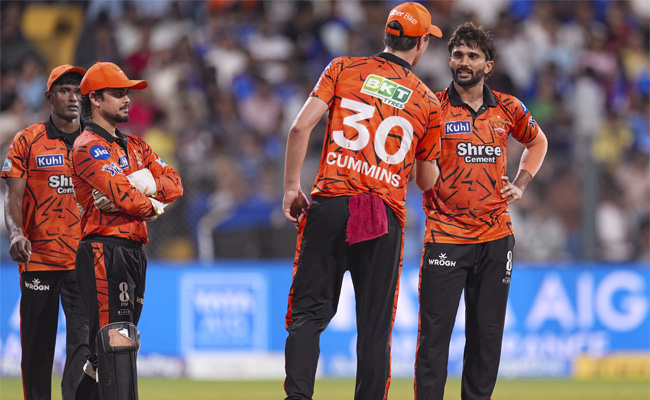
Mumbai (PTI): Ryan Rickelton's whirlwind unbeaten ton was overshadowed by Heinrich Klaasen's unbeaten 65 as Sunrisers Hyderabad defeated Mumbai Indians by six wickets in an IPL match here on Wednesday.
Chasing an imposing 244-run target, Travis Head (76 off 30) and Abhishek Sharma (45 off 24) shared 129 runs for the opening wicket to set the platform for SRH.
Klaasen (65 not out off 30 balls) then displayed his all-round hitting abilities to guide SRH home with the help of Nitish Kumar Reddy (21) and Salil Arora (30 not out off 10) in 18.4 overs.
Earlier, Rickelton's knock powered MI to 243 for five.
MI rode on a 93-run stand between Rickelton (123 not out off 55 balls) and Will Jacks (46 off 22) in 7.1 overs for the opening stand to power the side.
MI skipper Hardik Pandya scored a valuable 31 off 15 balls before being dismissed.
Praful Hinge (2/54), Eshan Malinga (1/29), Sakib Hasan (1/39) and Nitish Kumar Reddy (1/31) were the wicket-takers for SRH.
Brief Scores:
Mumbai Indian: 243 for 5 in 20 overs (Ryan Rickelton 123 not out; Praful Hinge 2/54).
Sunrisers Hyderabad: 249 for 4 in 18.4 overs (Travis Head 76, Heinrich Klaasen 65 not out; AM Ghazanfar 2/51).