PM chairs UNSC debate; Calls for cooperation to combat maritime threats posed by non-state actors
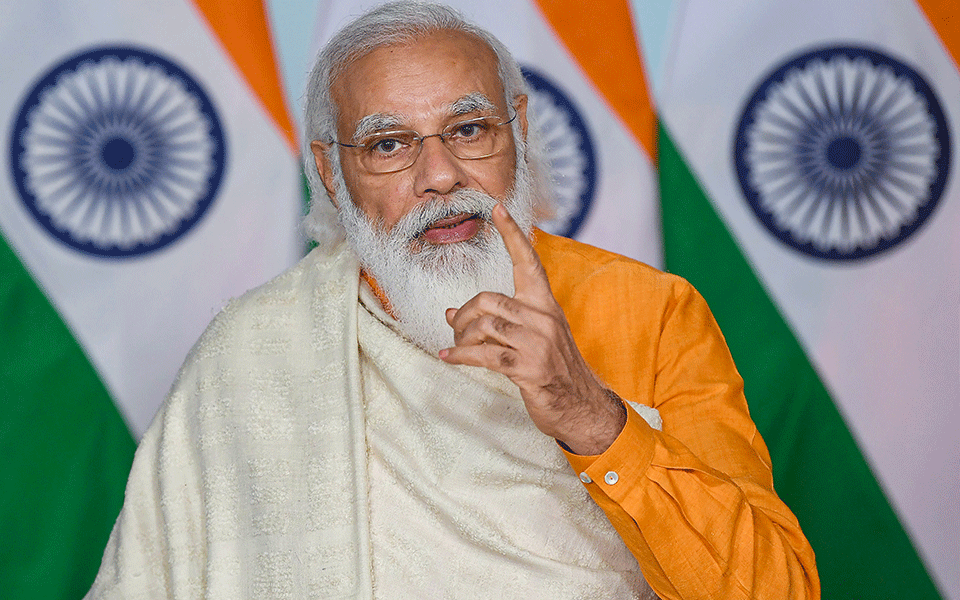
United Nations: Stressing on enhancing maritime security, Prime Minister Narendra Modi on Monday called for peaceful settlement of disputes as per international law and for jointly combating maritime threats posed by non-state actors as he chaired a high-level UN Security Council open debate.
Addressing the debate on "Enhancing Maritime Security - A Case for International Cooperation" via video conferencing, Modi proposed five principles for inclusive maritime security strategy, and mentioned India's vision SAGAR' for sustainable use of the oceans.
He also emphasised that the oceans are the world's common heritage and sea routes are the lifeline of international trade. He also highlighted that maritime routes were being misused for terrorism and piracy.
"We need a framework for mutual cooperation in order to conserve and utilise our shared maritime heritage. Such a framework cannot be created by any country alone. It requires joint efforts by all of us, he said.
Underlining that the countries' shared maritime heritage is facing many challenges, the Prime Minister said, "we should remove barriers for legitimate maritime trade. Global prosperity for all our nations depends on the active flow of maritime trade. Any hindrance in maritime trade can threaten the global economy."
Noting that free maritime trade has always been part of the civilisational ethos of India, Modi said that New Delhi has put forward the vision of Sagar - security and growth for all in the region and it wanted to create an inclusive framework for maritime security in the region.
"The vision aims for a safe, secure and stable maritime domain. For free maritime trade, it is also necessary that we fully respect the rights of the seafarers of other countries, he said.
The second principle, he said, was that the settlement of maritime disputes should be peaceful and on the basis of international law.
His remarks assume significance amidst China's maritime territorial dispute with countries in the Indo-Pacific region on the South China Sea and the East China Sea.
"This is very important for mutual trust and confidence. This is the only way we can ensure global peace and stability," he asserted.
Modi said it was with this understanding and maturity that India resolved its maritime boundary issues with its neighbour Bangladesh.
He said the third key principle was that the global community should jointly fight maritime threats posed by natural disasters and non-state actors, and added that India has taken several steps to enhance regional cooperation to address these issues.
India has taken several steps to enhance regional cooperation on this subject, he added.
"We have provided support for hydrographic surveying and training of maritime security personnel to several countries. India's role in the Indian Ocean has been that of a net security provider, he added.
Preserving the maritime environment and maritime resources, and encouraging responsible maritime connectivity were the fourth and fifth principles enunciated by the prime minister.
"Our Oceans directly impact our climate and hence, it is very important that we keep our maritime environment free of pollutants like plastic waste and oil spills, he said.
"I'm confident that we can develop a global roadmap for maritime security cooperation based on these five principles," he added.
Modi is the first Indian Prime Minister to preside over a UN Security Council Open Debate, according to the Prime Minister's Office.
The meeting was attended by several heads of state and government of member states of the United Nations Security Council (UNSC), including Russian President Vladimir Putin and US Secretary of State Antony Blinken, and high-level briefers from the UN system and key regional organisations.
The open debate was focussed on ways to effectively counter maritime crime and insecurity, and strengthen coordination in the maritime domain.
The UN Security Council has discussed and passed resolutions on different aspects of maritime security and maritime crime in the past.
However, this is the first time that maritime security was discussed in a holistic manner as an exclusive agenda item in such a high-level open debate.
Let the Truth be known. If you read VB and like VB, please be a VB Supporter and Help us deliver the Truth to one and all.
Trump says EU has until July 4 to approve last year's trade deal or it will face higher tariffs
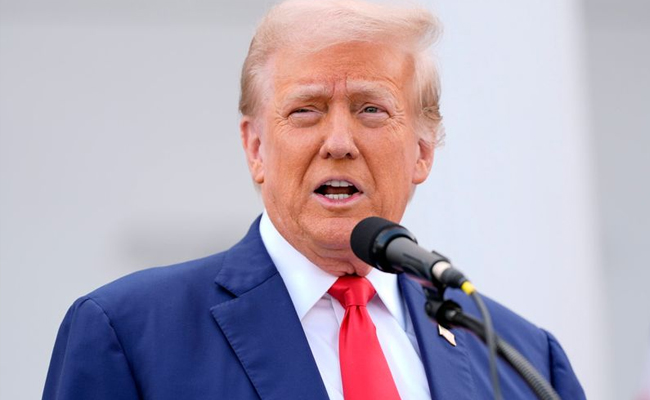
Washington (AP): President Donald Trump has said in a social media post that goods from the European Union would face higher tariff rates if the 27-member bloc fails to approve last year's trade framework by July 4.
The announcement on Thursday appeared to be a deadline extension after the president said last Friday that EU autos would face a higher 25 per cent tariff starting this week. Trump made the updated announcement after what he described as a "great call" with European Commission President Ursula von der Leyen.
Still, the US president was displeased that the European Parliament had yet to finalize the trade arrangement reached last year, which was further complicated in February by the US Supreme Court ruling that Trump lacked the legal authority to declare an economic emergency to impose the initial tariffs used to pressure the EU into talks.
"A promise was made that the EU would deliver their side of the Deal and, as per Agreement, cut their Tariffs to ZERO!" Trump posted. "I agreed to give her until our Country's 250th Birthday or, unfortunately, their Tariffs would immediately jump to much higher levels."
It was unclear from the post whether Trump was implying that the tariff rates would jump on all EU goods or the increase would only apply to autos.
His latest statement indicates he might be backing away from his earlier threat on EU autos by giving the European Parliament several more weeks to approve the agreement.
Under the original terms of the framework, the US would charge a 15 per cent tax on most goods imported from the EU.
But since the Supreme Court ruling, the administration has levied a 10 per cent tariff while investigating trade imbalances and national security issues, aiming to put in new tariffs to make up for lost revenues.