PM exerted pressure on Assam govt to prevent Rahul from visiting Sankardeva birthplace: Ramesh
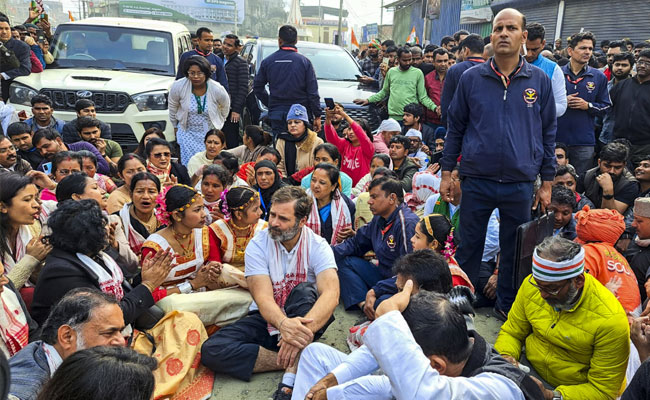
Nagaon (Assam) (PTI): Congress leader Jairam Ramesh on Monday claimed that Prime Minister Narendra Modi exerted pressure on the Assam government to prevent Rahul Gandhi from visiting the birthplace of Vaishnav saint Srimant Sankardeva to pay his obeisance.
Gandhi was prevented from visiting the venue this morning and stopped at Haiborgaon where he along with senior Congress leaders, party workers and supporters have sat on a dharna.
The managing committee of Sri Sankardeva Sattra on Sunday had announced that they will not allow the Congress leader to visit the sattra before 3pm on January 22 after Chief Minister Himanta Biswa Sarma had earlier in the day said at a press conference that he requested Gandhi not to visit before the consecration of Ram Temple in Ayodhya.
''We were given permission to visit the Sattra on January 11. But suddenly on January 20, we were told that Gandhi can visit only after the consecration of Ram temple'', he said.
It is clear that ''the arrogant powers want the entire focus of the camera on them and pressure was exerted on the Assam government to take this step'', he said.
''After the authorities had told Rahulji that there could be a law and order problem, he (Gandhi) offered to go alone but this, too, was refused. It is clear that it is their deliberate policy to prevent him from going to the holy place which occupies a place of social, cultural and religious importance for all'', Ramesh said.
The authorities said there are many Ram Bhakts in the Bardrava sattra premises and there could be a law and order situation but ''we assured them that no one except Rahulji will go'', he said.
Following this a lot of phone calls were made by the authorities and Lok Sabha MP Gaurav Gogoi and local Congress MLA Sibamoni Bora were allowed to proceed to the sattra to talk with the members of the managing committee to resolve the issue and ensure Gandhi's visit to the sacred place.
''Gandhi will continue to stage the dharna till Gogoi and Bora return from the sattra'', he said.
The managing committee has said they can visit after 3pm but ''what guarantee is there that Himanta Biswa Sarma will say at 2:30 pm that due to law and order situation, he will not be allowed to visit at all'', the Congress general secretary said.
The yatra will continue on its usual route after the issue is resolved, Ramesh added.
Let the Truth be known. If you read VB and like VB, please be a VB Supporter and Help us deliver the Truth to one and all.
India achieves major milestone in wind energy; capacity now 56 gigawatts: PM Modi
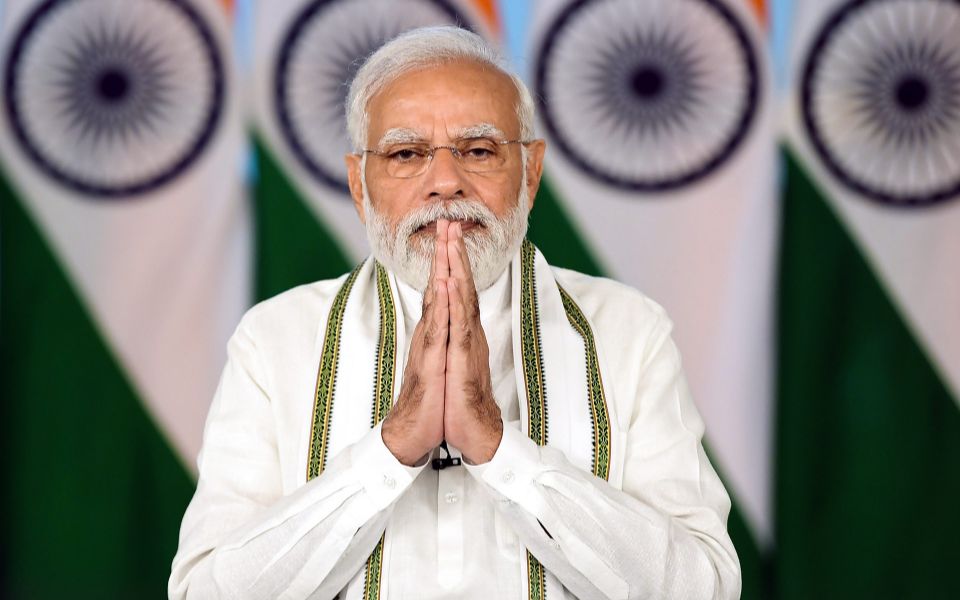
New Delhi (PTI): India has achieved a major milestone in wind energy, with the country's wind energy generation capacity exceeding 56 gigawatts, Prime Minister Narendra Modi said on Sunday.
In his monthly radio address 'Mann Ki Baat', Modi also said the country must save electricity and adopt clean energy.
“India recently achieved a major milestone in wind energy. India's wind energy generation capacity has now exceeded 56 gigawatts. In just the past year, nearly 6 gigawatts of new capacity have been added,” he said.
Underlining that solar and wind energy are essential for India's development, Modi said, “It is not just about the environment; it is about securing our future, and we all have a role to play in it.”
On April 22, Union Minister for New and Renewable Energy, Pralhad Joshi, said that India has recorded its best-ever year in wind energy capacity addition, with a historic 6.1 GW added during 2025-26.
India currently ranks fourth globally in wind energy, with more than 56.1 GW installed capacity and an additional 28 GW under implementation.
Emphasising the vast untapped potential of the sector, Joshi highlighted that India's wind energy potential at 150 metres hub height is estimated at nearly 1,164 GW.
He expressed confidence that with sustained efforts, the country will achieve 100 GW wind capacity by 2030 and 156 GW by 2036, contributing significantly to the net-zero target by 2070.
Joshi also underlined that wind energy plays a critical role in stabilising India's energy system, particularly due to its peak generation during evening and night hours, which aligns with high demand periods.
He noted that nearly 45 per cent of wind power generation occurs during peak demand hours, making it a vital complement to solar energy.