PM inaugurates India's longest rail-cum-road bridge in Assam
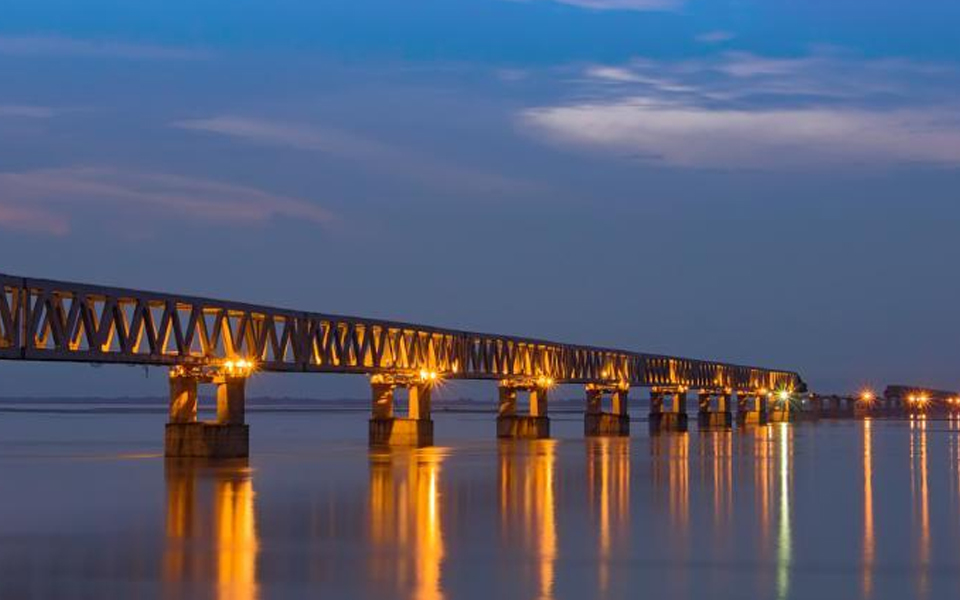
Bogibeel (Assam), Dec 25: Prime Minister Narendra Modi Tuesday inaugurated the country's longest rail-cum-road bridge over the Brahmaputra river at Bogibeel near Dibrugarh in Assam.
The prime minister, who reached Dibrugarh in the afternoon from New Delhi, flew directly to Bogibeel in a chopper and dedicated the 4.94-km-long double-decker bridge to the nation from the south bank of the river.
After greeting people, standing on the foothold of his vehicle, Modi deboarded the car and walked a few metres on the bridge along with Assam Governor Jagdish Mukhi and Chief Minister Sarbananda Sonowal.
The prime minister crossed the bridge in his cavalcade to the north bank of Brahmaputra, where he will flag off the Tinsukia-Naharlagun Intercity Express.
The train will run five days a week. The 4.9-km bridge will cut down the train-travel time between Tinsukia in Assam to Naharlagun town of Arunachal Pradesh by more than 10 hours.
Modi is scheduled to address a public rally in Dhemaji district later in the day.
The strategically important bridge, which begins at Dibrugarh and ends at Dhemaji districts of Assam, will remove communication bottlenecks to several districts of Arunachal Pradesh.
The Bogibeel Bridge, which was a part of the Assam Accord and sanctioned in 1997-98, is also likely to play a crucial role in defence movement along the India-China border in Arunachal Pradesh.
The foundation stone of the project was laid by former prime minister H D Deve Gowda on January 22, 1997, while work commenced on April 21, 2002, under the Atal Bihari Vajpayee-led government. The Congress-led UPA government had declared it a national project in 2007.
December 25 happens to be Vajpayee's birth anniversary.
Due to inordinate delay in its implementation, the cost of the project escalated by 85 per cent to Rs 5,960 crore from the sanctioned estimated cost of Rs 3,230.02 crore. The total length of the bridge was also revised to 4.94 km from the earlier 4.31 km.
The bridge is part of the infrastructure projects planned by India to improve logistics along the border in Arunachal Pradesh.
"The bridge will enhance the national security of the eastern region by facilitating swift movement of defence forces and their equipment. It was constructed in such a way that even a fighter jet can land on it in case of emergency," a source said.
A senior army official had earlier said the biggest advantage of the bridge will be easy movement of troops from southern to northern bank.
"This means travelling to the farthest most point of India's border with China will be shortened by several hundred kilometers," he had said.
Northeast Frontier Railway (NFR) Chief Public Relations Officer Pranav Jyoti Sharma had also said that the bridge will provide logistical support for the Indian Army manning the border.
The road distance from Dibrugarh to Itanagar will be reduced by 150 km and the railway travel distance between these two points will shorten by 705 km, he had said.
The bridge and the train will be a boon for the people of Dhemaji as major hospitals, medical colleges and airport are in Dibrugarh, the third-largest city in the Northeast.
Let the Truth be known. If you read VB and like VB, please be a VB Supporter and Help us deliver the Truth to one and all.
Cong slams Modi govt as 'anti-worker', calls for review of new Labour code
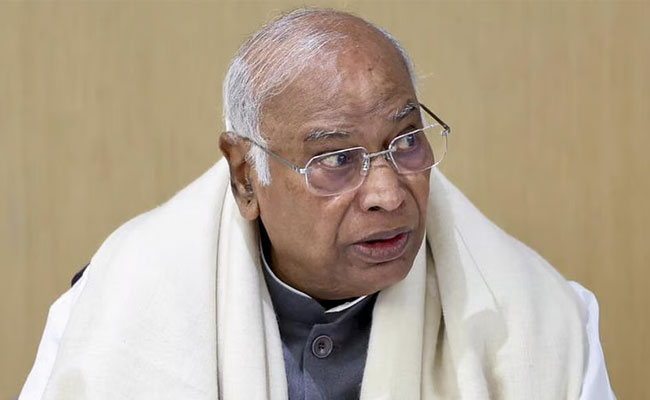
New Delhi (PTI): The Congress on Friday accused the Modi government of being "anti-worker" and demanded that the new labour code be reviewed, MGNREGA be revived as well as a national minimum wage of Rs 400 per day be established.
On International Labour Day, Congress president Mallikarjun Kharge took a swipe at the government and said unemployment in India today is a direct consequence of the 'Hum Do, Hamare Do' policies.
"Driven by the 'Hum Do, Hamare Do' policy, the Modi government implemented an anti-worker Labour Code. As a result, unrest has erupted everywhere - be it in Noida, at the IOCL facility in Panipat, Adani's factory in Raikheda, NTPC Patratu, or the Samsung factory in Sriperumbudur," Kharge said in a post in Hindi on X.
Instead of ensuring job security, this Code promotes policies such as contract labour and 'Hire & Fire' practices, Kharge said and called for a review of the new Labour Code.
The Modi government has effectively dismantled MGNREGA by forcibly pushing legislation through Parliament, he alleged.
"Mr. Modi has shifted 40% of the wage burden onto the State governments. State governments are unable to bear this financial strain and will eventually be forced to stop providing work," he claimed.
The Modi government has compelled workers into a state of unemployment and pushed them towards 'gig work', Kharge said.
Currently, 69% of the workforce is working for wages below the statutory minimum wage, he said.
The Modi government has engineered a crisis of stagnant wages, Kharge alleged.
"When adjusted for inflation, the wages of the majority of India's workers have grown by less than 1% annually over the last decade (from 2014-15 to 2022-23)," he said.
The Modi government has created a massive unemployment crisis among the educated workforce, specifically, among graduates, Kharge claimed and added that jobs have been eliminated through the sale of Public Sector Undertakings (PSUs).
"The government has refused to fill approximately 30 lakh vacant government positions. Furthermore, the government's policy blunders have led to the decimation of Micro, Small, and Medium Enterprises (MSMEs)," the Congress chief said.
The Congress reiterates its five demands for India's workers including revival of MGNREGA and its expansion to urban areas, Kharge said.
He said a national minimum wage of Rs 400 per day should be established, with MNREGA included within its scope.
Kharged demanded that a 'Right to Health' law must be enacted, providing Universal Health Coverage of up to Rs 25 lakh for laborers and workers.
"'Life Insurance and Accident Insurance' coverage must be provided for all unorganized workers. Preventing the contractualization of employment must be made a core priority of the government, and the new Labour Codes must be reviewed," Kharge asserted.