PM instructs armed forces that response to every action by Pak should be more forceful: Govt sources
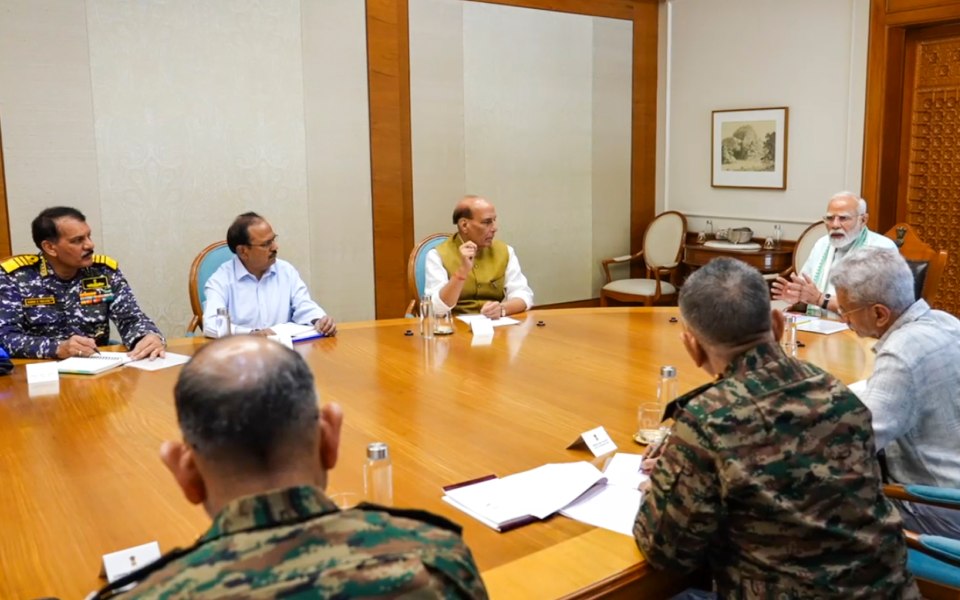
New Delhi, May 11 (PTI): There is a new normal in India's response to cross-border terrorism, with Prime Minister Narendra Modi instructing the armed forces that the country's response to every action by Pakistan should be more forceful, government sources said on Sunday.
Following Operation Sindoor, Prime Minister Modi told the armed forces that bullets must be responded to by artillery (Wahan se goli chalegi, toh yahan se gola chalega), the sources said.
They said Operation Sindoor is not concluded and there is a new normal in India's response to cross-border terrorism. The cost of cross-border terrorism will be raised, and Pakistan can't continue with terrorism while expecting cooperation in areas of its choosing.
They also said that India will never accept mediation in the Kashmir issue and the only matter to discuss is Pakistan returning the territory which is under its illegal occupation
Foreign Secretary Vikram Misri on Saturday evening announced that India and Pakistan reached an understanding to stop all firings and military actions on land, air and sea, with immediate effect, after four days of intense cross-border drone and missile strikes.
The development was first announced by US President Donald Trump, who claimed that the two countries had agreed to a "full and immediate ceasefire" after US mediation.
In a statement, US Secretary of State Marco Rubio said he was "pleased to announce the Governments of India and Pakistan have agreed to an immediate ceasefire and to start talks on a broad set of issues at a neutral site".
The only matter related to Kashmir to discuss is Pakistan returning territory under its illegal occupation, Government sources asserted on Sunday.
They made it clear that the Indus Waters Treaty will be in abeyance as long as terrorism sponsored by Pakistan against India continues.
Only talks with Pakistan will be through the Director General of Military Operations (DGMOs). There is no other issue to discuss, the sources said.
India's position after the May 7 strikes on terror infrastructure was that if Pakistan fires, India will respond more forcefully, they said, adding it was the Pakistani DGMO who reached out to the Indian DGMO on May 10 to de-escalate situation
After the Pahalgam attack, India had told countries that reached out to New Delhi it would hit terror infrastructure in Pakistan territories.
After the May 7 strikes, every Pakistani action was dealt with very firmly, the sources said.
Let the Truth be known. If you read VB and like VB, please be a VB Supporter and Help us deliver the Truth to one and all.
Maharashtra sets up state vaccination task force to strengthen immunisation programme

Mumbai (PTI): The Maharashtra government has set up a State Vaccination Task Force to strengthen the regular immunisation programme and review the progress of related campaigns, a health department official said on Monday.
The State Vaccination Task Force will comprise at least 29 members and will be headed by the administrative head of the health department, he informed.
The government has also constituted separate district-level and municipal vaccination task forces to improve implementation and address challenges at the grassroots level, he said.
Municipal task forces, chaired by respective civic commissioners, have been constituted in view of the vast urban population in Maharashtra and the role of civic bodies in implementing different health programmes.
The district-level task forces will function under the chairmanship of collectors.
"Complete immunisation of children at the appropriate age is an extremely simple, cost-effective and highly effective measure to reduce child mortality and the prevalence of diseases among kids. Immunisation is a powerful tool for reducing illness in children," maintained the official.
To ensure full vaccination of all children, the state government implements various campaigns from time to time as per the central government guidelines, he pointed out.
"Active participation and cooperation of other relevant government departments are essential (in making these campaigns successful)," according to the official.
The state-level body will review the regular immunisation programme, associated campaigns and vaccine-preventable diseases in detail. It will also conduct focused assessments of high-risk districts and municipal corporations, including vacancies at district, municipal and sub-district levels, availability of cold chain equipment, resource gaps and training requirements, he noted.
The state task force will review allocation and utilisation of funds for immunisation and ensure timely action by officers concerned based on reports from district and municipal task forces and state-level monitoring mechanisms, the official said.
It will also ensure active coordination and participation of other government departments in immunisation drives, while district and municipal task forces will carry out similar functions at their respective levels, the official added.