PM launches rail and road projects worth over Rs 3,250 cr in West Bengal
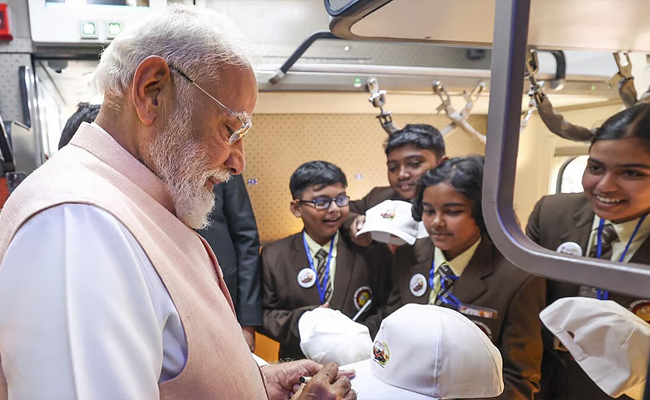
Malda (PTI): Prime Minister Narendra Modi on Saturday unveiled rail and road infrastructure projects worth Rs 3,250 crore, aimed at strengthening connectivity and accelerating development in West Bengal and the North East.
At a public function in Malda in north Bengal, the Prime Minister virtually flagged off four Amrit Bharat Express trains connecting New Jalpaiguri with Nagercoil and Tiruchirappalli, and Alipurduar with SMVT Bengaluru and Mumbai (Panvel).
Earlier, the Prime Minister flagged off the country’s most advanced and the first set of Vande Bharat sleeper trains between Howrah and Guwahati (Kamakhya) from Malda Town Railway Station.
The fully air-conditioned sleeper train is expected to cut travel time on the Howrah-Guwahati route by around 2.5 hours. Currently, it takes nearly 18 hours from Howrah to Guwahati by train.
Speaking at the inauguration function, Modi said the new projects, especially the new trains, will enable and empower the youth of the region.
“There was a time when we used to watch the developed foreign nations and dreamt of such modern trains in our country. Today that dream has come true,” the PM said.
“The new Vande Bharat sleeper train has connected the holy land of Maa Kali to that of Maa Kamakhya,” he added.
India has both modernised its transport facilities and made the country self-reliant, Modi said, adding that the country is currently making more railway coaches in India than in Europe or the US.
Speaking at the occasion, Railway Minister Ashwini Vaishnaw said that India would soon be exporting Vande Bharat trains.
“Keeping in mind the food tastes of the region, passengers of the Vande Bharat trains departing from Kolkata would be served Bengali cuisine and those from Guwahati would be offered Assamese food,” he announced.
A statement issued by the PMO stated that the new projects will enhance affordable and reliable long-distance rail connectivity.
“These services will support the mobility needs of common citizens, students, migrant workers and traders, while strengthening inter-state economic and social linkages,” it said.
At the function, Modi laid the foundation stone of four major railway projects in the state, including the new rail line between Balurghat and Hili, next-generation freight maintenance facilities at New Jalpaiguri, upgradation of the Siliguri Loco Shed, and modernisation of Vande Bharat train maintenance facilities in Jalpaiguri district.
“These projects will strengthen passenger and freight operations, improve logistics efficiency in North Bengal, and generate employment opportunities in the region,” the statement said.
The PM also flagged off two new train services equipped with LHB coaches to facilitate connectivity of the region’s youth, students, and IT professionals to Bengaluru, a major IT hub of the country.
Modi laid the foundation stone for the rehabilitation and four-laning of the Dhupguri–Falakata section of National Highway-31D, a key project to improve regional road connectivity in North Bengal.
“These projects will play a vital role in building modern infrastructure creation and improved connectivity, strengthening the Eastern and North-Eastern regions as key growth engines of the nation,” the statement said.
On a two-day visit to eastern India, Modi is scheduled to criss-cross poll-bound Bengal and Assam, blending high-voltage political messaging with a clutch of infrastructure launches as the countdown to the 2026 assembly elections enters its decisive phase.
He is scheduled to return to the state on Sunday after holding a political rally in Malda on Saturday afternoon and then moving to Guwahati for his overnight stay there and spearheading a host of scheduled events the following morning.
On Sunday, the PM will address a keenly monitored political meeting from Singur in Hooghly district, the epicentre of the anti-land acquisition movement that propelled Mamata Banerjee to power in 2011 and reshaped the state’s political landscape.
Let the Truth be known. If you read VB and like VB, please be a VB Supporter and Help us deliver the Truth to one and all.
Kejriwal resorting to 'vendetta politics', says BJP after MP Sandeep Pathak booked
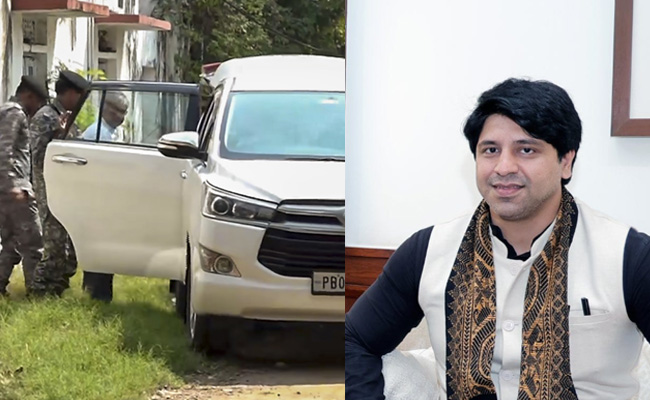
New Delhi (PTI): The BJP on Saturday accused Aam Aadmi Party's national convenor Arvind Kejriwal of vendetta politics after Punjab Police booked Rajya Sabha MP Sandeep Pathak, who recently defected to the BJP.
In an X post, BJP national spokesperson Shehzad Poonawalla claimed that Kejriwal is misusing the Punjab Police to settle political scores, and Chief Minister Bhagwant Mann has become a party to it.
"Two FIRs have been filed against Sandeep Pathak, who until recently was in the Aam Aadmi Party (AAP) as a Rajya Sabha MP and general secretary (organisation). What is baffling is the shameless, brazen vendetta politics being pursued by Arvind Kejriwal, with Bhagwant Mann complicit in it," Poonawalla said.
ALSO READ: BJP, TMC hail SC directions on counting of votes for West Bengal polls
"It is clear this has been done out of vendetta politics by Kejriwal, who is extremely vengeful and vindictive, and misuses the Punjab Police to pursue such political vendetta," he alleged.
Questioning the timing of the FIRs, Poonawalla said, "If these cases existed from the beginning, why were FIRs not filed earlier? If he was corrupt, why was he kept in the party for so long, especially when he was the general secretary (organisation)? Has any new material surfaced in the last few days, or has the alleged corruption occurred only now?"
He alleged that Kejriwal has an "old habit" of targeting political opponents and dissenters.
"We have seen how he has used the police against rivals, including Congress leaders. This is his old habit," Poonawalla said, referring to the withdrawal of Rajya Sabha MP Harbhajan Singh's security.
Poonawalla claimed that several leaders who had left AAP over the years, including Yogendra Yadav, Mayank Gandhi, Ashish Khetan, Ashutosh and Alka Lamba, were "hounded".
He accused the party of failing to introspect.
"Instead of introspecting on how they have changed -- from Anna to Lalu, from Lokpal to corruption -- they are indulging in vendetta politics, trying to victimise people using the strong arm of the law. This reflects an Emergency-like mindset and a dictatorial, Hitlerian mindset," he said.
According to sources, two FIRs have been lodged against Pathak under non-bailable sections.
No further details about the FIRs have been disclosed yet.
On April 24, the AAP suffered a jolt when seven of its 10 Rajya Sabha MPs quit, alleging that Arvind Kejriwal's party has strayed from its principles, values and core morals.
Of the seven MPs -- who were Pathak, Raghav Chadha, Ashok Mittal, Harbhajan Singh, Rajendra Gupta, Vikramjit Sahney and Swati Maliwal -- six were from Punjab.
Later, Rajya Sabha Chairman C P Radhakrishnan officially accepted their merger with the BJP, reducing AAP's strength in the Upper House to three.