PM Modi announces benefits for children orphaned by Covid
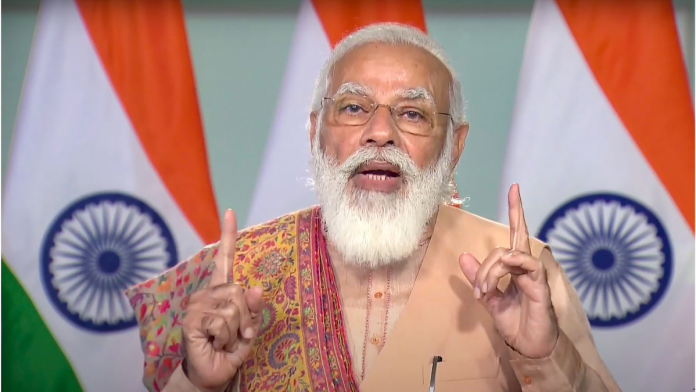
New Delhi, May 29: On the eve of his government's second anniversary in its second term, Prime Minister Narendra Modi on Saturday announced a number of welfare measures for children who lost their parents to COVID-19, including ensuring a corpus of Rs 10 lakh when they turn 18 and providing for their education.
Chairing a meeting to deliberate on steps which can be taken to support such children, he said they will be supported under the "PM-CARES for Children" scheme.
The Prime Minister's Office (PMO) said in a statement that fixed deposits will be opened in the names of such children, and the PM-CARES fund will contribute through a specially designed scheme to create a corpus of Rs 10 lakh for each of them when he or she reaches 18 years of age.
This corpus will be used to give a monthly financial support or stipend from 18 years of age for the next five years to take care of his or her personal requirements during the period of higher education. On reaching the age of 23 years, they will get the corpus amount as one lump-sum for personal and professional use.
While announcing these measures, Modi emphasised that children represent the country's future and the government will do everything possible to support and protect them so that they develop as strong citizens and have a bright future.
"The PM said that in such trying times it is our duty, as a society, to care for our children and instil hope for a bright future. All children who have lost both parents or surviving parent or legal guardian/adoptive parents due to Covid-19 will be supported under PM-CARES for Children' scheme," he said, according to the statement.
Highlighting measures for their education, the PMO said children under 10 years will be given admission in the nearest Kendriya Vidyalaya or in a private school as a day scholar.
Those between 11-18 years of age will be given admission in any central government residential school such as Sainik School and Navodaya Vidyalaya. In case the child remains under the care of a guardian or extended family, then he or she will be given admission in the nearest Kendriya Vidyalaya or in a private school as a day scholar.
If the child is admitted in a private school, fees as prescribed under the Right to Education Act norms will be given from the PM-CARES fund, and it will also pay for expenditure on uniform, text books and notebooks, the PMO added.
For higher education, children will be assisted in obtaining education loan for professional courses or higher education in India according to existing norms. The interest on this loan will be paid from the PM-CARES fund.
As an alternative, scholarship equivalent to the tuition fees or course fees for undergraduate and vocational courses will be provided to them under the central or state government schemes.
For children who are not eligible under the existing scholarship schemes, PM CARES will provide an equivalent scholarship.
All children will also be enrolled as a beneficiary under the Ayushman Bharat Scheme, or Pradhan Mantri Jan Arogya Yojana (PM-JAY), with a health insurance cover of Rs 5 lakh. The premium amount for these children till the age of 18 years will be paid by PM-CARES, it said.
Modi said the measures being announced have only been possible due to the generous contributions to the PM-CARES fund which will support India's fight against COVID-19.
As many as 577 children across the country were orphaned after their parents succumbed to COVID-19, Women and Child Development Minister Smriti Irani had said earlier this week citing reports of states and union territories from April 1 till May 25.
Irani thanked the prime minister for announcing the measures, and said "this will ensure children are not deprived of any opportunity & will pave the way for a secure future."
The Press Association also lauded the steps of the government. Its treasurer Santosh Thakur said, "The Press Association had written to the government to help in education of the children of media persons who lost their lives during the pandemic. Give admission them in Central, Navodaya & Sainik school. Children of the journalists will be benefited from such schemes.
Let the Truth be known. If you read VB and like VB, please be a VB Supporter and Help us deliver the Truth to one and all.
Sujit Nair raises concerns over speculation of DMK-AIADMK understanding to block TVK
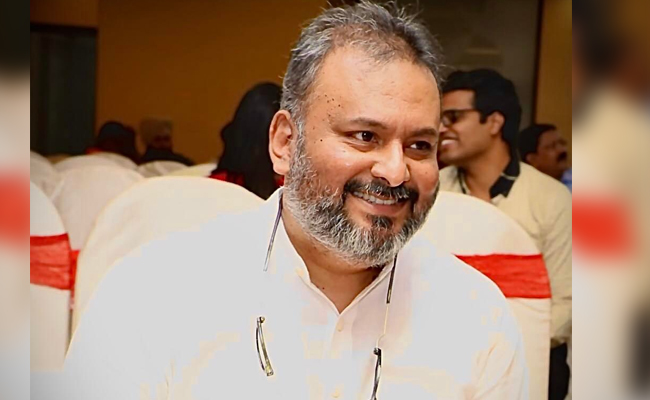
Chennai: Journalist and political commentator Sujit Nair has expressed concern over speculation that the Dravida Munnetra Kazhagam and the All India Anna Dravida Munnetra Kazhagam could explore a post-poll understanding to prevent Vijay-led Tamilaga Vettri Kazhagam from forming the government in Tamil Nadu.
In a social media post, Sujit Nair said the election verdict in Tamil Nadu reflected a clear public demand for political change and argued that the mandate should be respected irrespective of political preferences.
Referring to reports and political discussions surrounding a possible understanding between the DMK and AIADMK, he said he hoped such developments remained only speculative conversations and did not turn into reality.
Nair stated that if such an alliance were to take shape, it would raise serious questions about ideological politics in the country. He said TVK had emerged through a democratic electoral process and that the legitimacy to govern in a parliamentary democracy comes from the people’s verdict.
According to him, attempts to prevent an electoral winner from forming the government through unexpected political arrangements may be constitutionally valid, but many people could view them as politically opportunistic.
He further said that such a move could particularly affect the political image of the DMK, which has historically projected itself around ideology, social justice and opposition politics. Nair said that in ideological terms, the DMK appeared closer to TVK than to the AIADMK, and joining hands with its long-time political rival only to remain in power could weaken its broader political narrative.
He added that the same questions would apply to the AIADMK as well, as the party had spent decades positioning itself against the DMK and such an arrangement could create discomfort among its cadre and supporters.
Drawing a comparison with Maharashtra politics in 2019, Nair said he had expressed similar views when the Shiv Sena formed an alliance with the Indian National Congress and the Nationalist Congress Party after the Assembly elections.
He said post-poll alliances between long-standing political rivals often create a public perception that ideology and electoral mandates become secondary when political power equations come into play.
Nair also said such developments increase public cynicism towards politics and reinforce the belief among voters that ideology is often sidelined after elections.
He maintained that the Tamil Nadu verdict was emphatic and said respecting both the spirit and substance of the mandate was important for the credibility of democratic politics.