PM Modi cancelled Kashmir visit after receiving intelligence report on terror attack, alleges Kharge
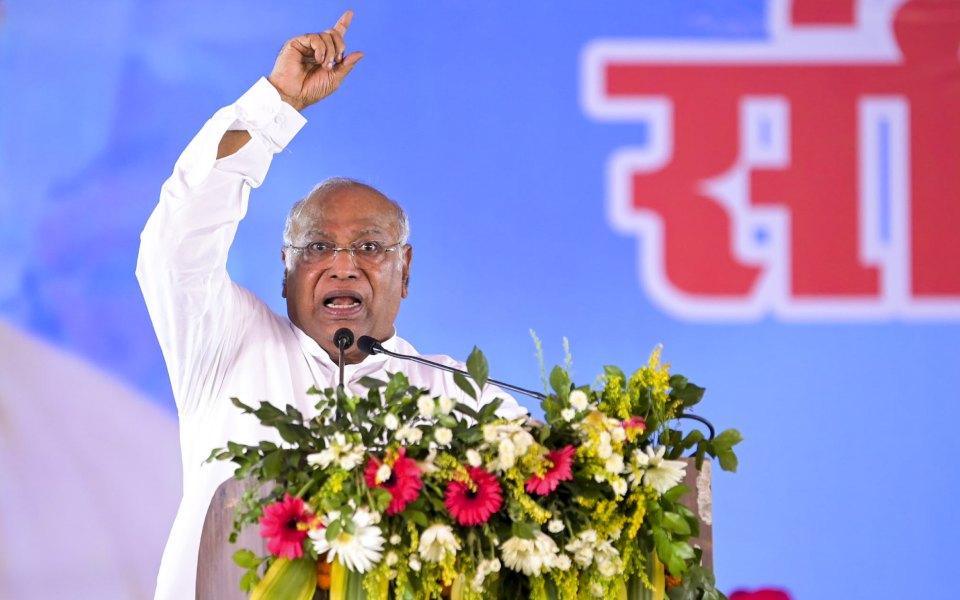
Ranchi, May 6 (PTI): Congress president Mallikarjun Kharge on Tuesday claimed that Prime Minister Narendra Modi had cancelled his Kashmir visit after "receiving an intelligence report three days before" the Pahalgam terror attack last month.
Noting that during an all-party meeting, the Centre accepted "intelligence failure" in the Pahalgam carnage, Kharge said the union government should be held accountable for "not reinforcing" security arrangements in Kashmir to protect people, even after such inputs.
Reacting to Kharge's allegation, the BJP claimed that the Congress president's criticism of PM Modi over alleged intelligence failure in the Pahalgam terror attack was intended to "lower the morale of security forces".
Jharkhand BJP chief Babulal Marandi said that Kharge's comment at a critical time when the "fight against terrorism and Pakistan was at a decisive juncture" was "uncalled for".
Addressing a 'Samvidhan Bachao' rally in Jharkhand's capital, Ranchi, the Congress chief claimed that he "got information that three days before the attack, an intelligence report was sent to Modi ji, and that is why Modi ji cancelled his visit to Kashmir".
"When an intelligence report says that it is not proper to visit there for your security, why did you not inform your security, intelligence, local police, and border force to protect people," the Congress chief asked.
He also claimed, "When you (PM) got the information, you cancelled your programme but did not send more forces to protect tourists there."
Twenty-six people, mostly tourists, were killed in the Pahalgam terror attack on April 22.
Kharge claimed, "India is faced with a huge crisis. The Centre accepted the intelligence failure during the all-party meeting. You (PM Modi) admitted that there was an intelligence flaw. When the Centre knew about the possible terror strike, why did it not put in place a system to protect people?"
"Shouldn't the Centre be accountable for the loss of lives in the Pahalgam attack when it accepted the intelligence failure," he asked.
Kharge asserted that the Congress stands behind the Centre for "any action against Pakistan after the Pahalgam attack" as the country is "supreme and beyond party, religion and caste".
He claimed, "We fight for India, poor people, tribals", but the BJP and the PM believed "only in 'jumla' (rhetoric)".
Kharge also alleged that Modi's policy is to "close public sector institutions, like HEC in Ranchi, and snatch jobs from SC, ST, OBC communities".
There were 30 lakh job vacancies, but the government was "silent" on it, he claimed.
Kharge accused the Centre of unleashing forces, like the ED, against Congress leader Sonia Gandhi, who made "efforts to sustain a paper" like the National Herald, which played a "crucial role in India's Independence struggle".
"Unlike any Jana Sangh, RSS or BJP leader, several Congress leaders, including former PM Jawaharlal Nehru, were imprisoned. Now, these people are teaching us the lesson of patriotism," he said.
Kharge alleged that agencies like ED were "misused to scare opposition leaders" and said that only two persons were penalised in around 200 cases.
Alleging that the prime minister was "instrumental" in sending a tribal CM (Hemant Soren) behind bars, Kharge said, "PM Modi shouldn't indulge in practices to frighten tribal leaders".
The Congress chief said he has written to the PM, requesting him to carry out the caste census at the earliest after holding a dialogue with all political parties on this issue.
"In a letter to the PM, I have urged him to remove the 50 per cent cap on reservation by a constitutional amendment and immediately implement Article 15(5) providing for reservations for SCs, STs and OBCs in institutions," he said.
The Jharkhand BJP hit out at Kharge for his attack on the PM over the Pahalgam attack, claiming that the Congress chief's criticism of PM Modi over alleged intelligence failure was intended to "lower the morale of security forces".
"The Congress is indulging in politics at a time when the country stands with PM Modi in the fight against terror", BJP's Marandi said.
Let the Truth be known. If you read VB and like VB, please be a VB Supporter and Help us deliver the Truth to one and all.
Rupee falls 20 paise to 95.43 against US dollar in early trade
Mumbai (PTI): The rupee depreciated 20 paise to 95.43 against US dollar in early trade on Tuesday as market sentiments remained fragile after renewed military exchanges between US and Iranian forces in the Gulf region.
Forex traders said investor anxiety due to instability in the Gulf is causing massive capital flight into safe-haven assets, with the US dollar acting as the primary beneficiary.
Moreover, Brent oil prices is hovering near USD 113 per barrel, maintaining pressure on oil-importing economies like India.
At the interbank foreign exchange market the rupee opened at 95.30 then lost ground to touch 95.43 against the US dollar, in initial trade, registering a fall of 20 paise over its previous close.
Rupee fell 39 paise to close at an all-time low of 95.23 against the US dollar on Monday.
"With oil boiling rupee on Monday fell to a closing low of 95.0875 and this morning the opening was still lower as it becomes more and more vulnerable when dollar index rises due to safe-haven buying and oil prices rise due to the continuous fighting in the Gulf Region," Anil Kumar Bhansali, Head of Treasury and Executive Director, Finrex Treasury Advisors LLP, said.
The higher oil prices will keep rupee sold off against the dollar as oil companies and FPIs intensify dollar buying, Bhansali added.
Meanwhile, the dollar index, which gauges the greenback's strength against a basket of six currencies, was trading at 98.51, up 0.15 per cent.
Brent crude, the global oil benchmark, was trading lower by 1.07 per cent at USD 113.22 per barrel in futures trade.
"Market sentiments remained fragile after renewed military exchanges between US and Iranian forces when Iranian forces launched fresh attacks in the Gulf as both sides sought to assert control over the strategic waterway," Bhansali said.
On the domestic equity market front, Sensex declined 361.62 points to 76,907.78 in early trade, while the Nifty dropped 134.90 points to 23,980.60.
Foreign Institutional Investors purchased equities worth Rs 2,835.62 crore on Monday, according to exchange data.