PM Modi hails country's judiciary for safeguarding people's rights
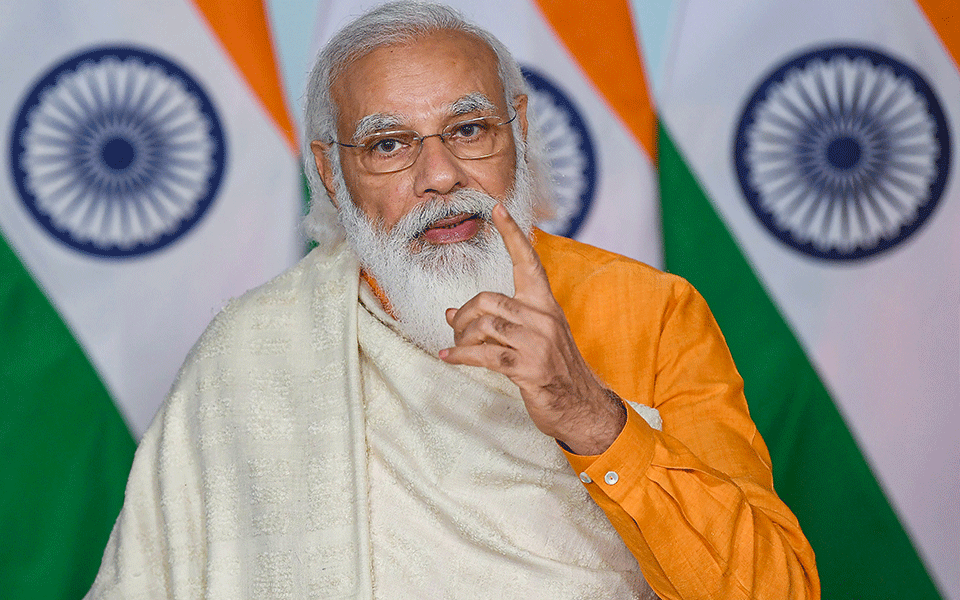
Ahmedabad: Prime Minister Narendra Modi on Saturday praised the country's judiciary, saying that it has performed its duty well in safeguarding people's rights and upholding personal freedom, and added that it has also strengthened the Constitution.
He said the Supreme Court in India has conducted the highest number of hearings via video-conferencing from among the top courts of all the countries in the world during the coronavirus pandemic.
Modi also said that in order to make the country's justice system future-ready, the possibility of using Artificial Intelligence (AI) was being explored.
He was speaking after virtually releasing a commemorative postage stamp on the Gujarat High Court for sixty years of its establishment.
"Every countryman can say that our judiciary has worked with firmness to uphold our Constitution. Our judiciary has strengthened the Constitution by its positive interpretation," Modi said.
"The Supreme Court has conducted the highest number of hearings through video-conferencing in the world during the pandemic," he said.
Through constructive and creative interpretation of the Constitution, our judiciary has strengthened the Constitution itself, he added.
"Whether it is to safeguard the rights of citizens, question of personal freedom, or a situation wherein the interest of the country is to be given top-most priority, the judiciary has both understood and fulfilled its responsibilities," he said.
He said the root of good governance is in law, as has been held in the ancient Indian scriptures, he said.
"This idea has been a part of our 'sanskar' since ancient times. This mantra gave moral strength to our freedom struggle, and the makers of our Constitution also gave it top priority," he said.
This trust towards the judiciary has given confidence to the common man, given him the strength to stand for truth, Modi said. The prime minister said that "the proud structure of justice stands on the pillar of Bar".
"Since decades, bar and judiciary have together been fulfilling the basic purpose of justice in our country," he said.
Modi also highlighted that the Gujarat High Court became the first court in India to start live streaming of proceedings during the pandemic.
"For us, it is a matter of satisfaction that the digital infrastructure created by the justice department under its e-court integrated mission mode has in such a short span of time helped our courts work in virtual mode," he said.
"Digital India mission is rapidly modernizing the justice system. Today, more than 18,000 courts have been computerised in the country. With video-conferencing and tele-conferencing getting legal sanctity from the Supreme Court, e-proceedings have gained pace across all courts.
"We feel proud to hear that our Supreme Court has become the top among the apex courts in terms of conducting hearings through video conferencing," he said.
Facilities like e-filing of cases, unique ID and QR codes to access case details, have given a new dimension to ease of justice, he said.
Talking about the National Judicial Data Grid (NJDG), Modi said that the system will help lawyers and litigants see cases and orders with a click of mouse.
"This ease of justice is not only improving the ease of living of our people, but has also helped in ease of doing business. This has given confidence among foreigners that their judicial rights will be safe in India. In its 2018 ease of doing business report, the World Bank has also praised the NJDG," he said.
The PM said that a Supreme Court committee and National Informatics Centre (NIC) are working together to further ease the justice system in India.
"To make our justice system future-ready, the possibility of Artificial Intelligence (AI) is also being explored," he said.
"With AI, the efficiency and speed of judiciary will increase. In these efforts, the country's Atmanirbhar Bharat campaign is going to play a big role. Under it, the video conference platform is also being encouraged," he said.
Modi said that e-seva kendras are also being opened in the high courts and district courts to bridge the digital divide.
He said e-Adalat has become "timely and convenient means of justice". During the pandemic, online e-Lok Adalat has become a new normal, he said.
Modi further said the first Lok Adalat was held in Junagadh in Gujarat around four decades back and it was the first state to begin evening courts and took many initiatives for the benefit of the poor.
Modi praised judiciary for presenting an excellent example of its dedication and duty during the COVID-19 pandemic period, by dispensing justice through video conferencing, SMS callout, e-filing and e-mail my case status services, streaming on court's display boards, uploading of orders on the daily basis, and others.
Union minister Ravi Shankar Prasad, Supreme Court judge Justice M R Shah, Gujarat HC Chief Justice Vikram Nath, state Chief Minister Vijay Rupani and others attended the event.
Let the Truth be known. If you read VB and like VB, please be a VB Supporter and Help us deliver the Truth to one and all.
Maharashtra sets up state vaccination task force to strengthen immunisation programme

Mumbai (PTI): The Maharashtra government has set up a State Vaccination Task Force to strengthen the regular immunisation programme and review the progress of related campaigns, a health department official said on Monday.
The State Vaccination Task Force will comprise at least 29 members and will be headed by the administrative head of the health department, he informed.
The government has also constituted separate district-level and municipal vaccination task forces to improve implementation and address challenges at the grassroots level, he said.
Municipal task forces, chaired by respective civic commissioners, have been constituted in view of the vast urban population in Maharashtra and the role of civic bodies in implementing different health programmes.
The district-level task forces will function under the chairmanship of collectors.
"Complete immunisation of children at the appropriate age is an extremely simple, cost-effective and highly effective measure to reduce child mortality and the prevalence of diseases among kids. Immunisation is a powerful tool for reducing illness in children," maintained the official.
To ensure full vaccination of all children, the state government implements various campaigns from time to time as per the central government guidelines, he pointed out.
"Active participation and cooperation of other relevant government departments are essential (in making these campaigns successful)," according to the official.
The state-level body will review the regular immunisation programme, associated campaigns and vaccine-preventable diseases in detail. It will also conduct focused assessments of high-risk districts and municipal corporations, including vacancies at district, municipal and sub-district levels, availability of cold chain equipment, resource gaps and training requirements, he noted.
The state task force will review allocation and utilisation of funds for immunisation and ensure timely action by officers concerned based on reports from district and municipal task forces and state-level monitoring mechanisms, the official said.
It will also ensure active coordination and participation of other government departments in immunisation drives, while district and municipal task forces will carry out similar functions at their respective levels, the official added.