PM Modi hoists saffron flag atop Ayodhya Ram temple, says centuries-old wounds healing today
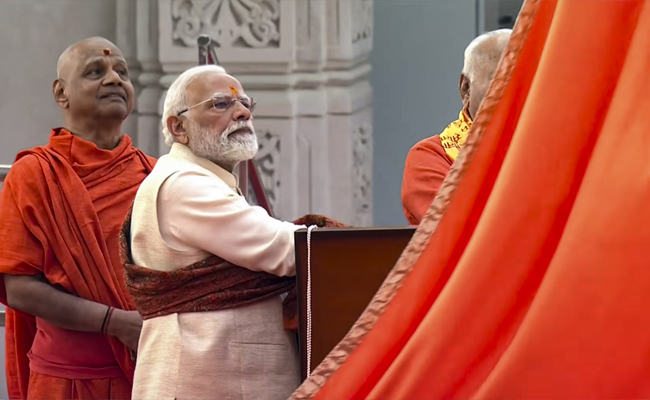
Ayodhya(UP) (PTI): Prime Minister Narendra Modi on Tuesday said the "wounds and pain" of centuries are healing as a 500-year-old resolve is finally being fulfilled with the formal completion of the Ram temple here.
Modi made the remarks after ceremonially hoisting a saffron flag atop the Ram temple, an event marking the official completion of the shrine.
He was joined by RSS chief Mohan Bhagwat, Uttar Pradesh Governor Anandiben Patel and Chief Minister Yogi Adityanath.
Calling the moment "epochal," the prime minister said Ayodhya was witnessing another historic milestone and added that "the entire country and the world are immersed in Ram."
Modi said the sacred flag would stand as a testament that "truth ultimately triumphs over falsehood," and congratulated Ram 'bhakts' along with all those who contributed to the construction of the temple.
Prime Minister Modi said, "Our Ram does not discriminate, and we too are moving forward with the same spirit," urging citizens to embrace inclusivity as the nation advances.
He said that by 2047, when India completes 100 years of Independence, the country must achieve the goal of becoming a developed nation, adding that "we will have to awaken the Ram within us" to realise this vision.
Modi stressed the need to take pride in India's civilisational heritage and "break free from the mentality of slavery," calling for a decisive effort over the next 10 years to shed inherited inferiority complexes.
He said the influence of Macaulay's legacy persisted long after Independence, asserting that India must rid itself of this mindset to progress.
Rejecting what he termed a "distortion" that democracy was borrowed from abroad, Modi said, "India is the birthplace of democracy and it is embedded in our DNA."
According to officials, the flag hoisting marked the formal completion of the Ram temple complex, nearly six years after the Supreme Court's landmark 2019 verdict that allotted the entire 2.77-acre disputed site for the Ram Mandir.
According to an official statement, the saffron flag measuring 22 feet x 11 feet is made of parachute-grade cloth with a thick nylon hoisting rope, and is mounted atop a 161-foot spire.
The flag bears symbols of the Sun, representing Lord Ram's Surya Vansh, Om, and the Kovidara tree, described as the state tree of Ram Rajya.
Temple officials said the idol of Ram Lalla is located in the 'Garbhagriha' on the ground floor, a climb of 32 steps from the Singh Dwar on the eastern side.
The complex includes five mandaps - Nritya, Rang, Sabha, Prarthana and Kirtan
and features restored heritage structures such as the ancient Shiv Mandir at Kuber Tila and the historic Sita Koop.
The Ram temple project began after the Supreme Court's unanimous judgment dated November 9, 2019.
Following the ruling, the Centre constituted the Shri Ram Janmabhoomi Teerth Kshetra Trust, announced by Prime Minister Modi on February 5, 2020.
The foundation stone for the temple was laid on August 5, 2020, and the 'Pran Pratishtha' of the Ram Lalla idol took place on January 22, 2022.
The Ram Darbar was opened to devotees on June 14, 2025.
Let the Truth be known. If you read VB and like VB, please be a VB Supporter and Help us deliver the Truth to one and all.
Gujarat builds 870 MW battery power backup network to stabilise renewable energy grid
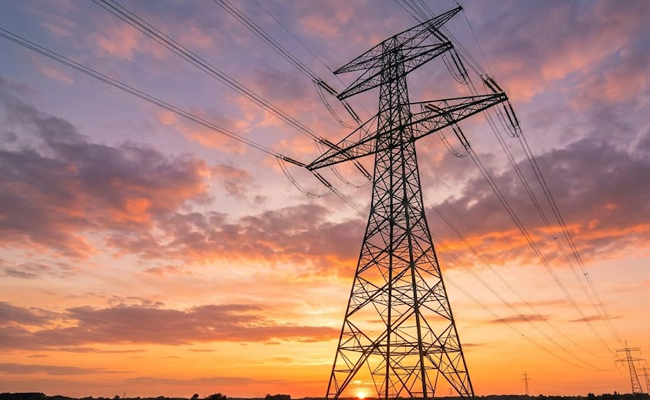
Gandhinagar (PTI): Gujarat has initiated battery storage systems at five locations in the state, with a total capacity of 870 MW, to maintain the stability of the renewable power grid, officials said on Saturday.
Battery Energy Storage Systems (BESS) are essential for storing electricity generated from solar and other renewable sources. They help manage additional load and maintain grid stability.
“Gujarat has initiated battery storage systems at five locations with a total capacity of 870 MW,” an official release stated.
The state has also registered 13 projects across Ahmedabad, Gandhinagar, Banaskantha, Patan and Kutch districts to set up additional battery storage systems, it said.
Modhera in Gujarat, India’s first solar village, has launched the country’s first BESS integrated with a solar power plant, it said.
"Under the leadership of Chief Minister Bhupendra Patel, the state has continued to advance in this direction and has strengthened its position among the leading states driving battery storage systems in India,” the release said.
Recently, a battery storage system was commissioned at Charal in the Sanand taluka of Ahmedabad, it said.
Four systems are operational at Modhera in Mehsana and Lakhpat in Kutch. The state government has also included advanced energy storage systems as a key component in the Gujarat Integrated Renewable Energy Policy, 2025, the release said.
Accordingly, standalone battery storage projects, works linked with new renewable energy installations, and those integrated with existing renewable energy systems are being approved, it said.
Once the Standard Operating Procedure is approved, registrations for battery storage will open for commercial and industrial users, it said, adding that the move will allow them to set up battery storage alongside their solar or wind projects.
The state government is developing battery storage systems across Gujarat, with companies being invited in through a competitive bidding process.
GETCO (Gujarat Energy Transmission Corporation) and power distribution companies strategically identify locations for battery storage systems based on grid capacity and operational requirements, the release said.
Power generation from solar and other renewable sources fluctuates throughout the day. Excess energy generated during peak hours can be stored and supplied later during periods of high demand, especially in the evening when solar output declines. Battery storage systems help reduce stress on the grid and improve grid stability, it added.