PM Modi holds high-level review meeting on national security amid LoC tensions
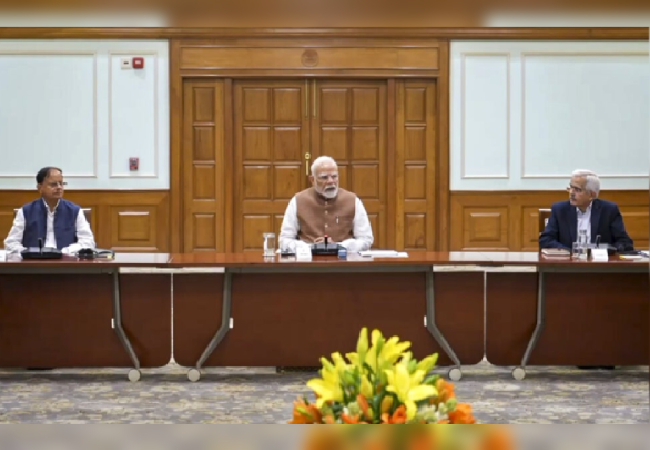
New Delhi: In the wake of rising tensions along the Line of Control (LoC), Prime Minister Narendra Modi chaired a high-level meeting on Thursday to assess national preparedness and ensure coordination between ministries and departments amid ongoing security concerns.
The meeting, held in New Delhi, was attended by the Cabinet Secretary, senior officials from the Prime Minister’s Office (PMO), and Secretaries from key ministries including Defence, Home Affairs, External Affairs, Information and Broadcasting, Power, Health, and Telecommunications.
A government press release stated that the Prime Minister emphasised the importance of seamless coordination among ministries and agencies to maintain operational continuity and institutional resilience during this sensitive time. He reviewed the plans and preparedness of ministries to handle the current situation effectively.
Ministries have been directed to carry out a thorough review of their essential functions, with special focus on emergency preparedness, internal communication systems, and overall readiness. Secretaries of various departments presented their action plans and assured the PM of a coordinated, whole-of-government approach.
During the discussion, several critical areas were reviewed, including the strengthening of civil defence mechanisms, countermeasures against misinformation and fake news, and protection of critical infrastructure. Ministries were also instructed to work in close coordination with state governments and grassroots-level institutions to ensure effective implementation on the ground.
The official statement said ministries are equipped to respond to any emerging scenario and are reinforcing systems accordingly.
Prior to the high-level review, PM Modi met National Security Advisor (NSA) Ajit Doval at his residence. Sources revealed that the NSA briefed the Prime Minister about the current situation along India’s western border, particularly after Operation Sindoor, and developments in the region. The closed-door meeting lasted nearly an hour.
Following this, the Union Home Secretary also met the Prime Minister to further update him on internal security matters.
These meetings come amid heightened tension in Jammu and Kashmir, where 13 civilians were killed and 59 others injured in heavy shelling by Pakistani forces along the LoC. All fatalities were reported from the Poonch sector. The government has confirmed that these were the result of ceasefire violations.
Let the Truth be known. If you read VB and like VB, please be a VB Supporter and Help us deliver the Truth to one and all.
EAM Jaishankar meets Jamaican PM, gifts over 10 BHISHM Cubes
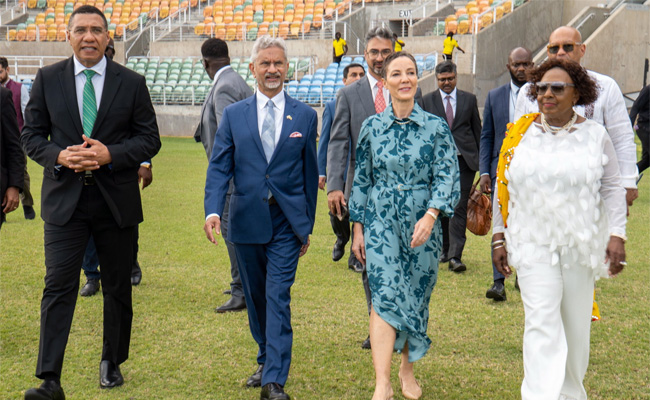
Kingston (PTI): External Affairs Minister S Jaishankar on Monday met Jamaican Prime Minister Andrew Holness and discussed ways to further deepen "political, economic and people-to-people cooperation."
Jaishankar also conveyed greetings from Prime Minister Narendra Modi to Holness.
"Pleased to call on Prime Minister @AndrewHolnessJM in Kingston. Conveyed the greetings of PM @narendramodi," Jaishankar posted on X.
"Discussed deepening our political, economic and people-to-people cooperation. Value his commitment towards further strengthening India-Jamaica relations," the post further read.
Also, the external affairs minister handed over 10 BHISHM (Bharat Health Initiative for Sahyog Hita & Maitri) Cubes as a gift to Jamaica.
"Formally handed over 10 BHISHM Cubes as a gift from India to Jamaica, in the presence of PM @AndrewHolnessJM, Health Minister @christufton and FM @kaminajsmith," Jaishankar posted on X.
"The BHISHM Cube mobile hospital system, designed for rapid deployment, will help Jamaica during disasters and emergencies. The gift of these cubes is a statement of friendship, a commitment to disaster preparedness, and an outcome of innovation," the post said.
Jaishankar arrived in Kingston on Saturday evening, marking the first leg of his nine-day tour of Jamaica, Suriname, and Trinidad and Tobago, aimed at further strengthening India's strategic and cultural ties with the Caribbean nations.
Earlier in the day, he interacted with the Indian diaspora and discussed India's ongoing transformation in infrastructure, human development and technology-driven governance and entrepreneurship with them.
He also highlighted the cricket bond between both countries as India gifted a scoreboard to Jamaica.
A scoreboard was dedicated at Sabina Park in Kingston. It is the home of the Jamaica cricket team and is the only Test cricket ground in the Caribbean island nation.
The minister expressed hope that the new scoreboard would witness many memorable innings, including those symbolising the enduring friendship between the two countries.
Cricket has long been a strong cultural bridge between India and Jamaica, which is part of the West Indies cricket team.
Jamaican players, including Chris Gayle, Courtney Walsh and Michael Holding, have played a major role in shaping the legacy of West Indies cricket in the international arena, contributing to its dominance in earlier decades and its continued global appeal.