PM Modi holds talks with Dutch counterpart Jetten; discusses trade, investment
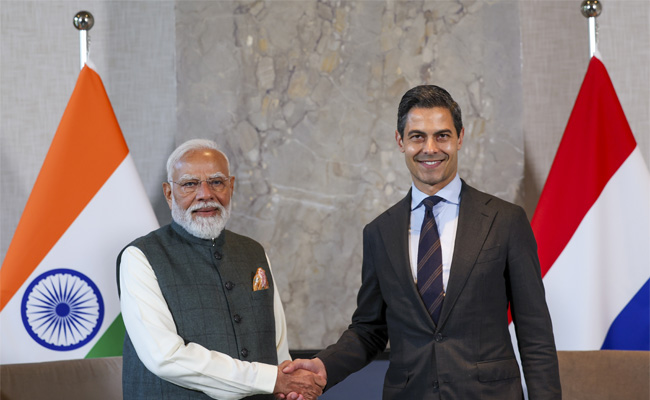
The Hague (PTI): Prime Minister Narendra Modi on Saturday held wide-ranging talks with his Dutch counterpart Rob Jetten, focusing on trade, investment, and critical technologies.
Modi arrived in the Netherlands on Friday on the second leg of his five-nation tour. This is his second trip to the Netherlands, following his visit in 2017.
Ahead of the bilateral talks, Modi, along with Jetten, held discussions with prominent CEOs of leading Dutch companies across various sectors such as energy, ports, health, agriculture trade, and technology, among others.
Modi invited Dutch companies to explore opportunities in India, particularly in maritime, renewable energy, digital technologies, semiconductors, artificial intelligence, and healthcare sectors.
"We are continuously reducing compliance and increasing the ease of doing business. We have recently carried out next-generation reforms in taxation, labour code, and governance," he told the business leaders.
The prime minister added that manufacturing in India is becoming very cost-effective, and in the services sector, it has become the engine of efficiency and innovation.
"We invite all of you to design and innovate in India. There can be no better time for this than today," he said.
"Today's India is a symbol of scale and stability. In terms of scale, we are also the fastest-growing major economy in the world and the world's largest talent pool. Infrastructure, clean energy or connectivity – no one in the world can match India's speed," Modi said.
"And on the subject of stability, I have completed 12 years of serving as the Prime Minister of the world's largest democracy. In these 12 years, with continuous reforms, we have transformed our economic DNA. Our direction has been clear – to give policy predictability to the private sector and increase opportunities for them," he added.
Modi said his government has opened up every sector for the private sector, be it space, mining or nuclear energy.
Ahead of the meeting, an agreement between ASML and Tata Electronics was signed in the presence of the two leaders.
The two prime ministers also called for early implementation of the India-EU-FTA.
Earlier, Prime Minister Modi met King Willem-Alexander and Queen Maxima at the Royal Palace and discussed close cooperation in digital technology, innovation, fintech and blue economy.
PM Modi's visit will build on the momentum of high-level engagements and close cooperation spanning diverse sectors, including defence, security, innovation, green hydrogen, semiconductors and a strategic partnership on water, the MEA said ahead of his visit.
The Netherlands is one of India's largest trade destinations in Europe, with bilateral trade worth USD 27.8 billion in 2024-25. The European nation is India's fourth-largest investor with cumulative foreign direct investment of USD 55.6 billion.
From the Netherlands, the prime minister will travel to Sweden for a two-day trip from May 17 to 18.
Let the Truth be known. If you read VB and like VB, please be a VB Supporter and Help us deliver the Truth to one and all.
At UN, India flags concerns over targeting of vessels in Strait of Hormuz
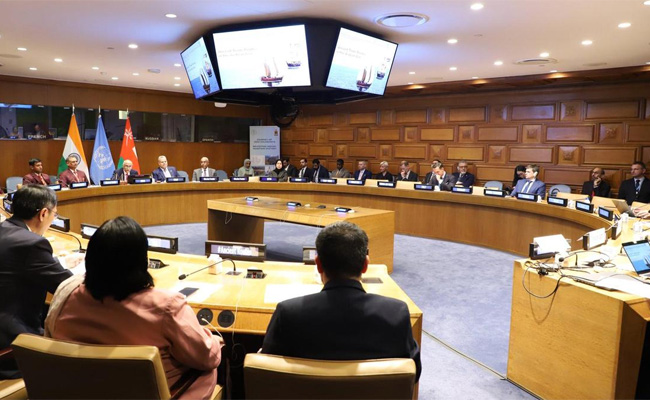
United Nations (PTI): Targeting commercial shipping, endangering civilian crew and impeding freedom of navigation in the Strait of Hormuz is "unacceptable", India’s Permanent Representative to the UN Parvathaneni Harish has said.
Harish's remarks at a special meeting of the United Nations Economic and Social Council (UNECOSOC) on safeguarding energy and supply flows came days after an India-flagged commercial vessel came under attack off the coast of Oman.
Omani authorities rescued all 14 crew members of the vessel sailing from Somalia, but it was not immediately known who carried out the strike.
In a post on X on Sunday, Harish said that at the UNECOSOC meeting, he shared India's approach to the recent energy and fertiliser crisis caused by the West Asia conflict.
"A combination of short-term and structural measures alongside international cooperation are essential to respond to the crisis," he said.
"Reiterated that targeting of commercial shipping, endangering civilian crew and impeding freedom of navigation in the Strait of Hormuz, are unacceptable. International law in this regard must be fully respected," he added.
The attack on the India-flagged vessel on May 13 took place amid the fragile situation in the Strait of Hormuz, a narrow waterway close to the coast of Oman through which roughly one-fifth of the world's energy supplies pass.
It has been severely disrupted by the conflict in West Asia that started on February 28, with the US and Israel launching joint attacks on Iran, triggering retaliatory strikes.
Earlier, India had described the attack as "unacceptable".
At least two other Indian-flagged ships have been attacked since the conflict broke out.
According to the UNECOSOC website, the meeting, which took place on Friday, focused on “Safeguarding energy and supply flows: Supporting global development through international cooperation”.