PM Modi leaves for home after concluding visit to Saudi Arabia
Riyadh:Prime Minister Narendra Modi concluded his visit to Saudi Arabia on Tuesday, during which he held extensive talks with the top Saudi leadership and addressed a key financial forum here.
Modi, who arrived here Monday night, held wide-ranging talks with Saudi King Salman bin Abdulaziz and powerful Crown Prince Mohammed bin Salman, during which a Strategic Partnership Council was established to coordinate on important issues.
A memorandum of under standing was also signed to roll out RuPay card in the Kingdom - making Saudi Arabia the third country in the Persian Gulf after the UAE and Bahrain to introduce India's digital payment system.
Ministry of External Affairs spokesperson Raveesh Kumar tweeted, "Leaving with a marked upswing in bilateral relations. PM Narendra Modi departs from Riyadh after steering the India-Saudi relationship on a upward trajectory pointing towards greater collaboration in future."
Prime Minister Modi also delivered a keynote address at the high-profile Future Investment Initiative (FII), dubbed as 'Davos in the desert', where he pressed for the United Nations reforms while expressing regret over some "powerful" countries using the global body as a "tool" rather than an "institution" to resolve conflicts.
At the forum, he said that India will invest a USD 100 billion in oil and gas infrastructure to meet energy needs of an economy that is being targeted to nearly double in five years. He also sought investment from the oil-rich Saudi Arabia and other nations to boost supplies.
India's relations with Saudi Arabia have been on an upswing over the last few years based on burgeoning energy ties. India's bilateral trade with Saudi Arabia was at USD 27.48 billion in 2017-18, making Saudi Arabia its fourth largest trading partner.
This was Prime Minister Modi's second visit to the country. During his first visit, King Salman conferred Saudi's highest civilian award on him. The Crown Prince visited India in February 2019, giving a further fillip to the bilateral ties.
Saudi Arabia last month said that it was looking at investing USD 100 billion in India in areas of energy, refining, petrochemicals, infrastructure, agriculture, minerals and mining.
Let the Truth be known. If you read VB and like VB, please be a VB Supporter and Help us deliver the Truth to one and all.
Delhi to adopt fully digital system for time bound traffic challan disposal
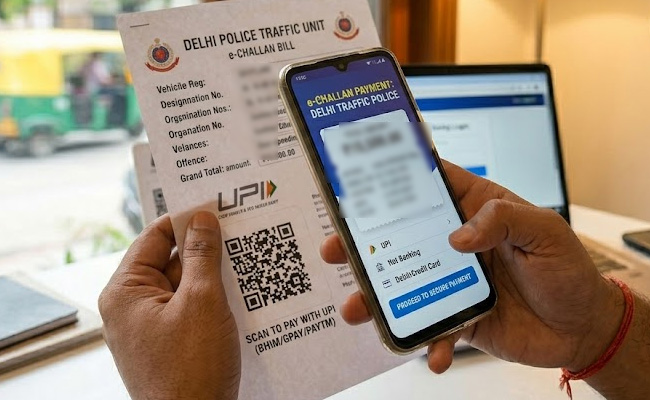
New Delhi (PTI): The Delhi government will soon implement amended Central Motor Vehicles Rules, 1989, making the traffic challan process completely digital and time-bound, to curb violations and enhance road safety, Chief Minister Rekha Gupta said on Sunday.
Under the new framework, avoiding challans will no longer be possible and timely resolution will be mandatory for all citizens. Importantly, violators will not be able to approach courts directly to contest a challan without first going through the prescribed process, said a Delhi CMO statement.
Anyone committing five or more traffic violations within a year will be classified as a "serious offender" and will risk suspension or disqualification of their driving licence under the amended rules, it said.
Gupta noted that the issuance of challans will now be fully modernised.
Police or authorised officers can issue challans either physically or electronically. In addition, violations captured through cameras and digital surveillance systems will automatically generate challans. The e-challans will be delivered within three days to the violators through their mobile numbers, and a physical notice will be delivered within 15 days.
Once a challan is issued, the violator will have 45 days to either pay the fine or challenge it before a grievance redressal officer through the online portal, supported by documentary evidence. If no action is taken within this period, the challan will be deemed accepted, and payment must be made within the next 30 days, the statement said.
If a challenge is rejected, the individual can either pay the fine within 30 days or approach the court after depositing 50 per cent of the challan amount.
Failure to act within the stipulated time will result in the challan being treated as accepted, with payment required within 15 days thereafter.
Payments can be made through electronic modes. The grievance redressal officer will be required to upload a decision on the portal within 30 days, it said.
The chief minister made it clear that once deadlines lapse, daily electronic notices will be issued. Continued non-payment will lead to restrictions on all vehicle-related services, including payment of taxes and processing of driving licence or registration-related requests.
The vehicle will be flagged on the official portal as 'not to be transacted,' effectively blocking any further transactions until the dues are cleared. In cases where necessary, and subject to court orders, police or authorised officers may also impound vehicles involved in violations.
All challans will be issued in the name of the registered vehicle owner, who will be notified via SMS, email or other digital means, it added.