PM Modi pays tributes at National War Memorial on Republic Day
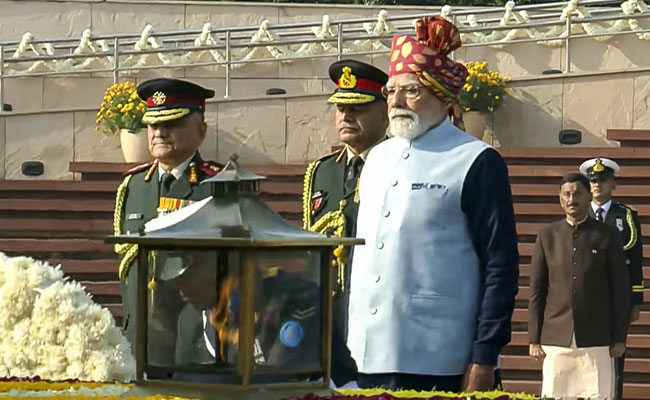
New Delhi (PTI): Prime Minister Narendra Modi paid tributes to fallen soldiers at the National War Memorial here on Monday on the occasion of the 77th Republic Day.
Escorted by the chief of defence staff and the three Service chiefs, the prime minister led the nation in paying solemn tributes by laying a wreath at the memorial.
Modi was received at the National War Memorial by Defence Minister Rajnath Singh.
The officers in uniform gave a salute while other dignitaries observed a two-minute silence to honour the fallen soldiers.
The silence was broken by the buglers sounding the 'Rouse', signalling the end of the two minutes of remembrance. The Guard Commander then ordered the 'Salami Shastra', concluding the ceremony.
The PM also signed the Visitors' Book before departing for the saluting dais at the Kartavya Path.
The iconic memorial in the India Gate complex was inaugurated by Modi in 2019. It is dedicated to soldiers killed during the India-China War in 1962, the India-Pakistan wars of 1947, 1965 and 1971, Indian Peace Keeping Force Operations in Sri Lanka and during the Kargil Conflict of 1999, and also those in the UN peacekeeping missions.
Spread over an area of approximately 40 acres, the National War Memorial comprises four concentric circles -- the 'Amar Chakra', 'Veerta Chakra', 'Tyag Chakra' and the 'Rakshak Chakra' with names of 25,942 soldiers inscribed in golden letters on granite tablets.
It also includes a central 15.5m obelisk, an eternal flame and six bronze murals depicting famous battles fought by the Indian Army, Air Force and Navy in a covered gallery (Veerta Chakra).
Let the Truth be known. If you read VB and like VB, please be a VB Supporter and Help us deliver the Truth to one and all.
Mangaluru: Four-way waste segregation rolled out under new rules
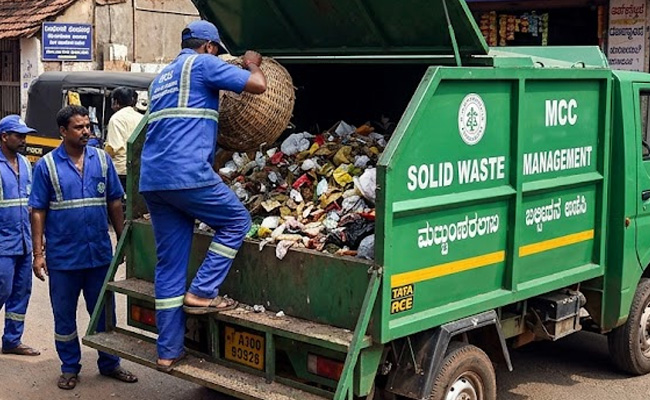
Mangaluru: The Mangaluru City Corporation (MCC) has begun implementing the revised Solid Waste Management Rules 2026, which came into effect nationwide from April 1, making four-way waste segregation mandatory for all residents and establishments.
According to Deccan Herald, under the new system, waste must be segregated into four categories before being handed over to collection vehicles:
1. Wet waste such as kitchen refuse, fruit and vegetable peels, leftover food, meat waste, flowers and leaves.
2. Dry waste including plastic materials, bottles, paper, cardboard and rubber
3. Sanitary waste comprising used sanitary pads, diapers, condoms and bandages
4. Special care or domestic hazardous waste such as used batteries, LED bulbs, tube lights, paint containers, pesticide bottles and thermometers.
MCC Commissioner Ravichandra Naik said wet and sanitary waste will be collected daily, while dry and hazardous waste will be collected once a week (Fridays) to improve efficiency in handling different waste streams.
The corporation has also introduced stricter norms for bulk waste generators, defined as establishments producing more than 100 kg of waste per day, or having a built-up area exceeding 20,000 square metres, including offices, malls, hospitals and large residential complexes, as well as units consuming over 40,000 litres of water daily, will be treated as bulk waste generators and will be subject to stricter norms.
The MCC warned that violations of segregation rules will attract penalties under the Solid Waste Management Bye-laws, 2019, and urged citizens to strictly follow the new system.
For further information, citizens have been advised to contact or visit the Health Department of the corporation during office hours, said the commissioner.
To encourage sustainable practices, the civic body has also launched an initiative recognising zero-waste weddings. Recently, Commissioner Ravichandra Naik honoured Veerendar and Suraksha for conducting an eco-friendly wedding at Rajatadri auditorium in Vamanjoor on March 30.
The MCC in its X handle said "the wedding embraced a zero waste, plastic free and eco friendly concept."
At the ceremony, no plastic bottles were used; guests were served drinks in steel tumblers. No tissue papers were distributed during the programme. Ice cream was served in cups made of arecanut sheets. The stage was decorated with flowers and eco-friendly reusable decorative materials.
Eco-Friendly Wedding: A Green Start!
— ಮಂಗಳೂರು ಮಹಾನಗರ ಪಾಲಿಕೆ | Mangaluru City Corporation (@mangalurucorp) March 31, 2026
Hon'ble Commissioner Sri Ravichandra Naik, KAS, presented an appreciation letter to the couple Suraksha-Veerendra for their noble initiative. Their wedding at Vamanjoor (30-03-2026) embraced a Zero Waste, Plastic-Free, & Eco-Friendly concept. pic.twitter.com/Rlf8piTDUN