PM Modi speaks to Brazil's Lula, says ties key for interests of Global South
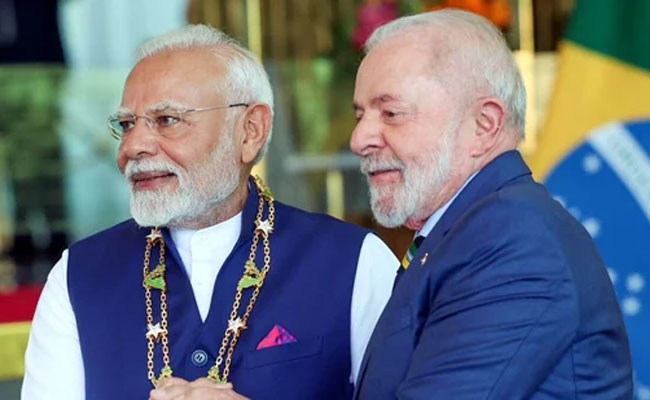
New Delhi (PTI): Prime Minister Narendra Modi spoke to Brazilian President Luiz Inacio Lula da Silva on Thursday and asserted that close cooperation was vital for advancing the shared interests of the Global South.
Modi received a call from the Brazilian president, and the two leaders underscored the importance of reformed multilateralism in addressing shared challenges, an official statement said.
The prime minister also said he was looking forward to welcoming the Brazilian president to India soon.
"Glad to speak with President Lula. We reviewed the strong momentum in the India-Brazil Strategic Partnership, which is poised to scale new heights in the year ahead," Modi said in a post on X.
"Our close cooperation is vital for advancing the shared interests of the Global South. I look forward to welcoming him to India soon," he added.
The two leaders reaffirmed their commitment to further strengthen the India-Brazil Strategic Partnership and take it to even greater heights in the year ahead, the statement said.
"The leaders also exchanged views on regional and global issues of mutual interest. They also underscored the importance of reformed multilateralism in addressing shared challenges," it said.
Recalling their meetings last year in Brasilia and South Africa, the two leaders noted with satisfaction the significant progress achieved across diverse areas of bilateral cooperation, including trade and investment, technology, defence, energy, health, agriculture, and people-to-people ties.
Let the Truth be known. If you read VB and like VB, please be a VB Supporter and Help us deliver the Truth to one and all.
Man arrested with Rs 2.54-crore heroin in Mumbai

Mumbai (PTI): Police have arrested a man and seized over 500 grams of heroin worth Rs 2.54 crore in the illicit market from him in Mumbai, officials said on Friday.
The police's Anti-Narcotics Cell (ANC) made the drug seizure in Santacruz in the western suburbs. The operation was conducted by the Kandivali unit of the ANC on Thursday as part of a special crackdown against drug trafficking in the area, they said.
Acting on specific inputs, an ANC team conducted a raid in Santacruz (East) and intercepted a man. During a search, the team recovered 508 grams of high-grade heroin from his possession, an official said.
The seized contraband, a highly addictive, opioid drug derived from morphine, is estimated to be worth Rs 2.54 crore in the international market, he informed.
Following the seizure, a case was registered against the man under relevant sections of the Narcotic Drugs and Psychotropic Substances (NDPS) Act, 1985, and he was formally placed under arrest in the early hours of Friday.
The police are currently investigating the source of the drug and trying to identify the intended recipients of the consignment, he said.