PM 'violating' Constitution, resorting to confrontational federalism: Cong
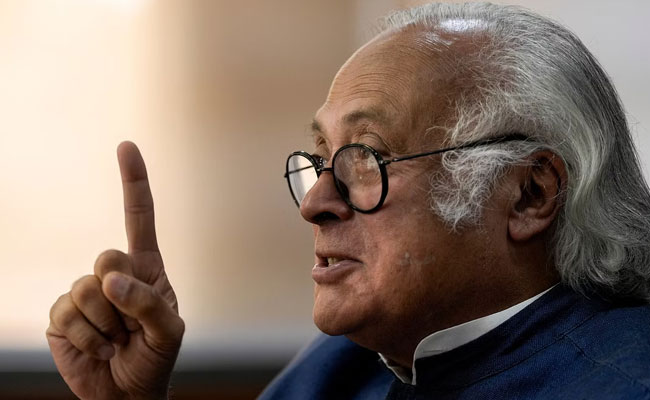
New Delhi (PTI): As INDIA bloc leaders gathered for a show of unity at the Ramlila ground here, the Congress on Sunday accused the Modi government of violating the Constitution by resorting to "confrontational federalism".
The Congress also accused the prime minister of resorting to fiscal centralisation, obstruction of state programs, destabilising state governments, misusing governors and subverting the rights of States.
In a statement, Congress general secretary Jairam Ramesh said as the INDIA Janbandhan's rally at Ramlila Maidan gets underway, it is necessary to recall how the PM is "violating", in letter and spirit, Article 1 of the Constitution of India that states "India, that is Bharat, shall be a Union of States."
He said the prime minister started off his innings in May 2014 talking big about cooperative federalism.
"Instead, what he has delivered is confrontational federalism. Cooperative federalism is based on consensus, for which the PM has demonstrated a singular unwillingness and incapacity. In contrast, confrontational federalism is based on creating conflict and division, which is the PM's core skill," Ramesh charged in his statement.
The Congress leader said there are five major patterns to the prime minister's "concerted assault" on the Constitution's federal structure - fiscal centralisation, obstruction of state programs, destabilising State governments, misuse of governors and subverting the rights of States.
Alleging fiscal centralisation, Ramesh said every time States get their constitutional share of taxes, or their legitimate entitlement, the PM and the FM make it out as though they are doing the states a big favour.
In reality, he said, there are multiple instances which show they are averse to sharing revenue with states.
He said cess is a type of tax that is not shared with the states and since 2014, the share of tax revenue collected as 'cess' or 'surcharge' has grown, from just around 10 percent to over 26 percent. In the last five years, the revenue collection from cessess have risen by over 133 percent, amounting to lakhs of crores withheld from states, he said.
Alleging interference in the Finance Commission, he said, "In a blatantly illegal and unconstitutional move, the prime minister tried to directly interfere in the working of the 14th Finance Commission, pressuring the Chairman to reduce the states' share of Central taxes from 42 percent to 33 percent".
Ramesh also alleged withholding of funds, saying 223 out of 236 taluks of Karnataka are grappling with the effects of drought, with 123 experiencing severe drought conditions.
Noting that Karnataka needs Rs 17,900 crore as compensation, and farmers have lost crops worth Rs 35,000 crore, he said not a single rupee has been released by the Centre to address this critical situation.
The Congress leader also accused the BJP of destabilising State governments and toppling several governments.
"Using its thousands of crores of ill-gotten electoral bond wealth and the intimidation of the ED/CBI/IT, the BJP has illegally attempted and/or successfully brought down many state governments since 2014 by breaking parties and buying MLAs. The list includes Maharashtra, Goa, Manipur, Madhya Pradesh, Puducherry, Uttarakhand, and Arunachal Pradesh," Ramesh charged.
"The ED, IT, and CBI have been rendered the frontal organisations of the BJP, and have been used to intimidate senior leaders of the INDIA bloc in several states. At least two chief ministers, and 11 ministers across the country, have been arrested while in office.
"The Modi government has been continuously inventing new ways for remote-controlled Governors to interfere in states functioning," he alleged.
Ramesh said Governors have become the first line of offense for the BJP in their attempts to topple Opposition Governments.
"In states like Maharashtra, even the Supreme Court has censured the Modi-appointed Governors for their unconstitutional attempts to destabilise sitting State Governments.
"Modi-appointed Governors are notorious for interfering in the governance of the state. This has included not giving assent to Bills for months or even years after they are passed in the legislature, facilitating the BJP's mergers and acquisitions department, hindering the appointment of Vice-Chancellors to universities, and refusing to allow the chief minister to decide his own Cabinet," the Congress leader alleged.
Alleging subverting the rights of states, he said the cooperative sector is a State subject, and different states have had huge success managing their own cooperatives, such as dairy in Gujarat or sugar in Maharashtra.
"However, the Modi government has tried to seize control of this sector by making a new Cooperatives Ministry in the Centre," he said.
Ramesh alleged that a stream of Modi-government interventions in education, whether NEP or NEET, takes away states' power to run their own education systems, and strips them of any voice in education policy.
"The myopic Centrally-imposed policies are making medical education inaccessible to state government school students, by setting the syllabus in accordance with the Central government curriculum. The linguistic diversity of India, from Marathi to Bengali, is not respected in these Central systems," he alleged.
Let the Truth be known. If you read VB and like VB, please be a VB Supporter and Help us deliver the Truth to one and all.
Putin meets Iran's FM Araghchi, says Russia ready to do its best to help bring peace to West Asia
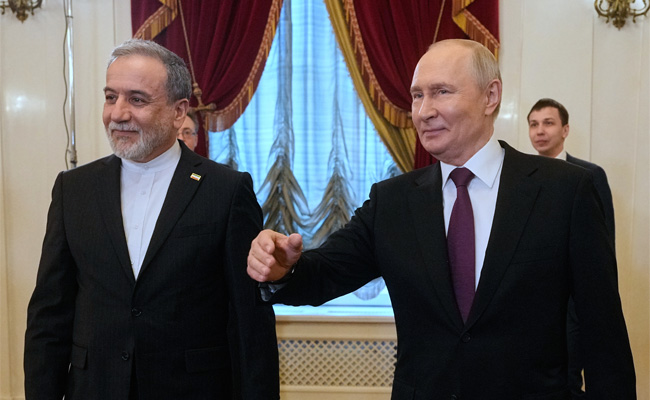
Moscow (PTI): Iran's Foreign Minister Abbas Araghchi on Monday met Russian President Vladimir Putin, who hailed the Iranian people for fighting bravely and heroically for their sovereignty and said Moscow is ready to do its best to help bring peace to West Asia as soon as possible.
Araghchi, who held talks with Omani and Pakistani leadership before arriving in Russia, met Putin in St. Petersburg and thanked him for supporting Iran, state-owned TASS news agency reported.
"Russia is ready to do everything in its power to ensure that peace in the Middle East is achieved as soon as possible," Putin said during his meeting with Araghchi, which was also attended by Russian Foreign Minister Sergey Lavrov.
Revealing that he received a message from Iranian Supreme Leader Mojtaba Khamenei last week, Putin asked Araghchi to convey his "gratitude for this message and best wishes for his health and well-being."
He praised the Iranian people for fighting "bravely and heroically" for their sovereignty, Iran's state-run PRESS TV reported.
"We really hope that, based on the courage and desire for independence, the Iranian people, under the guidance of the new leader, will weather this difficult period of trials and peace will come,” Putin said.
He also stressed that Russia “intends to maintain” its strategic relations with Iran.
Araghchi said that the world witnessed Iran’s strength in countering the US during the recent war, and that the Islamic Republic is a "stable and powerful establishment."
"With their courage, the Iranian people succeeded in resisting the US aggression and will be able to endure it,” he said.
He said that it became clear that Iran has “great friends and allies” like Russia, and conveyed “warmest greetings” from Supreme Leader Mojtaba Khamenei and President Masoud Pezeshkian to the Russian leader.
Araghchi said relations between Moscow and Tehran represent a “strategic partnership at the highest level” and will continue to develop "regardless of circumstances."
"We are grateful to you for the solid and strong positions in support of the Islamic Republic of Iran," he said.
Foreign Minister Lavrov said that the talks between President Putin and the Iranian Foreign Minister were "useful and constructive."
Kremlin Spokesman Dmitry Peskov later said that Russia is "ready to provide any good offices, any mediation services that are acceptable to the parties."
"We will be ready to do everything so that ultimately peace ensues, guaranteed peace, and that there is no return to hostilities," Peskov was quoted as saying by TASS.
He was asked how Moscow can assist in future negotiations on the Iranian settlement.
Araghchi arrived in Russia after his whirlwind trip to Islamabad, which, according to him, was “very productive” and involved “good consultations" with Pakistan's Army Chief Field Marshal Asim Munir, amid uncertainty over the second round of peace talks to resolve the war in West Asia.
"We held good consultations with our friends in Pakistan. The trip was successful. We assessed the outcome of our recent (meetings) and discussed in what direction and under what conditions talks can move on,” Araghchi said in a video posted on his Telegram channel upon his arrival in St Petersburg.
Referring to the second round of talks between the US and Iran to resolve the conflict in West Asia, Araghchi said: "Developments have taken place in the negotiations."
"Despite some progress in earlier rounds, the talks failed to reach their objectives due to the Americans' approach, the excessive demands they made, and the wrong approaches they adopted. Therefore, it was necessary to consult with our friends in Pakistan to review the latest situation,” Iran's official news agency IRNA quoted him as saying.
He said that the trip to Pakistan was a good opportunity to review developments related to the US-Israeli war against Iran, expressing confidence that “these consultations and coordination between the two countries will be highly significant.”
Araghchi arrived at St. Petersburg's Pulkovo Airport early Monday, where he was welcomed by Russian officials and Iran’s ambassador to Russia, Kazem Jalali, the report said.
The first round of peace talks between Iran and the US, held on April 11 and 12, failed to bring the desired result for the parties to the conflict.
The Iranian minister arrived in Islamabad for the second time on Sunday after a short visit to Oman, where he held talks with Sultan Haitham bin Tariq al-Said on security in the Strait of Hormuz and diplomatic efforts to end the Iran-US conflict.
After Araghchi left Pakistan for Oman on Saturday, President Donald Trump announced that US negotiators Steve Witkoff and Jared Kushner would no longer be going to Islamabad for talks with Iran, contending that Washington held all the cards on the matter.
Trump on Sunday reiterated that the US and Iranian officials can talk by phone for a peace solution to the conflict.
On Tuesday, Trump extended the two-week ceasefire with Iran indefinitely to give Tehran more time to prepare a unified proposal to end the war, just hours before the truce was set to expire.
The war began when the US and Israel jointly attacked Iran on February 28, killing Iranian Supreme Leader Ayatollah Ali Khamenei and several top commanders. The retaliation by the Islamic Republic extended the war to the entire Gulf region.