Polarisation across world is marked by social media growth, intolerance among communities: CJI
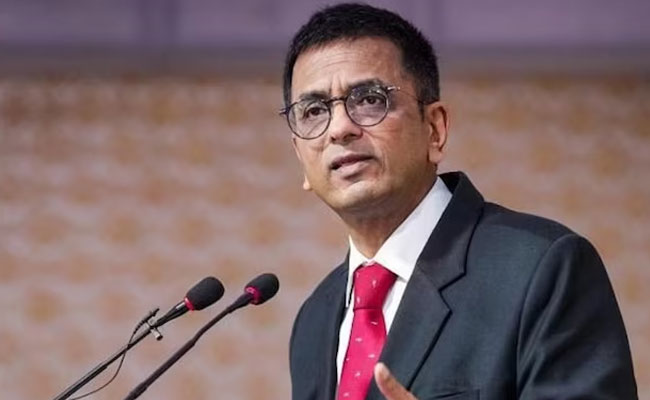
Mumbai (PTI): The polarisation across the world, with India not being an exception, is marked by the growth of social media and growing intolerance among communities, Chief Justice of India D Y Chandrachud has said here.
Speaking at the Jamnalal Bajaj Awards function on Friday, he also said that India's pluralistic culture and "ability to engage in dialogue" set it apart from many other countries which got independence during the same period but could not sustain democracy.
"Much of the polarisation which we see across the globalised world....the polarisation between right and left and the centre...the polarisation which we experience across the world and India is no exception, is also marked by the growth of social media, the sense of intolerance among communities, the short attention span which the younger generation has," Chandrachud said.
This was not an isolated phenomenon, and free markets and technology produced it, he added.
The CJI also spoke about how India's post-independence journey was unique.
Along with India, several other countries got freedom from colonial rule 75 years ago, but many of them were unable to attain true self- governance, while India was able to sustain its democracy, the CJI pointed out.
"What is that sets India apart from so many nations across the world which became free with us around the same time, but were not able to sustain freedom as a way of life? Some may possibly say that we internalised democracy, we have internalised constitutional values. Others will say the strength of our nation lies in its pluralistic culture, the culture of inclusion, the culture of all encompassing humanity," he stated.
The "power of gun" got the better of the rule of law in many countries, but India survived through the tough time because of our ability to engage in dialogue, Chandrachud added.
Public service is of paramount importance for a thriving society, but very few individuals embrace it wholeheartedly due to the challenges and barriers they encounter along the way, he said.
"Choosing a public service path often requires personal and professional sacrifice. Individuals may find themselves navigating a delicate balance where the demand of public duty clashes with the need of personal and career pursuits," the CJI said.
The judges see injustice "face to face", and while they try to resolve injustice within the boundaries of law, they also realize the limitations of law in creating a truly just society, he said.
"The importance of law lies in its ability to create a framework where there is an organised discourse possible, as I said where we replace the power bullets with power of reason. But equally, there is justice beyond the law and for justice beyond law we need to fathom our own hearts and our own communities to tap the innate goodness in the individual," Chandrachud said.
"Because the law can be a source of immense good, but law can be a source of immense arbitrariness (too). It depends on who wields the law and what are the social conditions in which the law is wielded," he added.
The 45th edition of the Jamnalal Bajaj Awards honoured, for their contribution to social service, Dr Regi George and Dr Lalitha Regi, Trustees, Tribal Health Initiative (THI); Dr Ramalakshmi Datta, Joint Director, Vivekananda Institute of Biotechnology; Sudha Varghese, Secretary, Nari Gunjan, and Raha Naba Kumar, Director and CEO, Gandhi Ashram Trust.
Let the Truth be known. If you read VB and like VB, please be a VB Supporter and Help us deliver the Truth to one and all.
Uttarakhand Assembly passes censure motion against opposition over women's reservation bill
Dehradun (PTI): The Uttarakhand Assembly passed a censure motion against the Congress and other opposition parties on Tuesday for allegedly blocking the passage of the Constitution (131st Amendment) Bill, 2026, in Parliament.
The motion, which expressed the House's formal disapproval of the opposition's conduct, triggered a massive uproar by Congress members, leading to the adjournment of the House sine die.
Parliamentary Affairs Minister Subodh Uniyal moved the censure motion, citing the "uncooperative attitude" of opposition parties toward the bill seeking 33 per cent reservation for women in legislative bodies.
Addressing a special daylong session convened specifically to discuss "Nari Samman -- Rights in Democracy", Chief Minister Pushkar Singh Dhami said the bill's passage would have benefitted every political party.
Dhami noted that after delimitation, the number of Assembly seats in the hill state would have gone up to 105, with 35 reserved for women. He added that the number of Lok Sabha seats from Uttarakhand would have risen from five to seven or eight.
"The opposition fears that if women from ordinary households enter politics, the shops of dynastic politics run by certain parties will shut down," the chief minister claimed.
He compared the opposition's conduct in Parliament to the assembly in Mahabharat where Draupadi was insulted. Dhami further likened the opposition's behaviour to the "arrogance of Ravan".
The chief minister highlighted his government's initiatives, asserting that Uttarakhand was the first state to implement a Uniform Civil Code (UCC) to protect women's rights. He said the UCC freed Muslim women from practices like "halala", "iddat", polygamy and child marriage.
Leader of Opposition Yashpal Arya questioned the technical feasibility of the bill, calling the ruling Bharatiya Janata Party's (BJP) claims of providing reservation by 2029 "misleading".
He argued that the bill is linked to census and delimitation processes. The Congress leader said the 2026 census would conclude by 2027 and the final data publication would take two more years.
"The delimitation process will take another six years. The actual implementation of this bill is not possible before 2034," Arya said, describing the move as a strategy to protect the BJP's "political ground".
The session also saw high drama outside the Assembly gates, where Congress MLA Virendra Jati staged a protest, demanding the payment of "outstanding" dues to farmers by sugar mills.
Jati arrived at the Assembly's main gate with a tractor-trolley loaded with sugarcane and dumped it on the road. The move brought the traffic to a halt, prompting traffic and security personnel to intervene and clear the area.
Women Congress workers also staged a demonstration against the "anti-people policies" of the state government.