Police, law and order to be under Centre in new UT of JK, land under elected govt
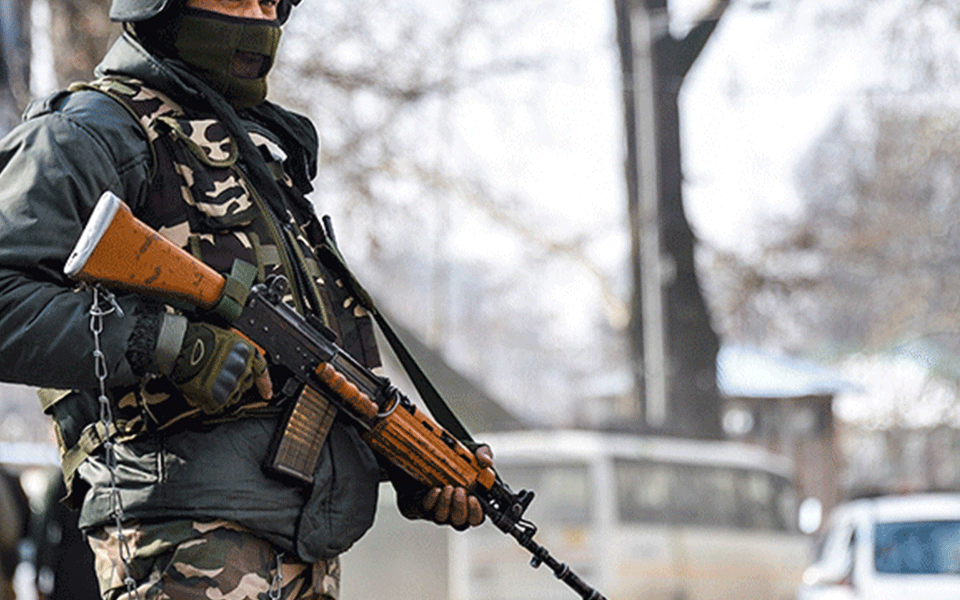
New Delhi: The Centre will be in direct control of the police and the law and order in Jammu and Kashmir from Thursday when it becomes a Union Territory, while the land will be under the elected government there.
According to the Jammu and Kashmir Reorganisation Act, 2019, the land -- the rights in or over it -- will be with the elected government of the Union Territory (UT) of Jammu and Kashmir, unlike in Delhi where the LG exercises control through the Delhi Development Authority (DDA), a central government entity.
The Act says the Legislative Assembly of the UT of Jammu and Kashmir may make laws for the whole or any part of the union territory with respect to any of the matters enumerated in the state list of the Constitution except the subjects mentioned in entries one and two -- 'public order' and 'police' respectively -- or the Concurrent List in the Seventh Schedule of the Constitution.
Police, and law and order in Delhi and Puducherry, both of which have their own legislative assembly, is controlled by the Centre through the Lieutenant Governor (LG).
All India Services like the Indian Administrative Service (IAS) and the Indian Police Service (IPS), and the Anti-Corruption Bureau (ACB) will be under the control of the LG and not the elected government of the UT of Jammu and Kashmir.
The services and the ACB have been among the key reasons for frequent tussle between the Arvind Kejriwal-led Delhi government and the Lieutenant Governor.
The Jammu and Kashmir Reorganisation Act says matters related to land, that is to say rights in or over it, land tenures, transfer and alienation of agricultural land, land improvement and agricultural loans will be under the domain of the elected government of the UT of Jammu and Kashmir.
Land revenue, including the assessment and collection, maintenance of land records, survey for revenue purposes and records of rights, and alienation of revenues will also come under the purview of the elected government of UT of Jammu and Kashmir.
Police, law and order, and land in the UT of Ladakh will be under the direct control of its LG, through whom the Centre will administer the high-altitude region. According to the Act, Ladakh will not have a legislative assembly.
On and from the appointed day, that is October 31, when the two new UTs will come into existence, the High Court of Jammu and Kashmir shall be the common high court for the UTs of Jammu and Kashmir, and Ladakh. The judges of the high court of J-K will become the judges of the common high court from Thursday.
The Act says the cadres of the IAS and IPS for the existing state of Jammu and Kashmir, on and from the appointed day, shall continue to function on the existing cadres.
However in future, the all India service officers to be posted to UTs of Jammu and Kashmir or Ladakh shall be borne on the Arunachal Pradesh, Goa, Mizoram and Union Territory cadre, more popularly known as UT cadre.
The total strength of the UT of Jammu and Kashmir assembly is 107 elected MLAs, which will be enhanced to 114 after delimitation. Twenty-four seats of the Assembly will continue to remain vacant as they fall under Pakistan-occupied Kashmir
Let the Truth be known. If you read VB and like VB, please be a VB Supporter and Help us deliver the Truth to one and all.
Delhi to adopt fully digital system for time bound traffic challan disposal
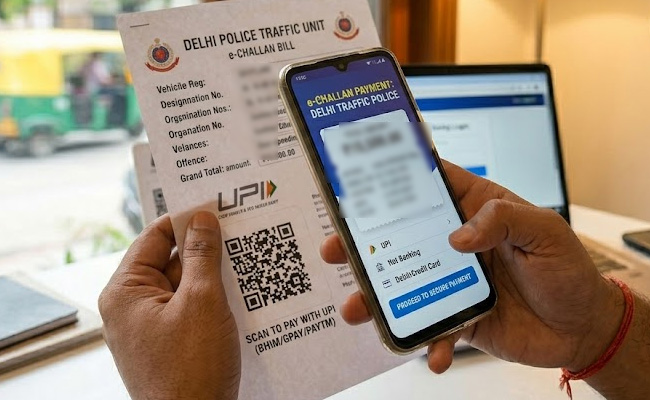
New Delhi (PTI): The Delhi government will soon implement amended Central Motor Vehicles Rules, 1989, making the traffic challan process completely digital and time-bound, to curb violations and enhance road safety, Chief Minister Rekha Gupta said on Sunday.
Under the new framework, avoiding challans will no longer be possible and timely resolution will be mandatory for all citizens. Importantly, violators will not be able to approach courts directly to contest a challan without first going through the prescribed process, said a Delhi CMO statement.
Anyone committing five or more traffic violations within a year will be classified as a "serious offender" and will risk suspension or disqualification of their driving licence under the amended rules, it said.
Gupta noted that the issuance of challans will now be fully modernised.
Police or authorised officers can issue challans either physically or electronically. In addition, violations captured through cameras and digital surveillance systems will automatically generate challans. The e-challans will be delivered within three days to the violators through their mobile numbers, and a physical notice will be delivered within 15 days.
Once a challan is issued, the violator will have 45 days to either pay the fine or challenge it before a grievance redressal officer through the online portal, supported by documentary evidence. If no action is taken within this period, the challan will be deemed accepted, and payment must be made within the next 30 days, the statement said.
If a challenge is rejected, the individual can either pay the fine within 30 days or approach the court after depositing 50 per cent of the challan amount.
Failure to act within the stipulated time will result in the challan being treated as accepted, with payment required within 15 days thereafter.
Payments can be made through electronic modes. The grievance redressal officer will be required to upload a decision on the portal within 30 days, it said.
The chief minister made it clear that once deadlines lapse, daily electronic notices will be issued. Continued non-payment will lead to restrictions on all vehicle-related services, including payment of taxes and processing of driving licence or registration-related requests.
The vehicle will be flagged on the official portal as 'not to be transacted,' effectively blocking any further transactions until the dues are cleared. In cases where necessary, and subject to court orders, police or authorised officers may also impound vehicles involved in violations.
All challans will be issued in the name of the registered vehicle owner, who will be notified via SMS, email or other digital means, it added.