Politician wanting to take credit: Tharoor slams Trump for declaring halting of Indo-Pak hostilities
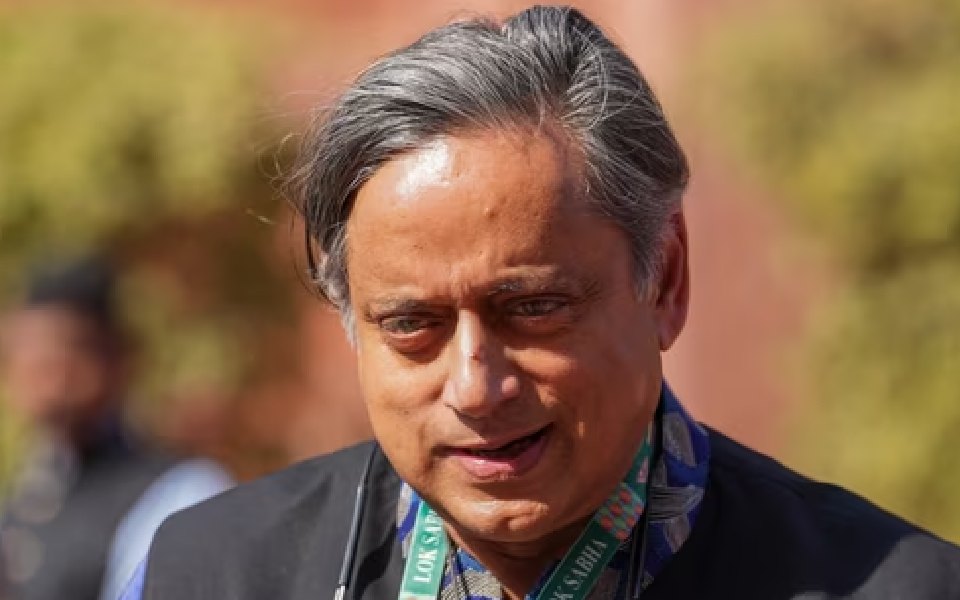
New Delhi, May 12 (PTI): Congress leader Shashi Tharoor on Monday described US President Donald Trump's announcement of halting military hostilities between India and Pakistan as "a politician wanting to take credit for something" and slammed the American leader for re-hyphenating the two South Asian countries.
Asserting that he did not like the social media post of Trump announcing the cessation of hostilities between India and Pakistan, Tharoor pointed out that the US president tried to make a "false equivalence" between India and Pakistan and said it was equating the victim with the perpetrator which was "shocking".
Asked about Trump's announcement, Tharoor told PTI Videos, "I see it as a particular politician wanting to take credit for something and I can see that the government of India probably said 'let them take the credit if they want to', but from our point of view we have made it clear that the peace followed a request from the DGMO of Pakistan who called his Indian counterpart at 3:35 pm (Saturday) and we did not take very long to say yes because we had never wanted a long war."
"We had made it very clear on May 7 that what we had done was to strike terrorist targets in reprisal for Pahalgam and the last thing that we wanted to see was the beginning of a long protracted conflict...We had said at every stage, we had done our thing, we have sent a message, if you react, we will react," the MP from Thiruvananthapuram said.
Clarifying that he was speaking as an individual MP, Tharoor said he did not like Trump's social media posts on the issue.
Tharoor said there were four problems with Trump's message including the "false equivalence" between India and Pakistan.
"You are making equivalent the victim and the perpetrator, which is really shocking. It is completely wrong to imply that as a result of this India is going to give some sort of negotiation to Pakistan. We will never negotiate to the point of a gun, we are never going to give the satisfaction to Pakistan of feeling that by unleashing a terrorist attack in Pahalgam they have somehow earned the right to negotiate with India," he said.
"I don't think that Mr Trump should have in any way, shape or form implied that the Kashmiri dispute has been internationalised by the American involvement. We don't even accept that there is a dispute of that nature, Kashmir is an integral part of India...we are not interested at all in internationalising the dispute," he said.
So the implication that the international community has a role to play in resolving this issue flies in the face of basic assumptions of India's foreign policy, Tharoor said.
"I do not believe we will do that. The fourth thing I did not like about Trump's tweet is that it re-hyphenated India and Pakistan," he said.
For the last 30 years, India has successfully in pursuade the world and US presidents since Clinton to not club the two countries together.
Tharoor also said the tension between India and Pakistan is not new.
"If we look back at the developments of the last decade, I think the last straw was the Pathankot attack...when the PM very graciously invited the Pakistanis to participate in the investigation into the attack. And they sent their intelligence people to an Indian airbase — something that had never happened before. They went back and said the Indians did it to themselves, that I think was the last straw.
"That’s when the prime minister felt, and the Government of India concluded, that you could never really trust the Pakistani military establishment and that entire apparatus there," he said.
"So if you look back at where things stood even before Pahalgam, it was not a very warm relationship. After Pahalgam, it’s taken a further dive — because, as you know, we’ve suspended the Indus Waters Treaty, we have reduced the number of personnel in the embassy here, in the High Commission, we have removed defence attaches," he said.
It is a very tense relationship even without a shooting war going on, Tharoor said.
"For three-four days we were shooting at each other which was a very serious matter which seems to have been brought to a halt right now. I hope it stays that way but even then peace in this case is just the absence of war," Tharoor said.
India and Pakistan have reached an understanding to stop all firings and military actions on land, air and sea with immediate effect after four days of cross-border strikes that triggered fears of a wider conflict.
In a short announcement, Foreign Secretary Vikram Misri said the directors general of military operations of the two countries agreed on the understanding during a call this afternoon.
The decision by India and Pakistan was first made public by Trump in a social media post while claiming that the talks between the two sides were mediated by the US.
Let the Truth be known. If you read VB and like VB, please be a VB Supporter and Help us deliver the Truth to one and all.
BCI urges CJI to take action against Andhra HC judge for sending young lawyer to 24-hour custody
New Delhi (PTI): The Bar Council of India on Wednesday sought the urgent intervention of Chief Justice of India Surya Kant following a "deeply disturbing" incident where a judge of the Andhra Pradesh High Court reportedly sent a young advocate to
24-hour judicial custody over a procedural lapse.
The Bar Council of India (BCI) Chairperson and senior advocate Manan Kumar Mishra, in a formal representation, termed the conduct of Justice Tarlada Rajasekhar Rao "grossly inappropriate" and "damaging to the confidence of the Bar".
“I most respectfully request your Lordship to kindly take immediate institutional cognizance of the matter and call for the video recording of the proceedings, the order passed, and the surrounding circumstances.
“I further request that appropriate administrative action may kindly be considered, including withdrawal of judicial work from the learned Judge pending review, his immediate transfer to some far off High Court, and his nomination for appropriate judicial training/orientation on court management, judicial temperament, Bar-Bench relations, and proportional exercise of contempt/judicial authority,” Mishra wrote.
This representation is made to preserve the “dignity, moral authority and public confidence of the judiciary”, he said, adding, “Judges command the highest respect not by fear, but by fairness, patience, restraint and constitutional humility”.
The communication urged the CJI to intervene at the earliest to ensure that the faith of Bar, particularly young advocates, in the protective and corrective role of the judiciary is restored.
The controversy stems from proceedings on May 5.
According to the BCI, a video circulating online shows Justice Rao rebuking a young advocate who was unable to produce a specific order copy during a hearing.
The letter said that despite the advocate "repeatedly seeking pardon and mercy" and claiming he was in physical pain, the judge remained "unmoved".
The judge allegedly told the lawyer, "now you will learn," and mocked his experience before directing the Registrar and police personnel to take him into custody for 24 hours.
The BCI chairperson said that the judge’s actions lacked proportionality and fairness.
"The dignity of the court is not enhanced when a lawyer is made to beg for grace in open court and is still sent to custody for a procedural lapse," the letter said.
"A young lawyer... is an officer of the Court, still learning, still growing, and entitled to correction without humiliation," it added.
The bar body said that such actions create a "chilling effect" on the legal fraternity, particularly among junior members, and undermine the mutual respect required between the Bench and the Bar.