Poonawalla of Serum Institute among 6 named 'Asians of the Year' by Singapore daily
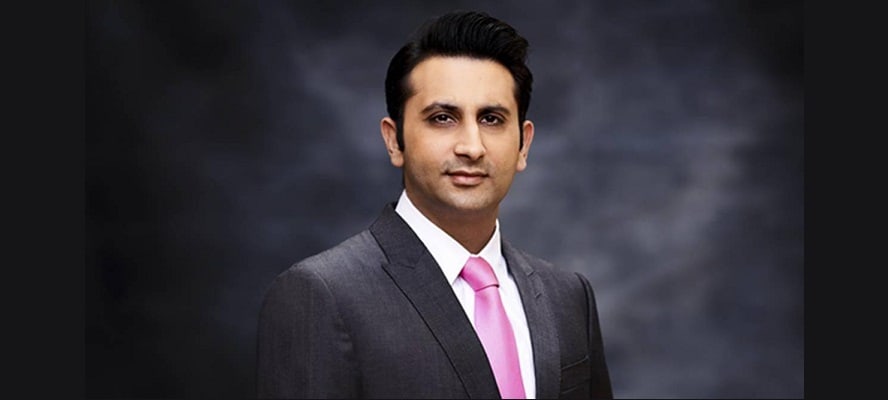
Singapore: Adar Poonawalla, the chief executive of the world's largest vaccine manufacturer Serum Institute of India, is among six people named "Asians of the Year" by Singapore's leading daily, The Straits Times for their work in fighting the COVID-19 pandemic.
Pune-based Serum Institute of India (SII) has collaborated with the University of Oxford and the British-Swedish pharmaceutical company AstraZeneca for making the COVID-19 vaccine, ''Covidshield'', and is conducting trials in India.
The other five named in the list are Chinese researcher Zhang Yongzhen, who led the team that mapped and published online the first complete genome of Sars-CoV-2, the virus that sparked the pandemic, China's Major-General Chen Wei, Japan's Dr. Ryuichi Morishita, and Singapore's Professor Ooi Eng Eong, who are among those at the forefront of developing vaccines against the virus, and South Korean businessman Seo Jung-jin whose company will enable the making and dispensing of the vaccines and other Covid-19 treatments to the world.
Collectively referred to as "the virus busters", they are heroes of a kind, having devoted themselves to the pressing cause of resolving the coronavirus pandemic, each in their own capacity, the daily said.
"Sars-CoV-2, the virus that has brought death and hardship to the world's largest and most populous continent, is meeting its tamer in The Virus Busters," the award citation said.
"We salute your courage, care, commitment, and creativity. In this peril-filled hour, you are a symbol of hope for Asia, indeed the world."
The Serum Institute was founded by Poonawalla's father Cyrus Poonawalla in 1966.
Poonawalla joined the Serum Institute of India in 2001 and became the CEO of Serum Institute with complete control of the day-to-day operations of the company in 2011.
Poonawalla said that he has put USD 250 million of his family fortune into ramping up his institute's manufacturing capacity.
"I decided to go all out," said Poonawalla, 39, who has pledged that his firm's COVID-19 vaccines will help supply lower- and middle-income countries that face significant disadvantages in the quest to obtain them.
Poonawalla said his institute is helping poorer countries level up in access to vaccines.
In the big picture of ending the pandemic, the commonality of purpose is key, said The Straits Times, Singapore's mainstream daily.
The Straits Times Asians of the Year have led the way, as have scores of other individuals in their own fields. When an end comes into sight, it will be due in no small part to these people who - undaunted by the tumult - have committed themselves to the sobering, much-needed work to put together an exit plan from the crisis, for humanity.
"There has not been a day this year when the pandemic has not been in the news. Straits Times' editors felt there could be no more deserving recipients this year than the people squaring up to Asia's biggest-ever health challenge, engaged in pioneering and courageous efforts to prevent the highly contagious virus from wreaking more damage, Bhagyashree Garekar, Straits Times' foreign editor, said on Saturday.
"In a year that is ending with a wish for great resets... Asia's virus busters are the face of hope on the horizon," said Garekar.
Between them, the recipients of the 2020 award capture the entire trajectory of the response to the COVID-19 pandemic.
In deciding to honor The Virus Busters, Straits Times editors had in mind those who have, in one way or another, enabled the complex, multi-stage process of preventing as many people around the world from getting the deadly disease in as little time as possible.
"Each year, ST editors seek out a person, team or organisation that has not only made or shaped the news but also helped contribute positively to Asia in the process, said Warren Fernandez, editor-in-chief of Singapore Press Holdings' English/Malay/Tamil Media Group and editor of Straits Times.
"This year, we naturally looked to those involved in the fight against Covid-19, which has dominated the headlines. We debated long and hard but finally agreed on a group of people who have done the most to help find an answer to the crisis brought on by the virus.
"They are a disparate group whose collective efforts have pushed forward the search for vaccines, allowing these to be discovered and delivered with an urgency never attempted or seen before. Their commitment and actions have helped save lives and give hope to people all around Asia, and the world," Fernandez said.
Let the Truth be known. If you read VB and like VB, please be a VB Supporter and Help us deliver the Truth to one and all.
Tribals, Scheduled Castes preserved India's identity and soul despite foreign invasions: Bhagwat
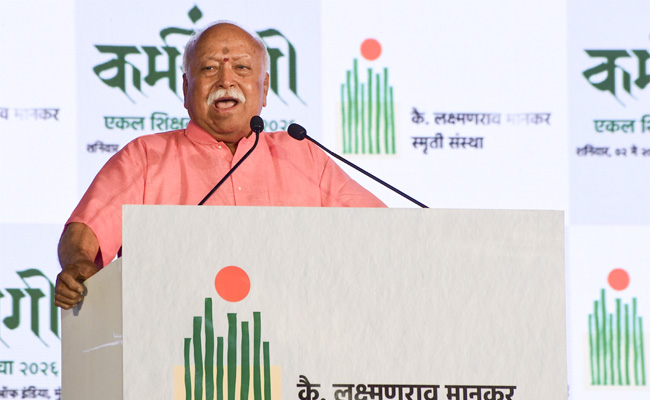
Mumbai (PTI): RSS chief Mohan Bhagwat has said that despite foreign invasions and hardships, tribal communities and Scheduled Castes preserved the country's identity and soul, stressing the need to integrate them into the mainstream development process.
He was speaking on Saturday at the Karmayogi awards ceremony in Mumbai, where Union Road Transport and Highways Minister Nitin Gadkari was also present.
"Human life is defined by giving back to the world, as we are all part of one great family. A person works and spends for the betterment of society, not as a favour, but out of duty. In serving others, we foster our own development. By helping others to thrive, we elevate ourselves and grow as human beings. This principle is the core value of this Indian land, commonly known as a Hindu society," Bhagwat said.
"This is the society's enduring ethos, which has survived for thousands of years. For various reasons, partly because of our indifference and partly because of foreign invasion, those who preserved this ethos paid a heavy price," he said.
The foreign invaders found that this ethos, this value system of the society is its soul and the key to keeping it alive. So they ensured that those who tried to preserve this soul would be uprooted and face extreme hardships, the Rashtriya Swayamsevak Sangh (RSS) chief noted.
But despite foreign invasions and hardships, tribal communities and Scheduled Castes preserved the country's identity and its soul, he said.
"Despite such adversities, the country's core identity remained intact among tribal communities and those belonging to SC and ST groups," he said, emphasising the need to integrate them into the mainstream development process while ensuring they receive equal access to services and facilities.
Referring to global developments, Bhagwat said the present world is "stumbling forward" and struggling to maintain balance, and asserted that India could emerge as a stabilising force.
The country must not only safeguard its own interests but also extend support to the world, he said.
"The world should get to see that the country is not only solving its own misery and sorrow but also helping the world to address similar issues," he said.
The RSS chief stressed that service to society is not a favour but a duty that contributes to one's own development.
Helping others grow also elevates individuals and strengthens the collective fabric of society, he said.
The so-called educated and developed sections have, over time, distanced themselves from these communities, Bhagwat pointed out, and called for the need to bridge this gap.
The identities preserved by these communities represent the true identity of Indian society, he said and underlined that without identity, existence itself is at risk.