Possible axis of China, Pakistan and Taliban-controlled Afghanistan cause for worry: Chidambaram
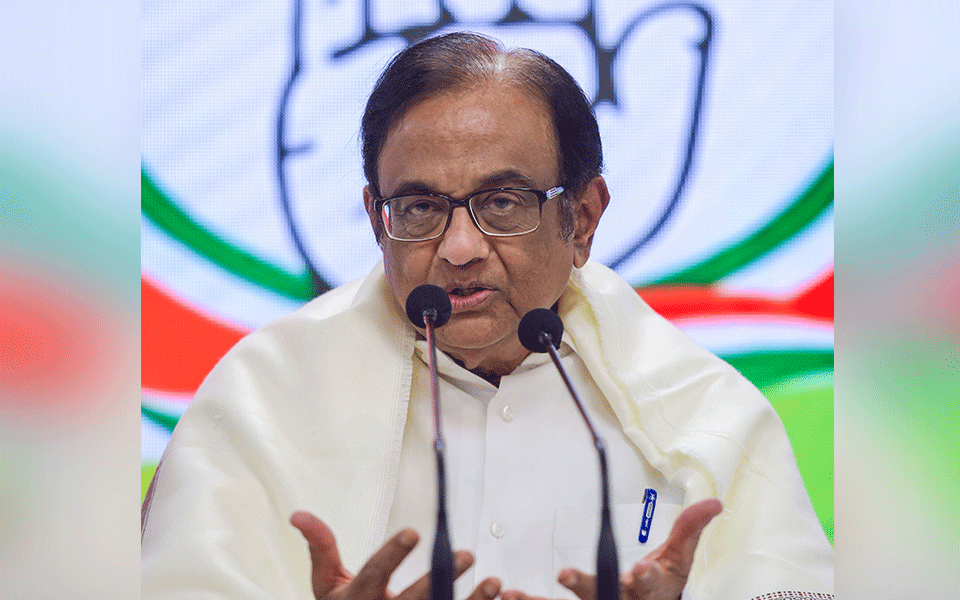
New Delhi(PTI): Senior Congress leader P Chidambaram on Wednesday said it is too premature to congratulate ourselves over the UN Security Council adopting a resolution on Afghanistan, and cautioned that the possible axis of China, Pakistan and Taliban-controlled Afghanistan is a cause for worry.
His remarks came after the UN Security Council, under India's Presidency, adopted a strong resolution demanding that the territory of Afghanistan not be used to threaten any country or shelter terrorists and that it expects the Taliban will adhere to commitments made by it on regarding the safe and orderly departure from the country of Afghans and all foreign nationals.
Reacting to the development, Chidambaram said the government is congratulating itself for the UNSC resolution adopted on Afghanistan.
"'Resolution' has two meanings. The first is that the issue has been 'resolved' or settled to India's satisfaction. That is not what happened at the UNSC. The second meaning is that we have put our wishes on paper and got some others to sign that paper! That is what happened at UNSC yesterday," the former Union minister said on Twitter.
It is too premature to congratulate ourselves, Chidambaram said.
The possible axis of China, Pakistan and Taliban-controlled Afghanistan is a cause for worry, he cautioned.
The Security Council on Monday adopted the resolution sponsored by France, UK and the US with 13 members voting in favour, none against and permanent, veto-wielding members Russia and China abstaining.
This was the first resolution adopted by the powerful 15-nation Council on the situation in Afghanistan following the takeover of Kabul by the Taliban and came on the penultimate day of India's Presidency of the Security Council for the month of August.
Let the Truth be known. If you read VB and like VB, please be a VB Supporter and Help us deliver the Truth to one and all.
Massive turnout in assembly polls across states, women voters outnumber men: EC data
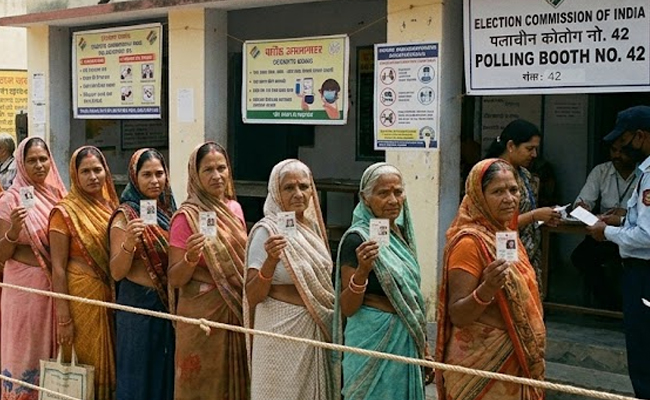
New Delhi (PTI): The recently-concluded assembly elections witnessed exceptionally high voter participation across states, with women voters outnumbering men in turnout percentages, according to Election Commission data.
West Bengal recorded the highest voter turnout among states, with 93.71 per cent polling in 293 constituencies where counting has been completed. The state saw over 6.38 crore votes cast, including postal ballots, against a total of more than 6.81 crore electors.
Women voters recorded a turnout of 93.8 per cent in the West Bengal Assembly polls, slightly higher than the 92.06 per cent participation among men.
The data for West Bengal does not include the figures for the Falta assembly constituency, which is scheduled for repolling.
Tamil Nadu registered an 85.01 per cent turnout, with nearly 4.8 crore votes polled from an electorate of 5.74 crore. Women voters recorded a turnout of 86.2 per cent, higher than the 83.77 per cent among men.
Assam also witnessed robust participation, with the final turnout touching 85.74 per cent. More than 2.15 crore votes were cast in the state, while female turnout at 86.53 per cent marginally exceeded the 84.95 per cent recorded among male voters.
Kerala registered a turnout of 78.11 per cent, with over 2.12 crore votes polled. Female voter participation stood at 81.17 per cent against 74.9 per cent among men.
Puducherry recorded a turnout of 89.82 per cent, with women voters again leading participation at 91.39 per cent. More than 8.5 lakh votes were polled in the Union territory.
Yet, women's representation among elected candidates remained modest.
Tamil Nadu elected 23 women MLAs (9.83 per cent) out of 234 members, West Bengal elected 37 women legislators (12.62 per cent) out of 293, while Kerala returned only 11 women MLAs (7.85 per cent) in the 140-member House.
Only two third-gender candidates contested the elections - one each from Tamil Nadu and Kerala, and both lost, forfeiting their deposits.
The elections also reflected extensive electoral mobilisation infrastructure. West Bengal had the highest number of polling stations at 85,092, followed by Tamil Nadu with 75,064 and Assam with 31,490.
In terms of candidates, Tamil Nadu saw the largest contest with 4,023 candidates in the fray across 234 constituencies, averaging 17 candidates per seat and peaking at 79 contestants in one constituency.
West Bengal pitted 2,920 candidates for 293 constituencies, while Kerala had the fewest contestants among the major states, with 883 candidates for 140 seats.
The data also showed relatively low NOTA votes across states. Tamil Nadu recorded the lowest NOTA share at 0.4 per cent of total votes polled, while Assam recorded the highest at 1.23 per cent. In West Bengal, 0.78 per cent of the total votes polled were NOTA, while it 0.77 per cent and 0.57 per cent of the electorate opted for None of the Above (NOTA) in Puducherry and Kerala, respectively.